The Five Pillars of Islam
English book, p. 48
By Maulana Wahiduddin Khan
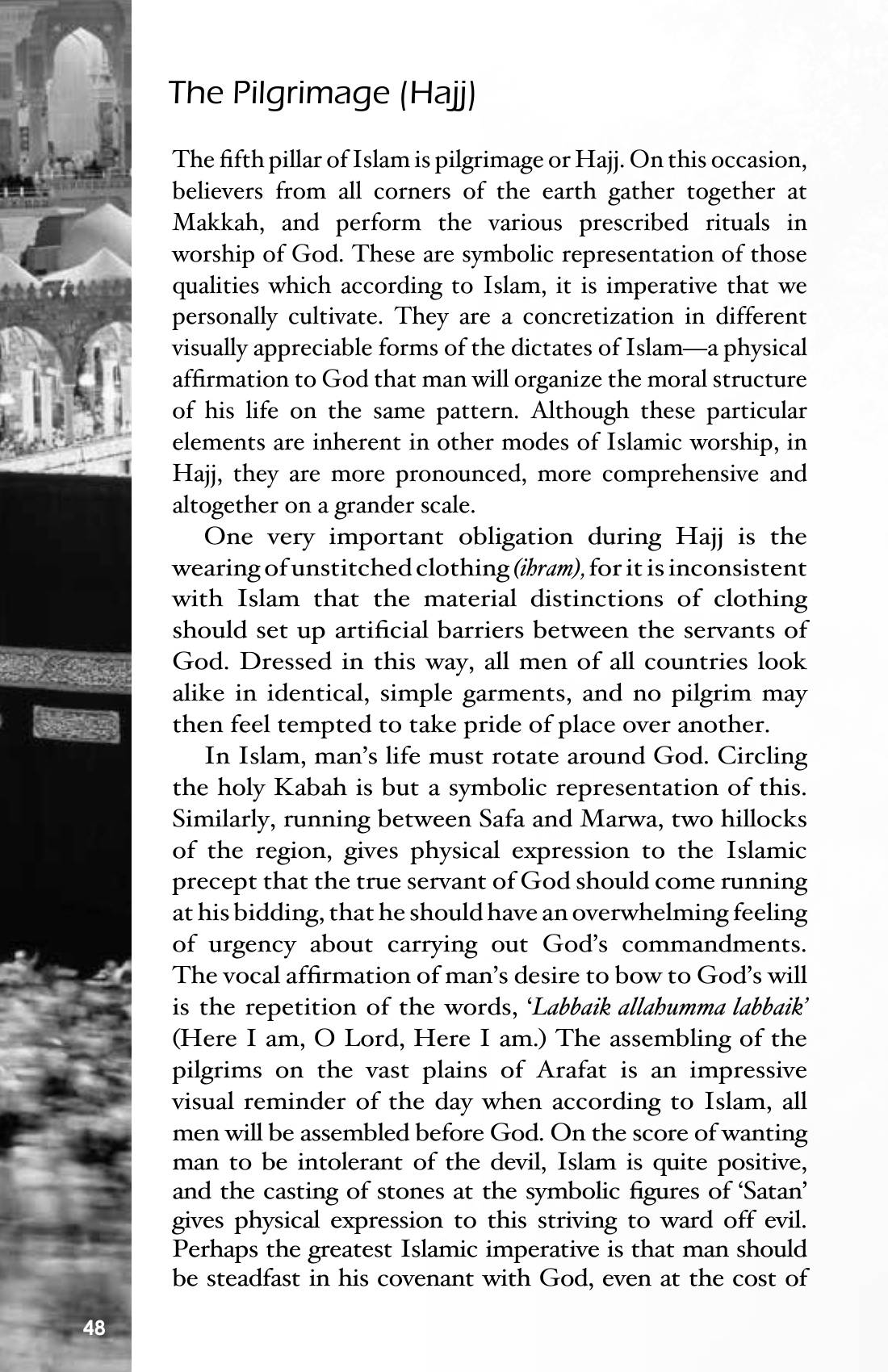
The Pilgrimage (Hajj) The fifth pillar of Islam is pilgrimage or Hajj. On this occasion, believers from all corners of the earth gather together at Makkah, and perform the various prescribed rituals in worship of God. These are symbolic representation of those qualities which according to Islam, it is imperative that we personally cultivate. They are a concretization in different visually appreciable forms of the dictates of Islam—a physical affirmation to God that man will organize the moral structure of his life on the same pattern. Although these particular elements are inherent in other modes of Islamic worship, in Hajj, they are more pronounced, more comprehensive and altogether on a grander scale. One very important obligation during Hajj is the wearing of unstitched clothing (ihram), for it is inconsistent with Islam that the material distinctions of clothing should set up artificial barriers between the servants of God. Dressed in this way, all men of all countries look alike in identical, simple garments, and no pilgrim may then feel tempted to take pride of place over another. In Islam, man’s life must rotate around God. Circling the holy Kabah is but a symbolic representation of this. Similarly, running between Safa and Marwa, two hillocks of the region, gives physical expression to the Islamic precept that the true servant of God should come running at his bidding, that he should have an overwhelming feeling of urgency about carrying out God’s commandments. The vocal affirmation of man’s desire to bow to God’s will is the repetition of the words, ‘Labbaik allahumma labbaik’ (Here I am, O Lord, Here I am.) The assembling of the pilgrims on the vast plains of Arafat is an impressive visual reminder of the day when according to Islam, all men will be assembled before God. On the score of wanting man to be intolerant of the devil, Islam is quite positive, and the casting of stones at the symbolic figures of ‘Satan’ gives physical expression to this striving to ward off evil. Perhaps the greatest Islamic imperative is that man should be steadfast in his covenant with God, even at the cost of
‹ Previous page Next page › About this book Open in the reader