Women’s Spiritual Role in Early Muslim Society
English book, p. 229
By Maulana Wahiduddin Khan
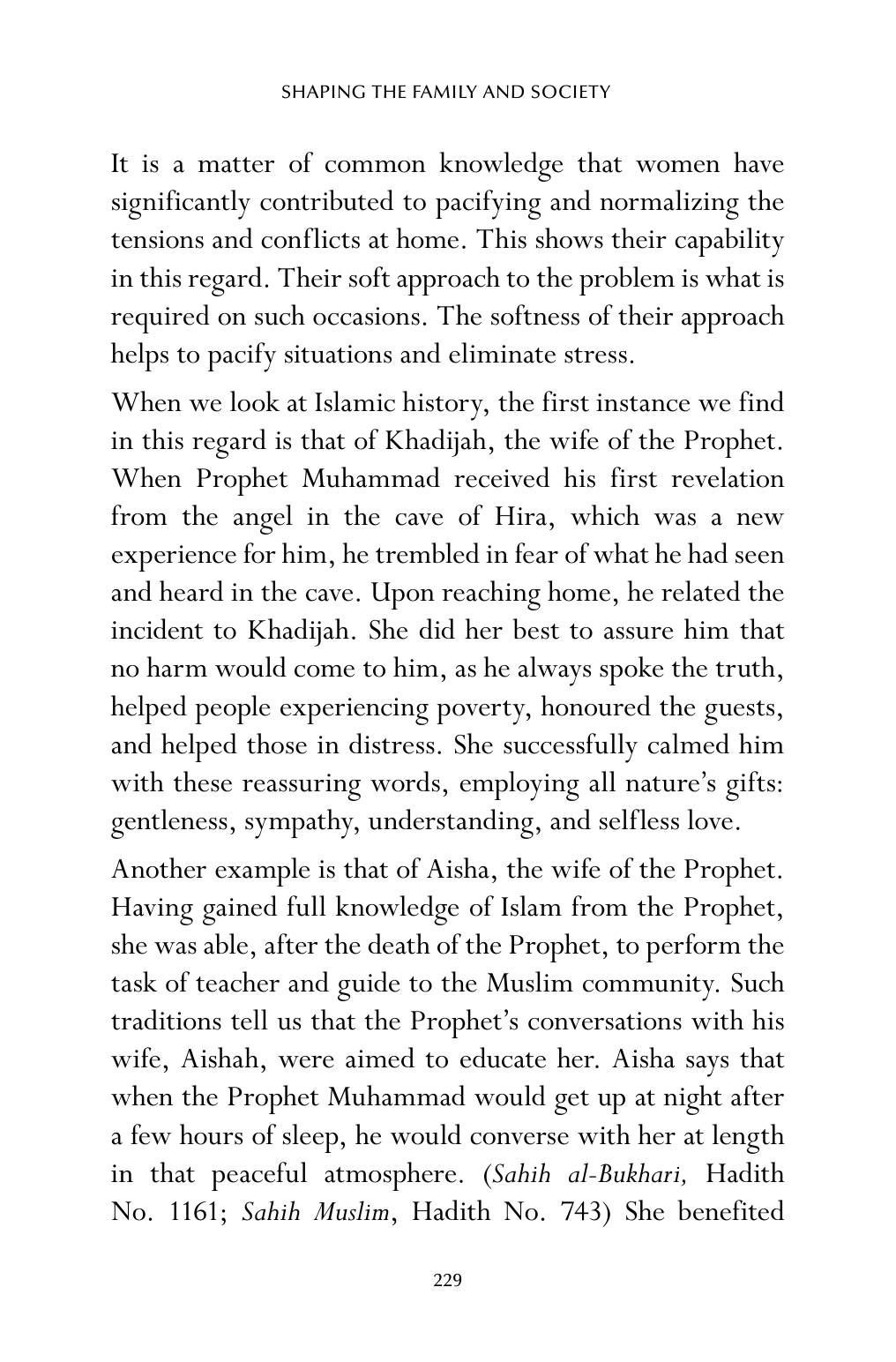
SHAPING THE FAMILY AND SOCIETY It is a matter of common knowledge that women have significantly contributed to pacifying and normalizing the tensions and conflicts at home. This shows their capability in this regard. Their soft approach to the problem is what is required on such occasions. The softness of their approach helps to pacify situations and eliminate stress. When we look at Islamic history, the first instance we find in this regard is that of Khadijah, the wife of the Prophet. When Prophet Muhammad received his first revelation from the angel in the cave of Hira, which was a new experience for him, he trembled in fear of what he had seen and heard in the cave. Upon reaching home, he related the incident to Khadijah. She did her best to assure him that no harm would come to him, as he always spoke the truth, helped people experiencing poverty, honoured the guests, and helped those in distress. She successfully calmed him with these reassuring words, employing all nature’s gifts: gentleness, sympathy, understanding, and selfless love. Another example is that of Aisha, the wife of the Prophet. Having gained full knowledge of Islam from the Prophet, she was able, after the death of the Prophet, to perform the task of teacher and guide to the Muslim community. Such traditions tell us that the Prophet’s conversations with his wife, Aishah, were aimed to educate her. Aisha says that when the Prophet Muhammad would get up at night after a few hours of sleep, he would converse with her at length in that peaceful atmosphere. (Sahih al-Bukhari, Hadith No. 1161; Sahih Muslim, Hadith No. 743) She benefited
‹ Previous page Next page › About this book Open in the reader