Religion and Scientific Reasoning
Al-Risala (English), February 1984, p. 17
By Maulana Wahiduddin Khan
Maulana Wahiduddin Khan is named as the default author of the periodical; a piece that carries another writer’s byline is credited to that writer.
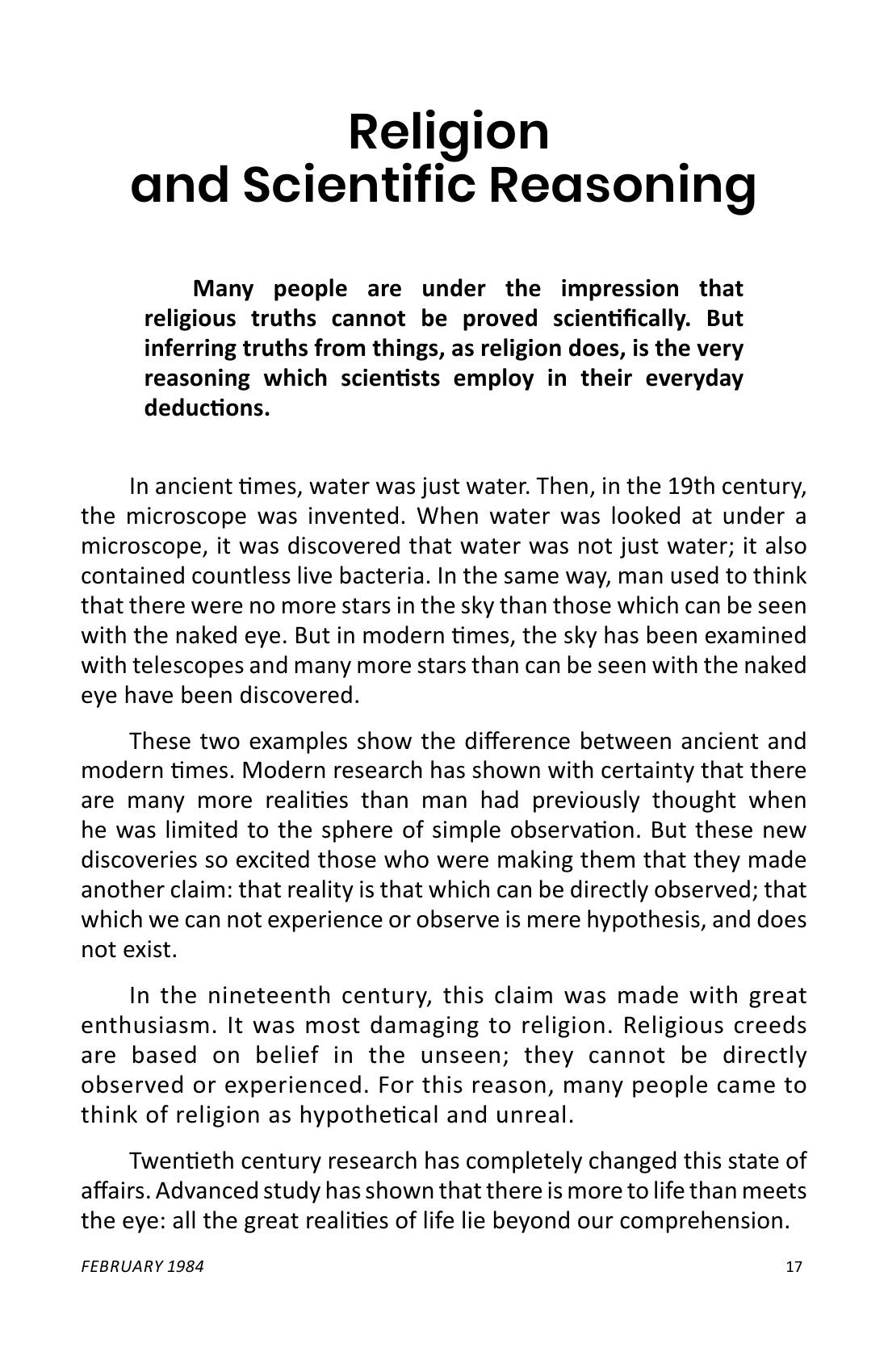
Religion and Scientific Reasoning Many people are under the impression that religious truths cannot be proved scientifically. But inferring truths from things, as religion does, is the very reasoning which scientists employ in their everyday deductions. In ancient times, water was just water. Then, in the 19th century, the microscope was invented. When water was looked at under a microscope, it was discovered that water was not just water; it also contained countless live bacteria. In the same way, man used to think that there were no more stars in the sky than those which can be seen with the naked eye. But in modern times, the sky has been examined with telescopes and many more stars than can be seen with the naked eye have been discovered. These two examples show the difference between ancient and modern times. Modern research has shown with certainty that there are many more realities than man had previously thought when he was limited to the sphere of simple observation. But these new discoveries so excited those who were making them that they made another claim: that reality is that which can be directly observed; that which we can not experience or observe is mere hypothesis, and does not exist. In the nineteenth century, this claim was made with great enthusiasm. It was most damaging to religion. Religious creeds are based on belief in the unseen; they cannot be directly observed or experienced. For this reason, many people came to think of religion as hypothetical and unreal. Twentieth century research has completely changed this state of affairs. Advanced study has shown that there is more to life than meets the eye: all the great realities of life lie beyond our comprehension.
‹ Previous page Next page › About this issue Open in the reader