Fulfilling a Muslim’s Need: A great act of worship
Al-Risala (English), May 1984, p. 1984
By Maulana Wahiduddin Khan
Maulana Wahiduddin Khan is named as the default author of the periodical; a piece that carries another writer’s byline is credited to that writer.
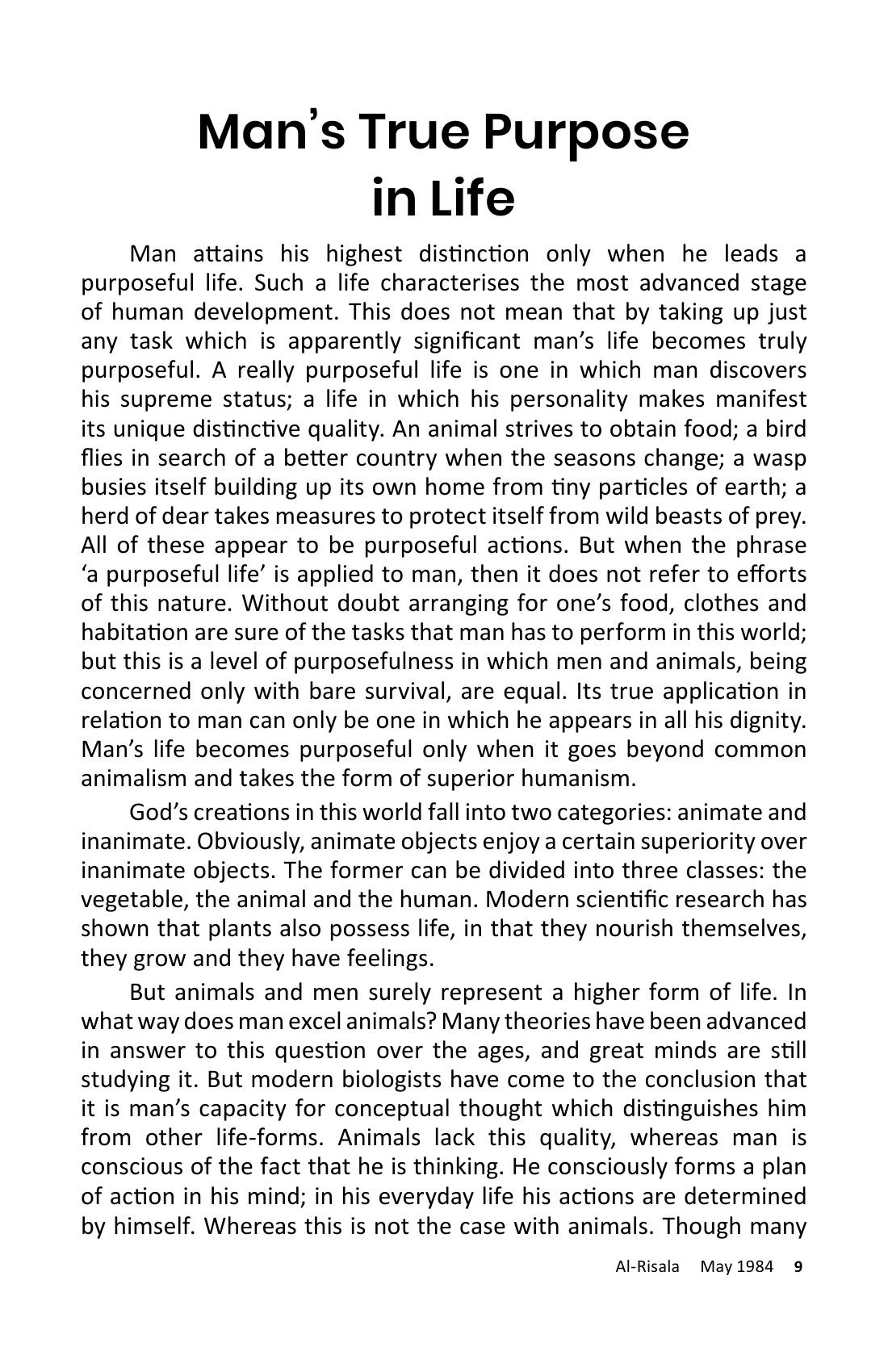
Man’s True Purpose in Life Man attains his highest distinction only when he leads a purposeful life. Such a life characterises the most advanced stage of human development. This does not mean that by taking up just any task which is apparently significant man’s life becomes truly purposeful. A really purposeful life is one in which man discovers his supreme status; a life in which his personality makes manifest its unique distinctive quality. An animal strives to obtain food; a bird flies in search of a better country when the seasons change; a wasp busies itself building up its own home from tiny particles of earth; a herd of dear takes measures to protect itself from wild beasts of prey. All of these appear to be purposeful actions. But when the phrase ‘a purposeful life’ is applied to man, then it does not refer to efforts of this nature. Without doubt arranging for one’s food, clothes and habitation are sure of the tasks that man has to perform in this world; but this is a level of purposefulness in which men and animals, being concerned only with bare survival, are equal. Its true application in relation to man can only be one in which he appears in all his dignity. Man’s life becomes purposeful only when it goes beyond common animalism and takes the form of superior humanism. God’s creations in this world fall into two categories: animate and inanimate. Obviously, animate objects enjoy a certain superiority over inanimate objects. The former can be divided into three classes: the vegetable, the animal and the human. Modern scientific research has shown that plants also possess life, in that they nourish themselves, they grow and they have feelings. But animals and men surely represent a higher form of life. In what way does man excel animals? Many theories have been advanced in answer to this question over the ages, and great minds are still studying it. But modern biologists have come to the conclusion that it is man’s capacity for conceptual thought which distinguishes him from other life-forms. Animals lack this quality, whereas man is conscious of the fact that he is thinking. He consciously forms a plan of action in his mind; in his everyday life his actions are determined by himself. Whereas this is not the case with animals. Though many
‹ Previous page Next page › About this issue Open in the reader