FROM MAULANA’S DESK
Spirit of Islam, 2019, p. 3
By Maulana Wahiduddin Khan
Maulana Wahiduddin Khan is named as the default author of the periodical; a piece that carries another writer’s byline is credited to that writer.
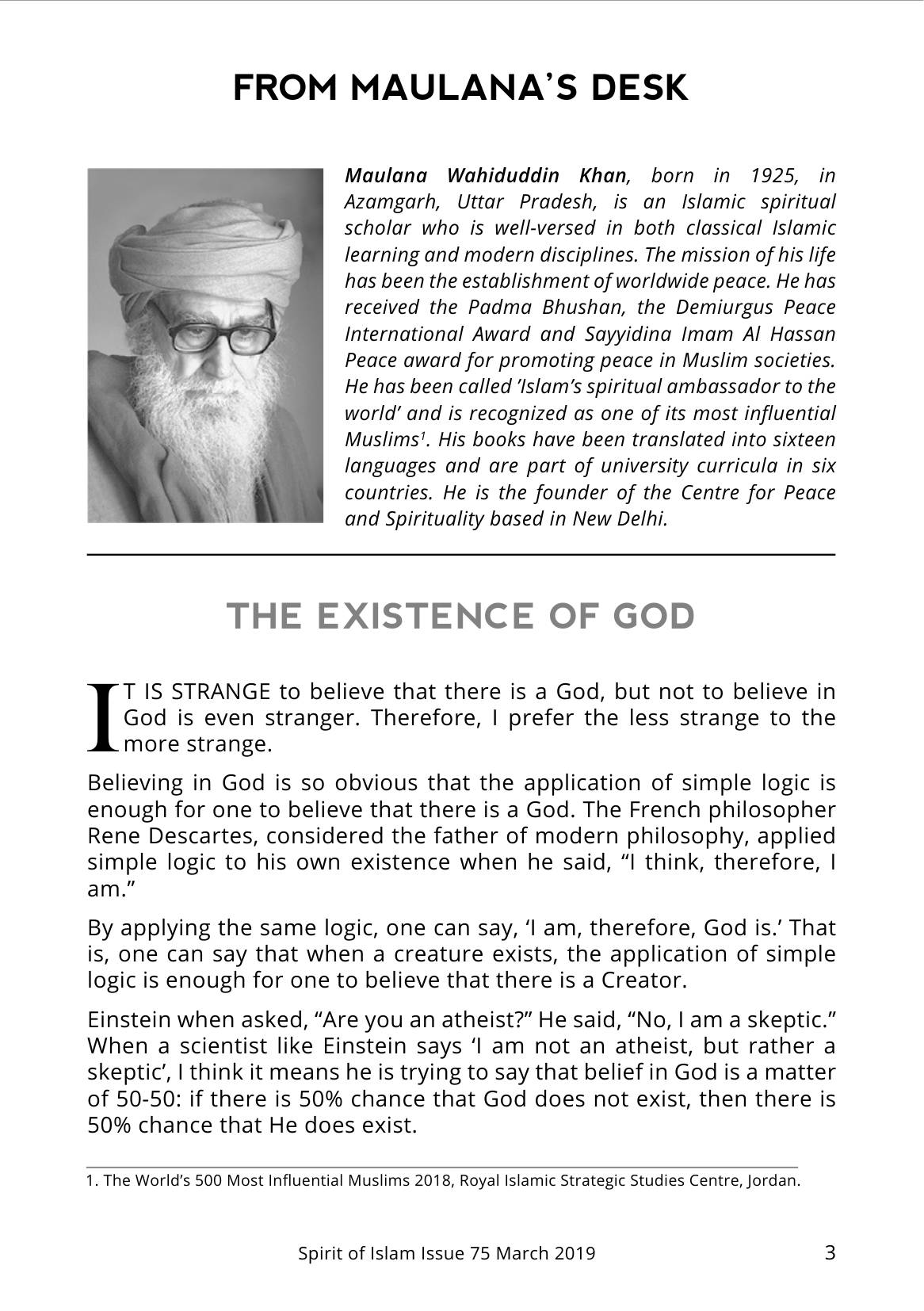
FROM MAULANA’S DESK 1. The World’s 500 Most Influential Muslims 2018, Royal Islamic Strategic Studies Centre, Jordan. Maulana Wahiduddin Khan, born in 1925, in Azamgarh, Uttar Pradesh, is an Islamic spiritual scholar who is well-versed in both classical Islamic learning and modern disciplines. The mission of his life has been the establishment of worldwide peace. He has received the Padma Bhushan, the Demiurgus Peace International Award and Sayyidina Imam Al Hassan Peace award for promoting peace in Muslim societies. He has been called ’Islam’s spiritual ambassador to the world’ and is recognized as one of its most influential Muslims1. His books have been translated into sixteen languages and are part of university curricula in six countries. He is the founder of the Centre for Peace and Spirituality based in New Delhi. THE EXISTENCE OF GOD I T IS STRANGE to believe that there is a God, but not to believe in God is even stranger. Therefore, I prefer the less strange to the more strange. Believing in God is so obvious that the application of simple logic is enough for one to believe that there is a God. The French philosopher Rene Descartes, considered the father of modern philosophy, applied simple logic to his own existence when he said, “I think, therefore, I am.” By applying the same logic, one can say, ‘I am, therefore, God is.’ That is, one can say that when a creature exists, the application of simple logic is enough for one to believe that there is a Creator. Einstein when asked, “Are you an atheist?” He said, “No, I am a skeptic.” When a scientist like Einstein says ‘I am not an atheist, but rather a skeptic’, I think it means he is trying to say that belief in God is a matter of 50-50: if there is 50% chance that God does not exist, then there is 50% chance that He does exist.
‹ Previous page Next page › About this issue Open in the reader