FROM MAULANA’S DESK
Spirit of Islam, 2019, p. 3
By Maulana Wahiduddin Khan
Maulana Wahiduddin Khan is named as the default author of the periodical; a piece that carries another writer’s byline is credited to that writer.
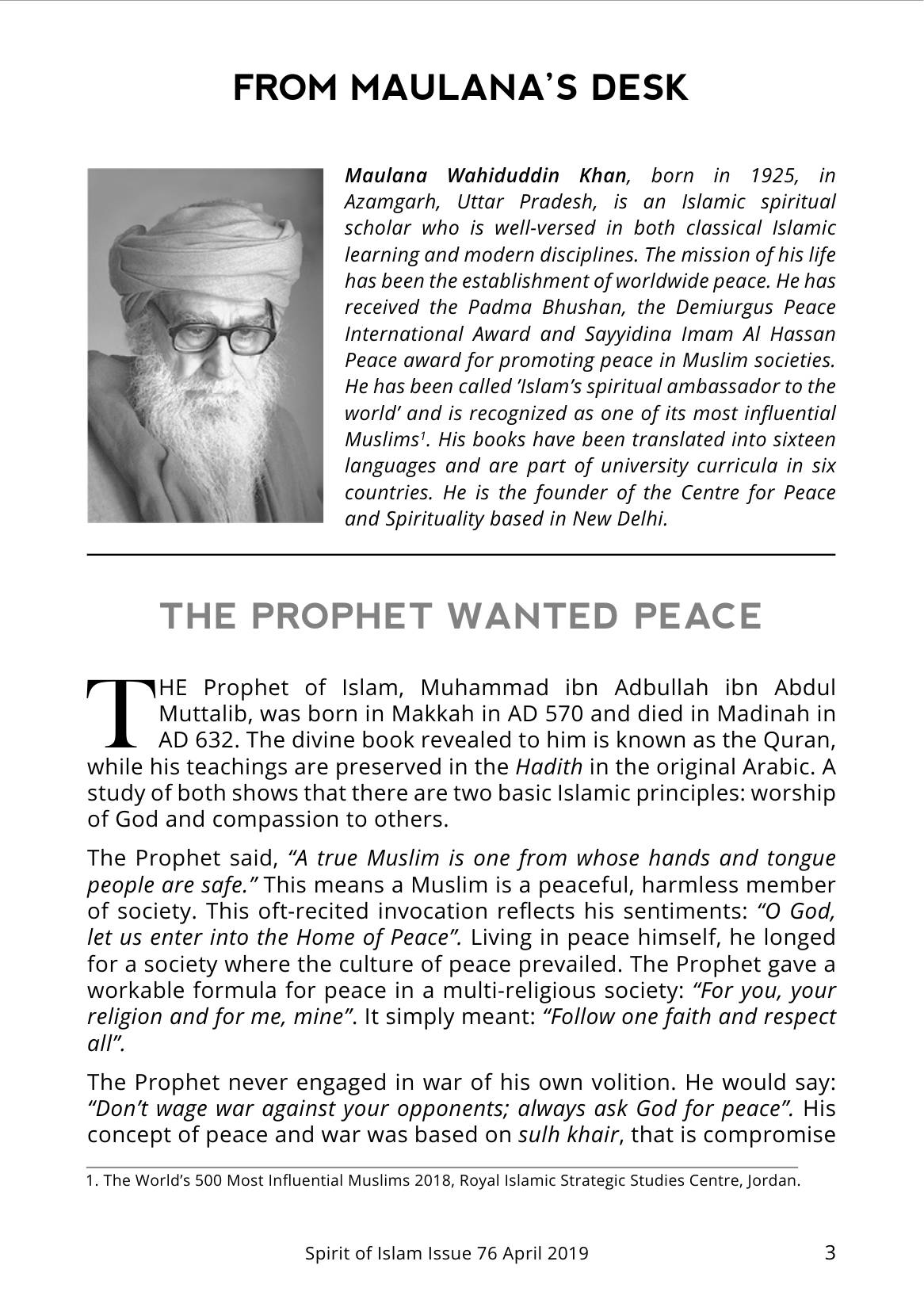
FROM MAULANA’S DESK 1. The World’s 500 Most Influential Muslims 2018, Royal Islamic Strategic Studies Centre, Jordan. Maulana Wahiduddin Khan, born in 1925, in Azamgarh, Uttar Pradesh, is an Islamic spiritual scholar who is well-versed in both classical Islamic learning and modern disciplines. The mission of his life has been the establishment of worldwide peace. He has received the Padma Bhushan, the Demiurgus Peace International Award and Sayyidina Imam Al Hassan Peace award for promoting peace in Muslim societies. He has been called ’Islam’s spiritual ambassador to the world’ and is recognized as one of its most influential Muslims1. His books have been translated into sixteen languages and are part of university curricula in six countries. He is the founder of the Centre for Peace and Spirituality based in New Delhi. THE PROPHET WANTED PEACE T HE Prophet of Islam, Muhammad ibn Adbullah ibn Abdul Muttalib, was born in Makkah in AD 570 and died in Madinah in AD 632. The divine book revealed to him is known as the Quran, while his teachings are preserved in the Hadith in the original Arabic. A study of both shows that there are two basic Islamic principles: worship of God and compassion to others. The Prophet said, “A true Muslim is one from whose hands and tongue people are safe.” This means a Muslim is a peaceful, harmless member of society. This oft-recited invocation reflects his sentiments: “O God, let us enter into the Home of Peace”. Living in peace himself, he longed for a society where the culture of peace prevailed. The Prophet gave a workable formula for peace in a multi-religious society: “For you, your religion and for me, mine”. It simply meant: “Follow one faith and respect all”. The Prophet never engaged in war of his own volition. He would say: “Don’t wage war against your opponents; always ask God for peace”. His concept of peace and war was based on sulh khair, that is compromise
‹ Previous page Next page › About this issue Open in the reader