FROM MAULANA’S DESK
Spirit of Islam, 2019, p. 4
By Maulana Wahiduddin Khan
Maulana Wahiduddin Khan is named as the default author of the periodical; a piece that carries another writer’s byline is credited to that writer.
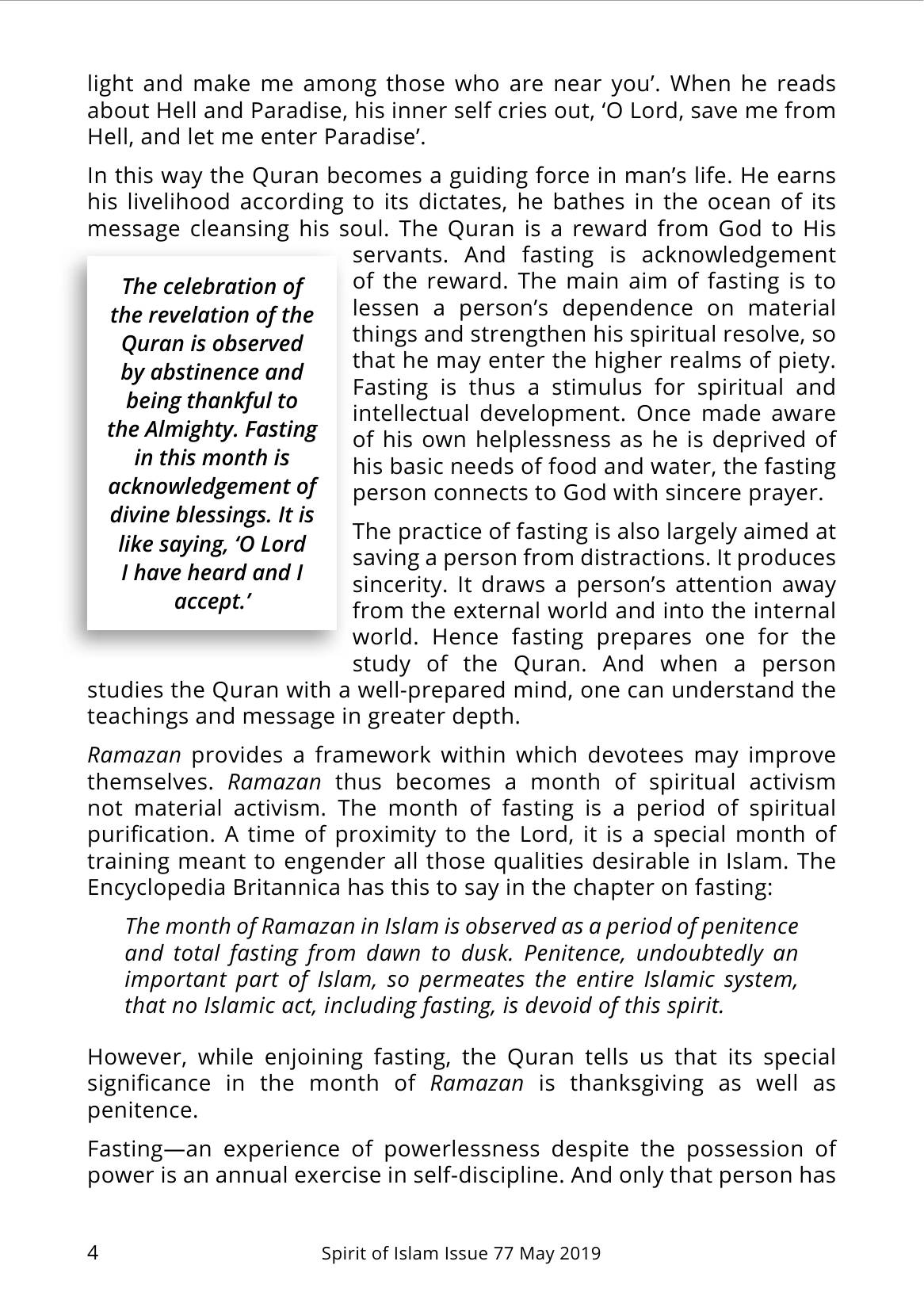
light and make me among those who are near you’. When he reads about Hell and Paradise, his inner self cries out, ‘O Lord, save me from Hell, and let me enter Paradise’. In this way the Quran becomes a guiding force in man’s life. He earns his livelihood according to its dictates, he bathes in the ocean of its message cleansing his soul. The Quran is a reward from God to His servants. And fasting is acknowledgement of the reward. The main aim of fasting is to lessen a person’s dependence on material things and strengthen his spiritual resolve, so that he may enter the higher realms of piety. Fasting is thus a stimulus for spiritual and intellectual development. Once made aware of his own helplessness as he is deprived of his basic needs of food and water, the fasting person connects to God with sincere prayer. The practice of fasting is also largely aimed at saving a person from distractions. It produces sincerity. It draws a person’s attention away from the external world and into the internal world. Hence fasting prepares one for the study of the Quran. And when a person studies the Quran with a well-prepared mind, one can understand the teachings and message in greater depth. Ramazan provides a framework within which devotees may improve themselves. Ramazan thus becomes a month of spiritual activism not material activism. The month of fasting is a period of spiritual purification. A time of proximity to the Lord, it is a special month of training meant to engender all those qualities desirable in Islam. The Encyclopedia Britannica has this to say in the chapter on fasting: The month of Ramazan in Islam is observed as a period of penitence and total fasting from dawn to dusk. Penitence, undoubtedly an important part of Islam, so permeates the entire Islamic system, that no Islamic act, including fasting, is devoid of this spirit. However, while enjoining fasting, the Quran tells us that its special significance in the month of Ramazan is thanksgiving as well as penitence. Fasting—an experience of powerlessness despite the possession of power is an annual exercise in self-discipline. And only that person has The celebration of the revelation of the Quran is observed by abstinence and being thankful to the Almighty. Fasting in this month is acknowledgement of divine blessings. It is like saying, ‘O Lord I have heard and I accept.’
‹ Previous page Next page › About this issue Open in the reader