THE WORD OF GOD
Spirit of Islam, 2019, p. 44
By Maulana Wahiduddin Khan
Maulana Wahiduddin Khan is named as the default author of the periodical; a piece that carries another writer’s byline is credited to that writer.
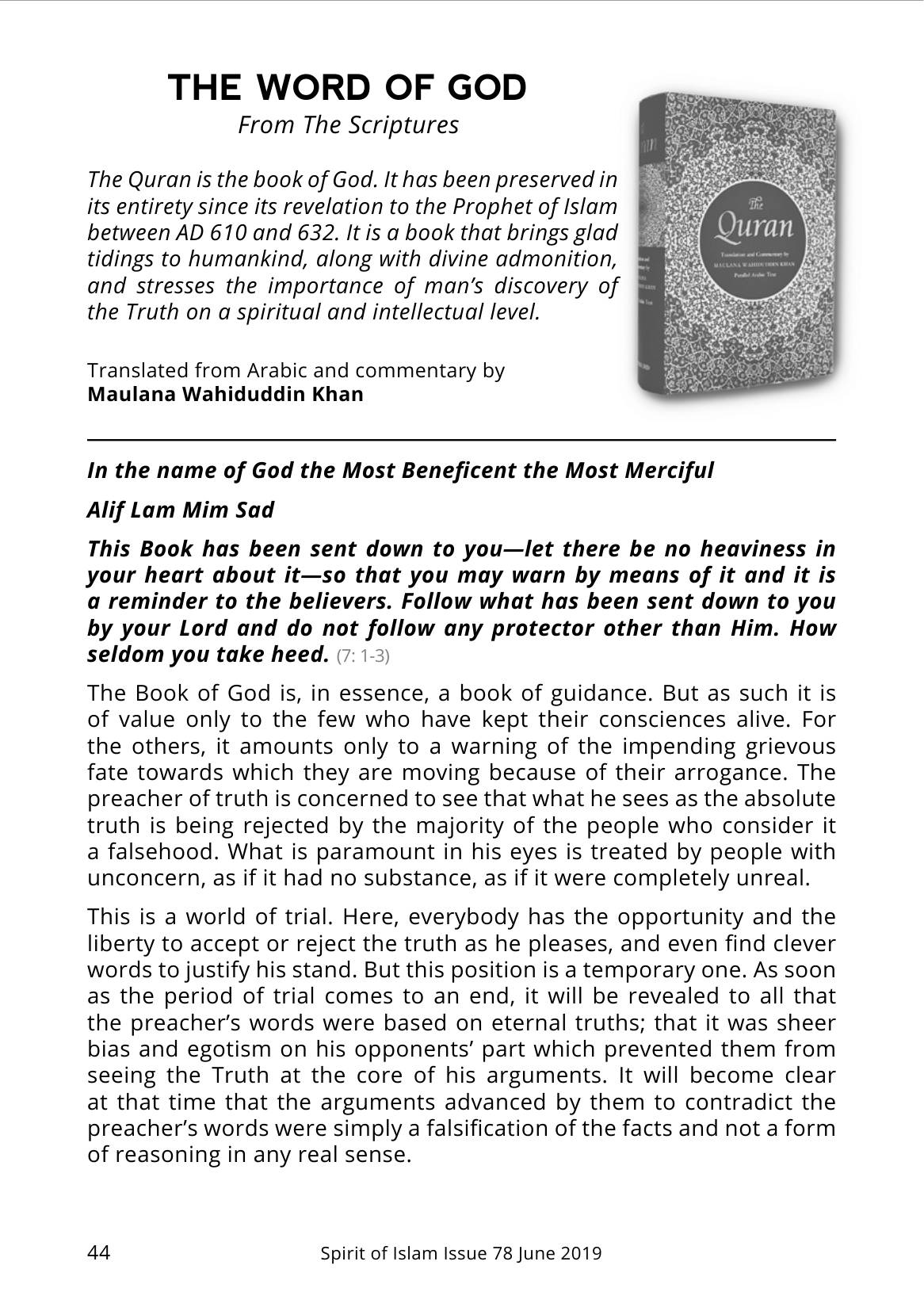
THE WORD OF GOD From The Scriptures The Quran is the book of God. It has been preserved in its entirety since its revelation to the Prophet of Islam between AD 610 and 632. It is a book that brings glad tidings to humankind, along with divine admonition, and stresses the importance of man’s discovery of the Truth on a spiritual and intellectual level. Translated from Arabic and commentary by Maulana Wahiduddin Khan In the name of God the Most Beneficent the Most Merciful Alif Lam Mim Sad This Book has been sent down to you—let there be no heaviness in your heart about it—so that you may warn by means of it and it is a reminder to the believers. Follow what has been sent down to you by your Lord and do not follow any protector other than Him. How seldom you take heed. (7: 1-3) The Book of God is, in essence, a book of guidance. But as such it is of value only to the few who have kept their consciences alive. For the others, it amounts only to a warning of the impending grievous fate towards which they are moving because of their arrogance. The preacher of truth is concerned to see that what he sees as the absolute truth is being rejected by the majority of the people who consider it a falsehood. What is paramount in his eyes is treated by people with unconcern, as if it had no substance, as if it were completely unreal. This is a world of trial. Here, everybody has the opportunity and the liberty to accept or reject the truth as he pleases, and even find clever words to justify his stand. But this position is a temporary one. As soon as the period of trial comes to an end, it will be revealed to all that the preacher’s words were based on eternal truths; that it was sheer bias and egotism on his opponents’ part which prevented them from seeing the Truth at the core of his arguments. It will become clear at that time that the arguments advanced by them to contradict the preacher’s words were simply a falsification of the facts and not a form of reasoning in any real sense.
‹ Previous page Next page › About this issue Open in the reader