THE WORD OF GOD
Spirit of Islam, 2019, p. 43
By Maulana Wahiduddin Khan
Maulana Wahiduddin Khan is named as the default author of the periodical; a piece that carries another writer’s byline is credited to that writer.
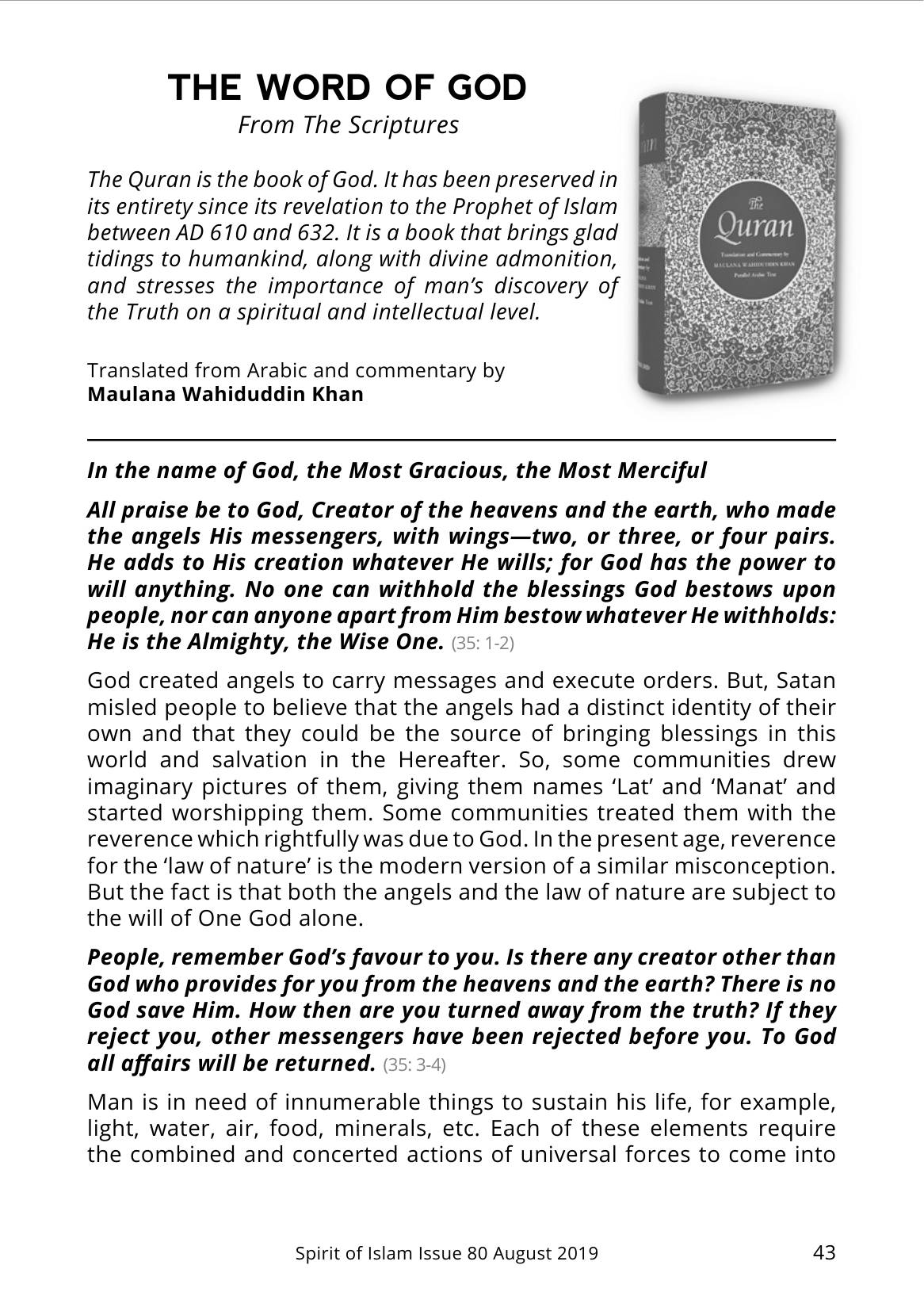
THE WORD OF GOD From The Scriptures The Quran is the book of God. It has been preserved in its entirety since its revelation to the Prophet of Islam between AD 610 and 632. It is a book that brings glad tidings to humankind, along with divine admonition, and stresses the importance of man’s discovery of the Truth on a spiritual and intellectual level. Translated from Arabic and commentary by Maulana Wahiduddin Khan In the name of God, the Most Gracious, the Most Merciful All praise be to God, Creator of the heavens and the earth, who made the angels His messengers, with wings—two, or three, or four pairs. He adds to His creation whatever He wills; for God has the power to will anything. No one can withhold the blessings God bestows upon people, nor can anyone apart from Him bestow whatever He withholds: He is the Almighty, the Wise One. (35: 1-2) God created angels to carry messages and execute orders. But, Satan misled people to believe that the angels had a distinct identity of their own and that they could be the source of bringing blessings in this world and salvation in the Hereafter. So, some communities drew imaginary pictures of them, giving them names ‘Lat’ and ‘Manat’ and started worshipping them. Some communities treated them with the reverence which rightfully was due to God. In the present age, reverence for the ‘law of nature’ is the modern version of a similar misconception. But the fact is that both the angels and the law of nature are subject to the will of One God alone. People, remember God’s favour to you. Is there any creator other than God who provides for you from the heavens and the earth? There is no God save Him. How then are you turned away from the truth? If they reject you, other messengers have been rejected before you. To God all affairs will be returned. (35: 3-4) Man is in need of innumerable things to sustain his life, for example, light, water, air, food, minerals, etc. Each of these elements require the combined and concerted actions of universal forces to come into
‹ Previous page Next page › About this issue Open in the reader