FROM MAULANA’S DESK
Spirit of Islam, 2019, p. 3
By Maulana Wahiduddin Khan
Maulana Wahiduddin Khan is named as the default author of the periodical; a piece that carries another writer’s byline is credited to that writer.
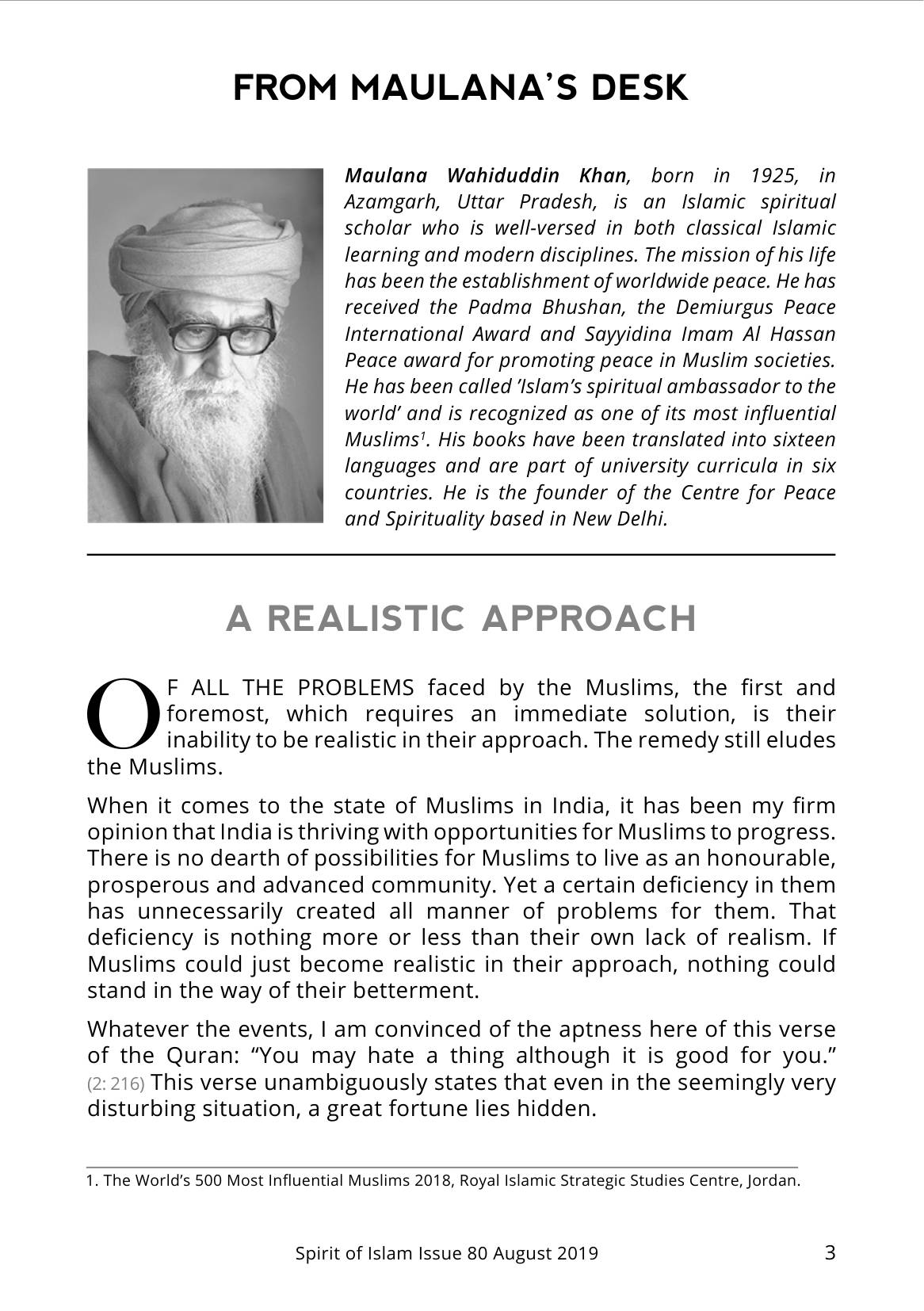
FROM MAULANA’S DESK 1. The World’s 500 Most Influential Muslims 2018, Royal Islamic Strategic Studies Centre, Jordan. Maulana Wahiduddin Khan, born in 1925, in Azamgarh, Uttar Pradesh, is an Islamic spiritual scholar who is well-versed in both classical Islamic learning and modern disciplines. The mission of his life has been the establishment of worldwide peace. He has received the Padma Bhushan, the Demiurgus Peace International Award and Sayyidina Imam Al Hassan Peace award for promoting peace in Muslim societies. He has been called ’Islam’s spiritual ambassador to the world’ and is recognized as one of its most influential Muslims1. His books have been translated into sixteen languages and are part of university curricula in six countries. He is the founder of the Centre for Peace and Spirituality based in New Delhi. A REALISTIC APPROACH O F ALL THE PROBLEMS faced by the Muslims, the first and foremost, which requires an immediate solution, is their inability to be realistic in their approach. The remedy still eludes the Muslims. When it comes to the state of Muslims in India, it has been my firm opinion that India is thriving with opportunities for Muslims to progress. There is no dearth of possibilities for Muslims to live as an honourable, prosperous and advanced community. Yet a certain deficiency in them has unnecessarily created all manner of problems for them. That deficiency is nothing more or less than their own lack of realism. If Muslims could just become realistic in their approach, nothing could stand in the way of their betterment. Whatever the events, I am convinced of the aptness here of this verse of the Quran: “You may hate a thing although it is good for you.” (2: 216) This verse unambiguously states that even in the seemingly very disturbing situation, a great fortune lies hidden.
‹ Previous page Next page › About this issue Open in the reader