FROM MAULANA’S DESK
Spirit of Islam, 2019, p. 3
By Maulana Wahiduddin Khan
Maulana Wahiduddin Khan is named as the default author of the periodical; a piece that carries another writer’s byline is credited to that writer.
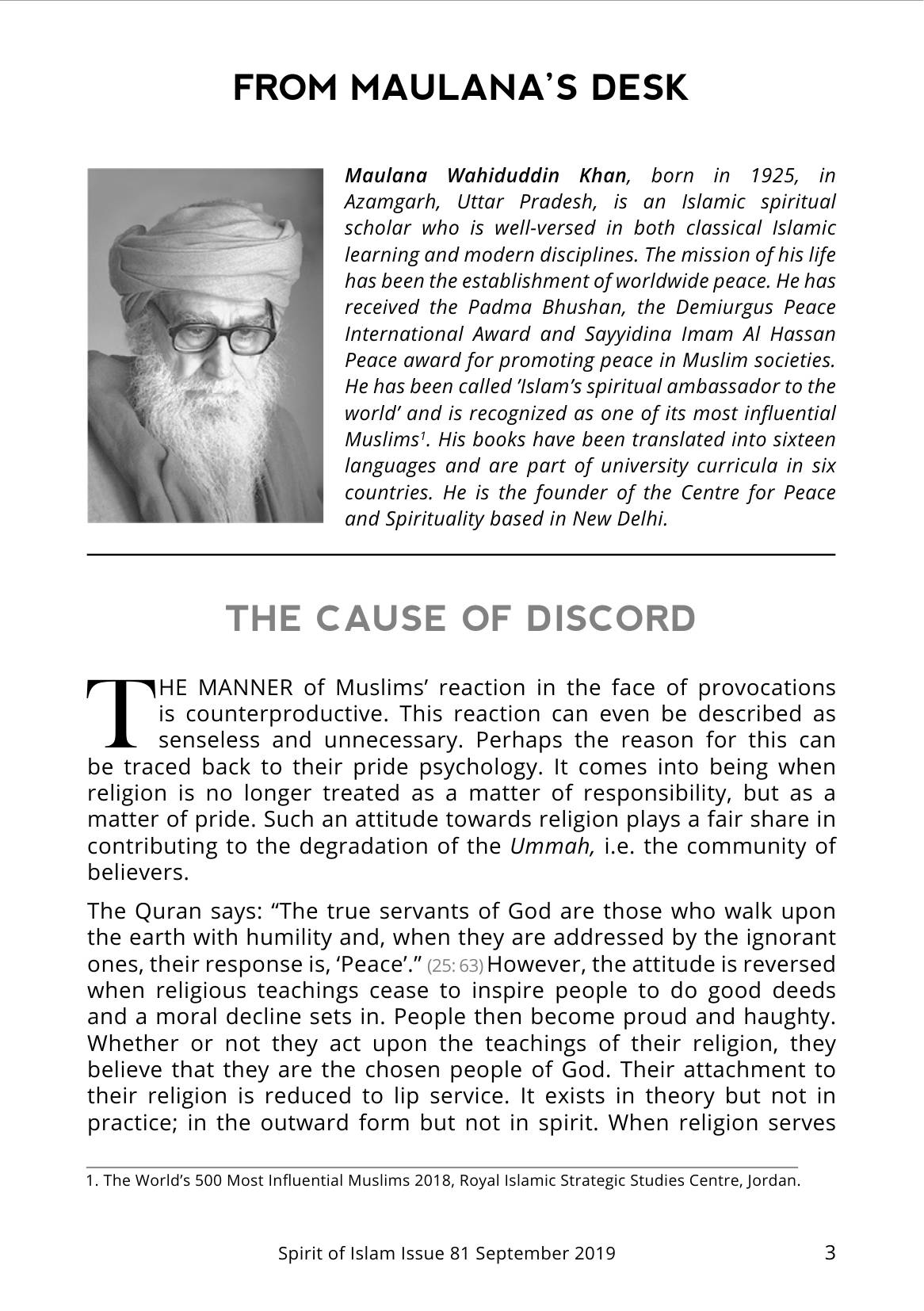
FROM MAULANA’S DESK 1. The World’s 500 Most Influential Muslims 2018, Royal Islamic Strategic Studies Centre, Jordan. Maulana Wahiduddin Khan, born in 1925, in Azamgarh, Uttar Pradesh, is an Islamic spiritual scholar who is well-versed in both classical Islamic learning and modern disciplines. The mission of his life has been the establishment of worldwide peace. He has received the Padma Bhushan, the Demiurgus Peace International Award and Sayyidina Imam Al Hassan Peace award for promoting peace in Muslim societies. He has been called ’Islam’s spiritual ambassador to the world’ and is recognized as one of its most influential Muslims1. His books have been translated into sixteen languages and are part of university curricula in six countries. He is the founder of the Centre for Peace and Spirituality based in New Delhi. THE CAUSE OF DISCORD T HE MANNER of Muslims’ reaction in the face of provocations is counterproductive. This reaction can even be described as senseless and unnecessary. Perhaps the reason for this can be traced back to their pride psychology. It comes into being when religion is no longer treated as a matter of responsibility, but as a matter of pride. Such an attitude towards religion plays a fair share in contributing to the degradation of the Ummah, i.e. the community of believers. The Quran says: “The true servants of God are those who walk upon the earth with humility and, when they are addressed by the ignorant ones, their response is, ‘Peace’.” (25: 63) However, the attitude is reversed when religious teachings cease to inspire people to do good deeds and a moral decline sets in. People then become proud and haughty. Whether or not they act upon the teachings of their religion, they believe that they are the chosen people of God. Their attachment to their religion is reduced to lip service. It exists in theory but not in practice; in the outward form but not in spirit. When religion serves
‹ Previous page Next page › About this issue Open in the reader