FROM MAULANA’S DESK
Spirit of Islam, 2019, p. 3
By Maulana Wahiduddin Khan
Maulana Wahiduddin Khan is named as the default author of the periodical; a piece that carries another writer’s byline is credited to that writer.
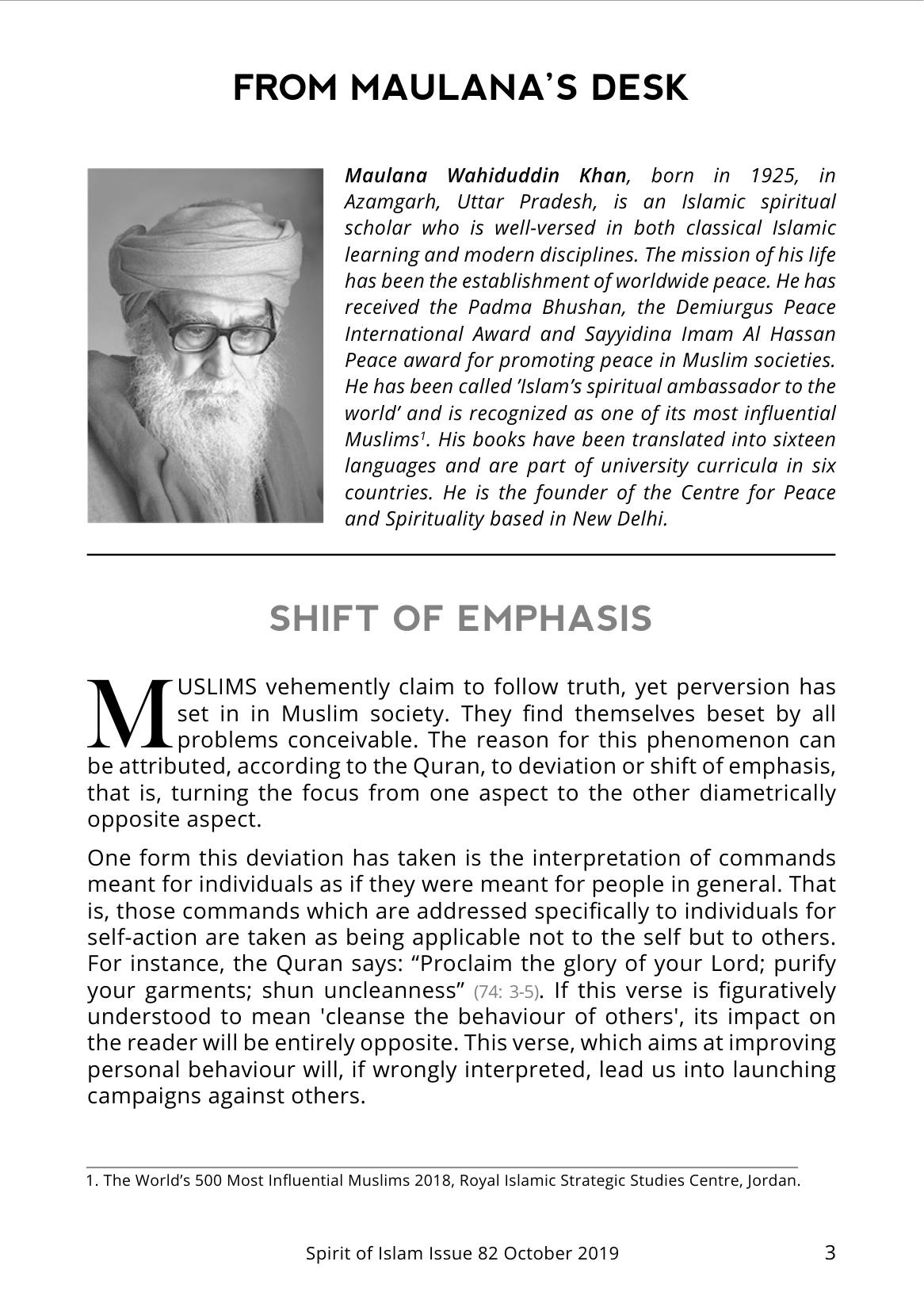
FROM MAULANA’S DESK 1. The World’s 500 Most Influential Muslims 2018, Royal Islamic Strategic Studies Centre, Jordan. Maulana Wahiduddin Khan, born in 1925, in Azamgarh, Uttar Pradesh, is an Islamic spiritual scholar who is well-versed in both classical Islamic learning and modern disciplines. The mission of his life has been the establishment of worldwide peace. He has received the Padma Bhushan, the Demiurgus Peace International Award and Sayyidina Imam Al Hassan Peace award for promoting peace in Muslim societies. He has been called ’Islam’s spiritual ambassador to the world’ and is recognized as one of its most influential Muslims1. His books have been translated into sixteen languages and are part of university curricula in six countries. He is the founder of the Centre for Peace and Spirituality based in New Delhi. SHIFT OF EMPHASIS M USLIMS vehemently claim to follow truth, yet perversion has set in in Muslim society. They find themselves beset by all problems conceivable. The reason for this phenomenon can be attributed, according to the Quran, to deviation or shift of emphasis, that is, turning the focus from one aspect to the other diametrically opposite aspect. One form this deviation has taken is the interpretation of commands meant for individuals as if they were meant for people in general. That is, those commands which are addressed specifically to individuals for self-action are taken as being applicable not to the self but to others. For instance, the Quran says: “Proclaim the glory of your Lord; purify your garments; shun uncleanness” (74: 3-5). If this verse is figuratively understood to mean 'cleanse the behaviour of others', its impact on the reader will be entirely opposite. This verse, which aims at improving personal behaviour will, if wrongly interpreted, lead us into launching campaigns against others.
‹ Previous page Next page › About this issue Open in the reader