THE WORD OF GOD
Spirit of Islam, May 2013, p. 43
By Maulana Wahiduddin Khan
Maulana Wahiduddin Khan is named as the default author of the periodical; a piece that carries another writer’s byline is credited to that writer.
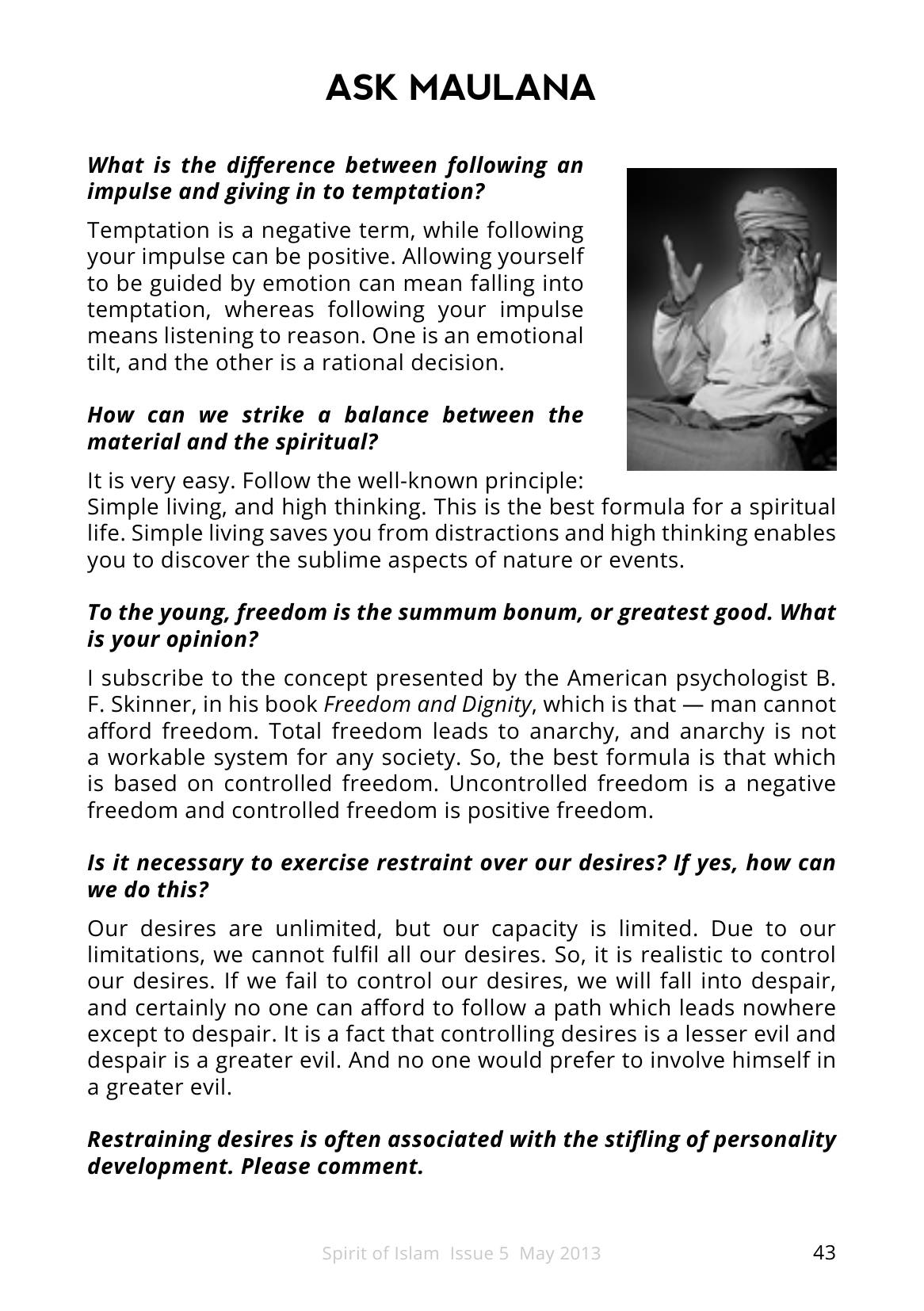
ASK MAULANA What is the difference between following an impulse and giving in to temptation? Temptation is a negative term, while following your impulse can be positive. Allowing yourself to be guided by emotion can mean falling into temptation, whereas following your impulse means listening to reason. One is an emotional tilt, and the other is a rational decision. How can we strike a balance between the material and the spiritual? It is very easy. Follow the well-known principle: Simple living, and high thinking. This is the best formula for a spiritual life. Simple living saves you from distractions and high thinking enables you to discover the sublime aspects of nature or events. To the young, freedom is the summum bonum, or greatest good. What is your opinion? I subscribe to the concept presented by the American psychologist B. F. Skinner, in his book Freedom and Dignity, which is that — man cannot afford freedom. Total freedom leads to anarchy, and anarchy is not a workable system for any society. So, the best formula is that which is based on controlled freedom. Uncontrolled freedom is a negative freedom and controlled freedom is positive freedom. Is it necessary to exercise restraint over our desires? If yes, how can we do this? Our desires are unlimited, but our capacity is limited. Due to our limitations, we cannot fulfil all our desires. So, it is realistic to control our desires. If we fail to control our desires, we will fall into despair, and certainly no one can afford to follow a path which leads nowhere except to despair. It is a fact that controlling desires is a lesser evil and despair is a greater evil. And no one would prefer to involve himself in a greater evil. Restraining desires is often associated with the stifling of personality development. Please comment.
‹ Previous page Next page › About this issue Open in the reader