EXPERIENCING THE PRESENCE OF GOD
Spirit of Islam, June 2013, p. 9
By Maulana Wahiduddin Khan
Maulana Wahiduddin Khan is named as the default author of the periodical; a piece that carries another writer’s byline is credited to that writer.
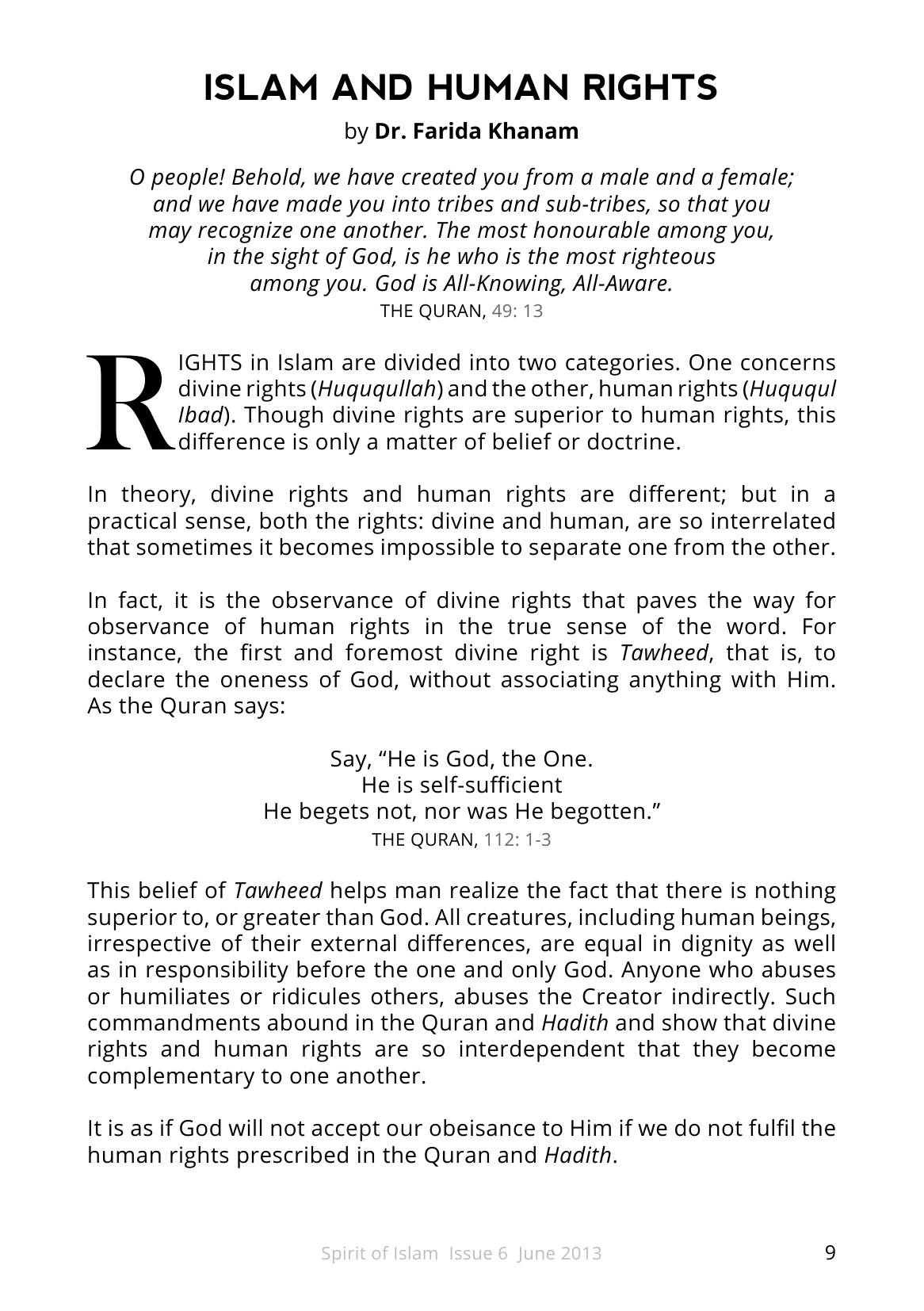
ISLAM AND HUMAN RIGHTS by Dr. Farida Khanam O people! Behold, we have created you from a male and a female; and we have made you into tribes and sub-tribes, so that you may recognize one another. The most honourable among you, in the sight of God, is he who is the most righteous among you. God is All-Knowing, All-Aware. THE QURAN, 49: 13 RIGHTS in Islam are divided into two categories. One concerns divine rights (Huququllah) and the other, human rights (Huququl Ibad). Though divine rights are superior to human rights, this difference is only a matter of belief or doctrine. In theory, divine rights and human rights are different; but in a practical sense, both the rights: divine and human, are so interrelated that sometimes it becomes impossible to separate one from the other. In fact, it is the observance of divine rights that paves the way for observance of human rights in the true sense of the word. For instance, the first and foremost divine right is Tawheed, that is, to declare the oneness of God, without associating anything with Him. As the Quran says: Say, “He is God, the One. He is self-sufficient He begets not, nor was He begotten.” THE QURAN, 112: 1-3 This belief of Tawheed helps man realize the fact that there is nothing superior to, or greater than God. All creatures, including human beings, irrespective of their external differences, are equal in dignity as well as in responsibility before the one and only God. Anyone who abuses or humiliates or ridicules others, abuses the Creator indirectly. Such commandments abound in the Quran and Hadith and show that divine rights and human rights are so interdependent that they become complementary to one another. It is as if God will not accept our obeisance to Him if we do not fulfil the human rights prescribed in the Quran and Hadith.
‹ Previous page Next page › About this issue Open in the reader