FROM MAULANA'S DESK
Spirit of Islam, June 2013, p. 4
By Maulana Wahiduddin Khan
Maulana Wahiduddin Khan is named as the default author of the periodical; a piece that carries another writer’s byline is credited to that writer.
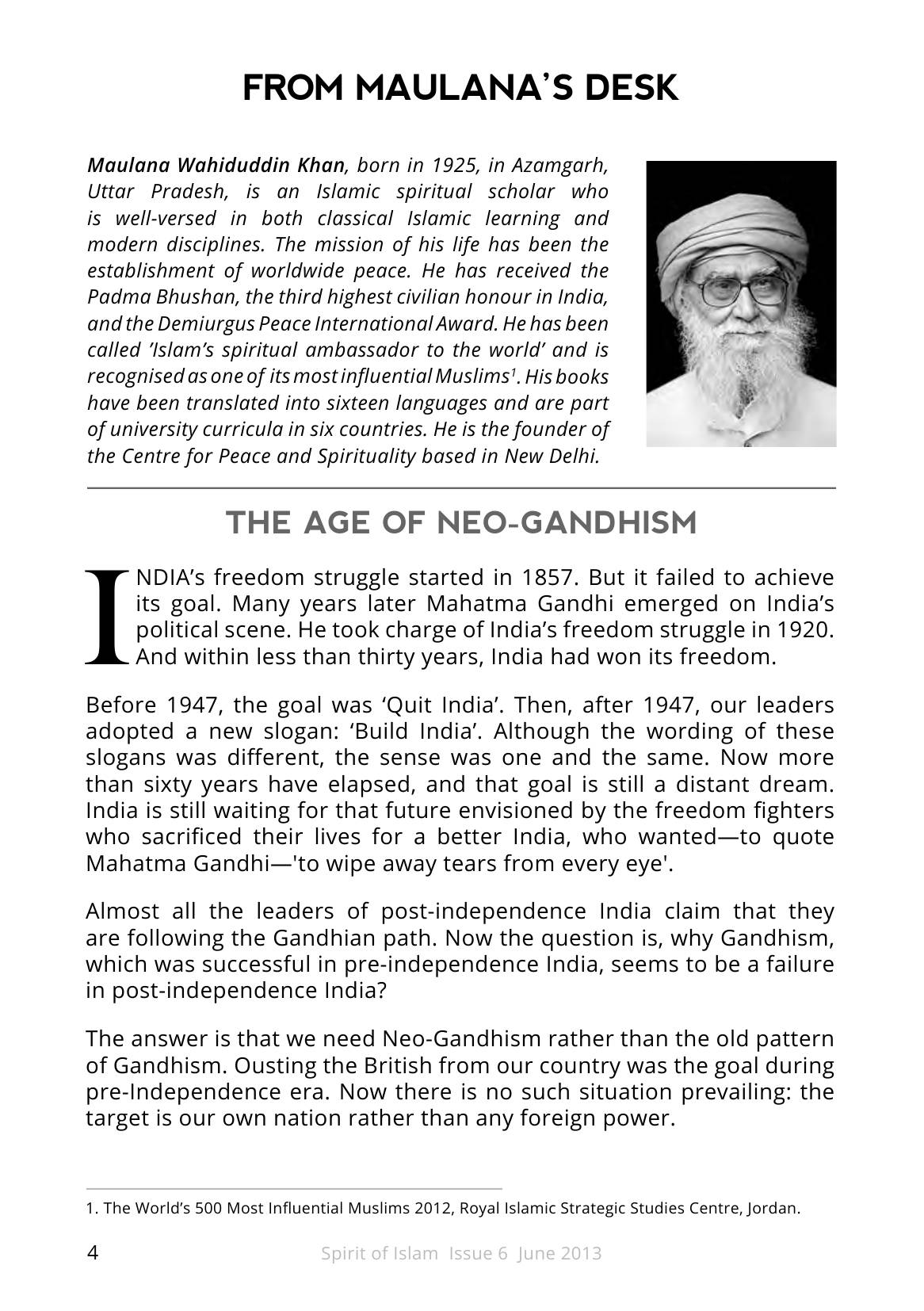
FROM MAULANA’S DESK I NDIA’s freedom struggle started in 1857. But it failed to achieve its goal. Many years later Mahatma Gandhi emerged on India’s political scene. He took charge of India’s freedom struggle in 1920. And within less than thirty years, India had won its freedom. Before 1947, the goal was ‘Quit India’. Then, after 1947, our leaders adopted a new slogan: ‘Build India’. Although the wording of these slogans was different, the sense was one and the same. Now more than sixty years have elapsed, and that goal is still a distant dream. India is still waiting for that future envisioned by the freedom fighters who sacrificed their lives for a better India, who wanted—to quote Mahatma Gandhi—'to wipe away tears from every eye'. Almost all the leaders of post-independence India claim that they are following the Gandhian path. Now the question is, why Gandhism, which was successful in pre-independence India, seems to be a failure in post-independence India? The answer is that we need Neo-Gandhism rather than the old pattern of Gandhism. Ousting the British from our country was the goal during pre-Independence era. Now there is no such situation prevailing: the target is our own nation rather than any foreign power. 1. The World’s 500 Most Influential Muslims 2012, Royal Islamic Strategic Studies Centre, Jordan. Maulana Wahiduddin Khan, born in 1925, in Azamgarh, Uttar Pradesh, is an Islamic spiritual scholar who is well-versed in both classical Islamic learning and modern disciplines. The mission of his life has been the establishment of worldwide peace. He has received the Padma Bhushan, the third highest civilian honour in India, and the Demiurgus Peace International Award. He has been called ’Islam’s spiritual ambassador to the world’ and is recognised as one of its most influential Muslims1. His books have been translated into sixteen languages and are part of university curricula in six countries. He is the founder of the Centre for Peace and Spirituality based in New Delhi. THE AGE OF NEO-GANDHISM
‹ Previous page Next page › About this issue Open in the reader