FROM MAULANA'S DESK
Spirit of Islam, Sept 2013, p. 4
By Maulana Wahiduddin Khan
Maulana Wahiduddin Khan is named as the default author of the periodical; a piece that carries another writer’s byline is credited to that writer.
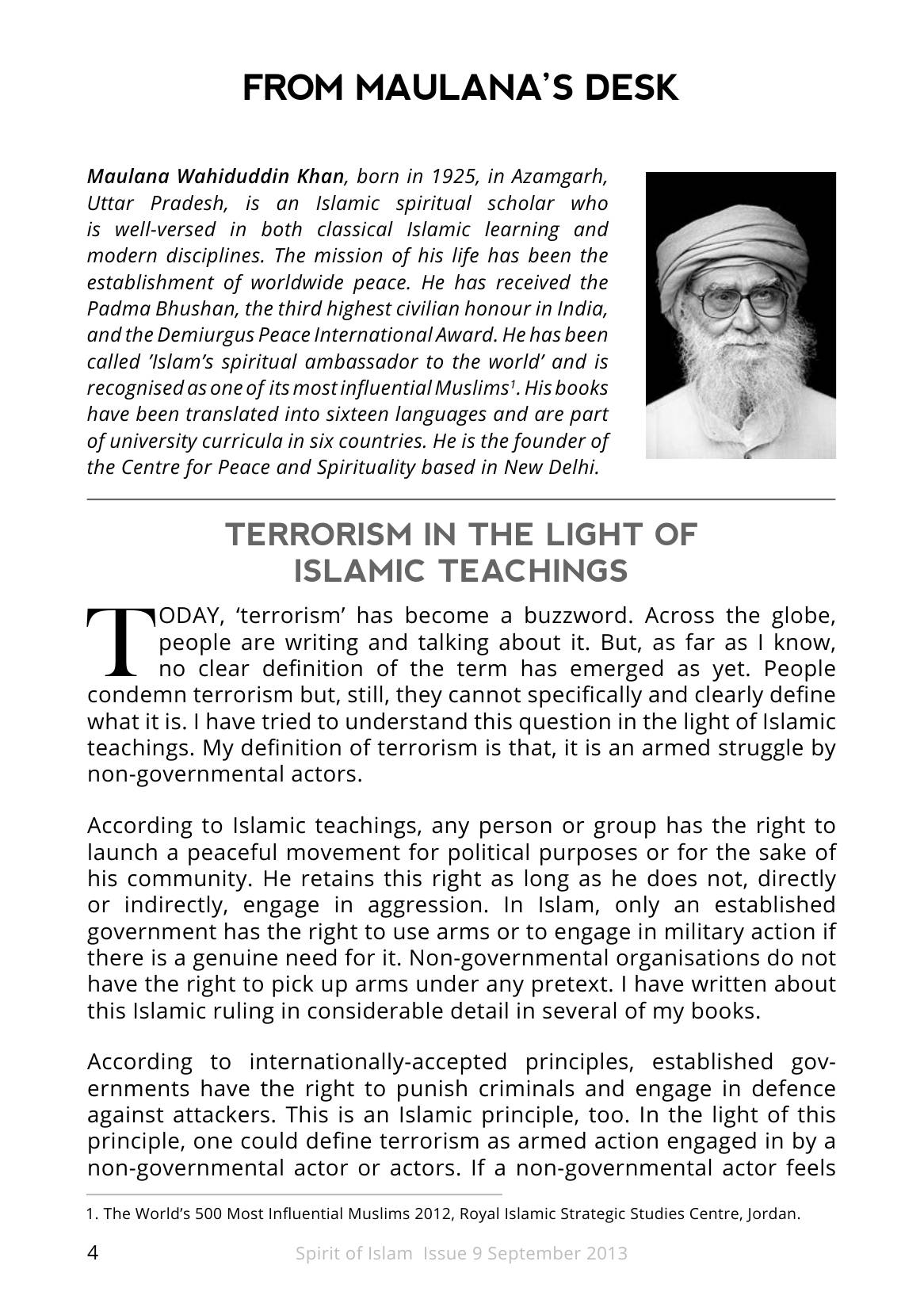
FROM MAULANA’S DESK 1. The World’s 500 Most Influential Muslims 2012, Royal Islamic Strategic Studies Centre, Jordan. Maulana Wahiduddin Khan, born in 1925, in Azamgarh, Uttar Pradesh, is an Islamic spiritual scholar who is well-versed in both classical Islamic learning and modern disciplines. The mission of his life has been the establishment of worldwide peace. He has received the Padma Bhushan, the third highest civilian honour in India, and the Demiurgus Peace International Award. He has been called ’Islam’s spiritual ambassador to the world’ and is recognised as one of its most influential Muslims1. His books have been translated into sixteen languages and are part of university curricula in six countries. He is the founder of the Centre for Peace and Spirituality based in New Delhi. T ODAY, ‘terrorism’ has become a buzzword. Across the globe, people are writing and talking about it. But, as far as I know, no clear definition of the term has emerged as yet. People condemn terrorism but, still, they cannot specifically and clearly define what it is. I have tried to understand this question in the light of Islamic teachings. My definition of terrorism is that, it is an armed struggle by non-governmental actors. According to Islamic teachings, any person or group has the right to launch a peaceful movement for political purposes or for the sake of his community. He retains this right as long as he does not, directly or indirectly, engage in aggression. In Islam, only an established government has the right to use arms or to engage in military action if there is a genuine need for it. Non-governmental organisations do not have the right to pick up arms under any pretext. I have written about this Islamic ruling in considerable detail in several of my books. According to internationally-accepted principles, established gov ernments have the right to punish criminals and engage in defence against attackers. This is an Islamic principle, too. In the light of this principle, one could define terrorism as armed action engaged in by a non-governmental actor or actors. If a non-governmental actor feels TERRORISM IN THE LIGHT OF ISLAMIC TEACHINGS
‹ Previous page Next page › About this issue Open in the reader