NON-VIOLENCE Our Only Hope
Spirit of Islam, Dec 2013, p. 29
By Maulana Wahiduddin Khan
Maulana Wahiduddin Khan is named as the default author of the periodical; a piece that carries another writer’s byline is credited to that writer.
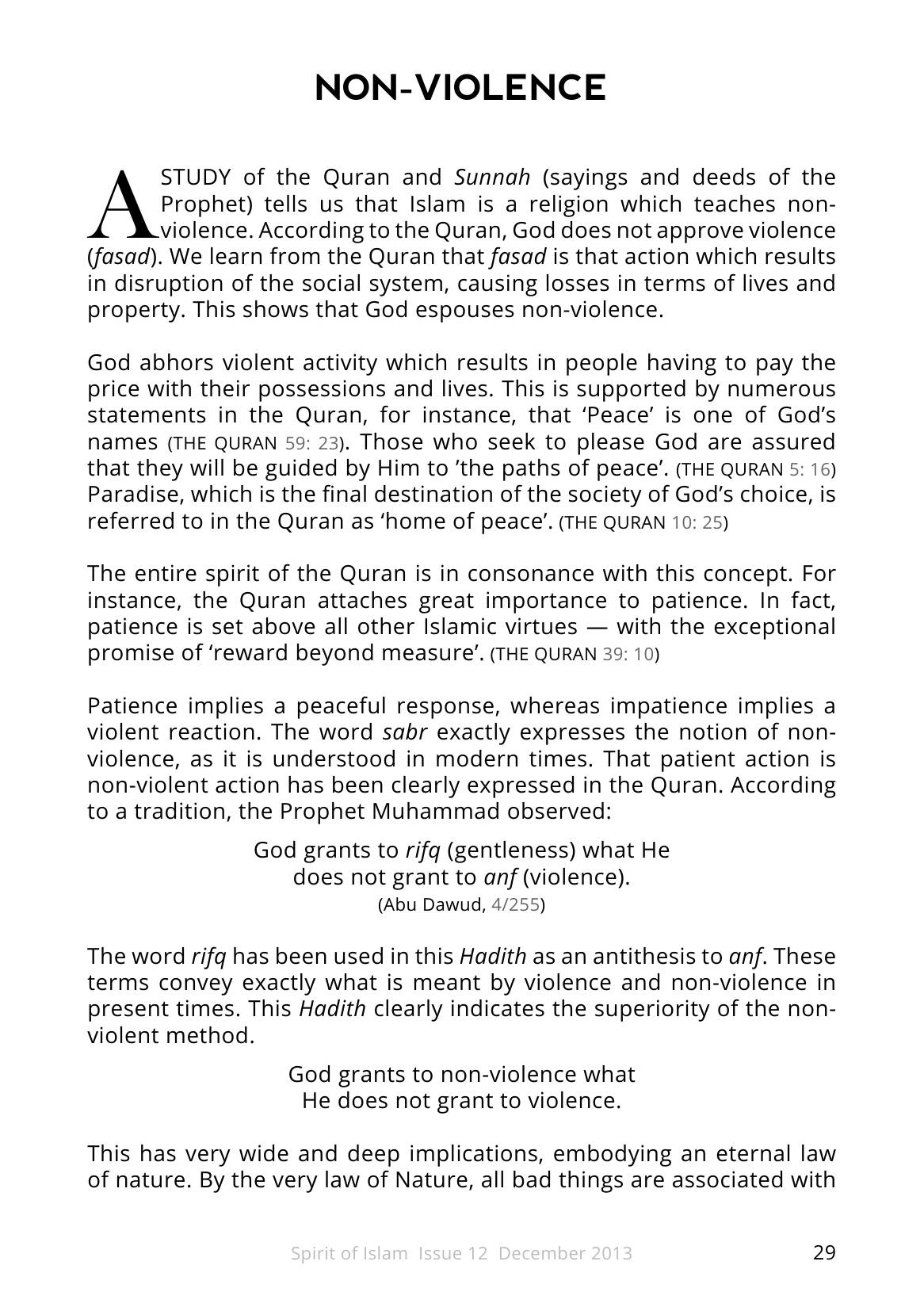
NON-VIOLENCE A STUDY of the Quran and Sunnah (sayings and deeds of the Prophet) tells us that Islam is a religion which teaches nonviolence. According to the Quran, God does not approve violence (fasad). We learn from the Quran that fasad is that action which results in disruption of the social system, causing losses in terms of lives and property. This shows that God espouses non-violence. God abhors violent activity which results in people having to pay the price with their possessions and lives. This is supported by numerous statements in the Quran, for instance, that ‘Peace’ is one of God’s names (THE QURAN 59: 23). Those who seek to please God are assured that they will be guided by Him to ’the paths of peace’. (THE QURAN 5: 16) Paradise, which is the final destination of the society of God’s choice, is referred to in the Quran as ‘home of peace’. (THE QURAN 10: 25) The entire spirit of the Quran is in consonance with this concept. For instance, the Quran attaches great importance to patience. In fact, patience is set above all other Islamic virtues — with the exceptional promise of ‘reward beyond measure’. (THE QURAN 39: 10) Patience implies a peaceful response, whereas impatience implies a violent reaction. The word sabr exactly expresses the notion of nonviolence, as it is understood in modern times. That patient action is non-violent action has been clearly expressed in the Quran. According to a tradition, the Prophet Muhammad observed: God grants to rifq (gentleness) what He does not grant to anf (violence). (Abu Dawud, 4/255) The word rifq has been used in this Hadith as an antithesis to anf. These terms convey exactly what is meant by violence and non-violence in present times. This Hadith clearly indicates the superiority of the nonviolent method. God grants to non-violence what He does not grant to violence. This has very wide and deep implications, embodying an eternal law of nature. By the very law of Nature, all bad things are associated with
‹ Previous page Next page › About this issue Open in the reader