ASK MAULANA
Spirit of Islam, Dec 2013, p. 45
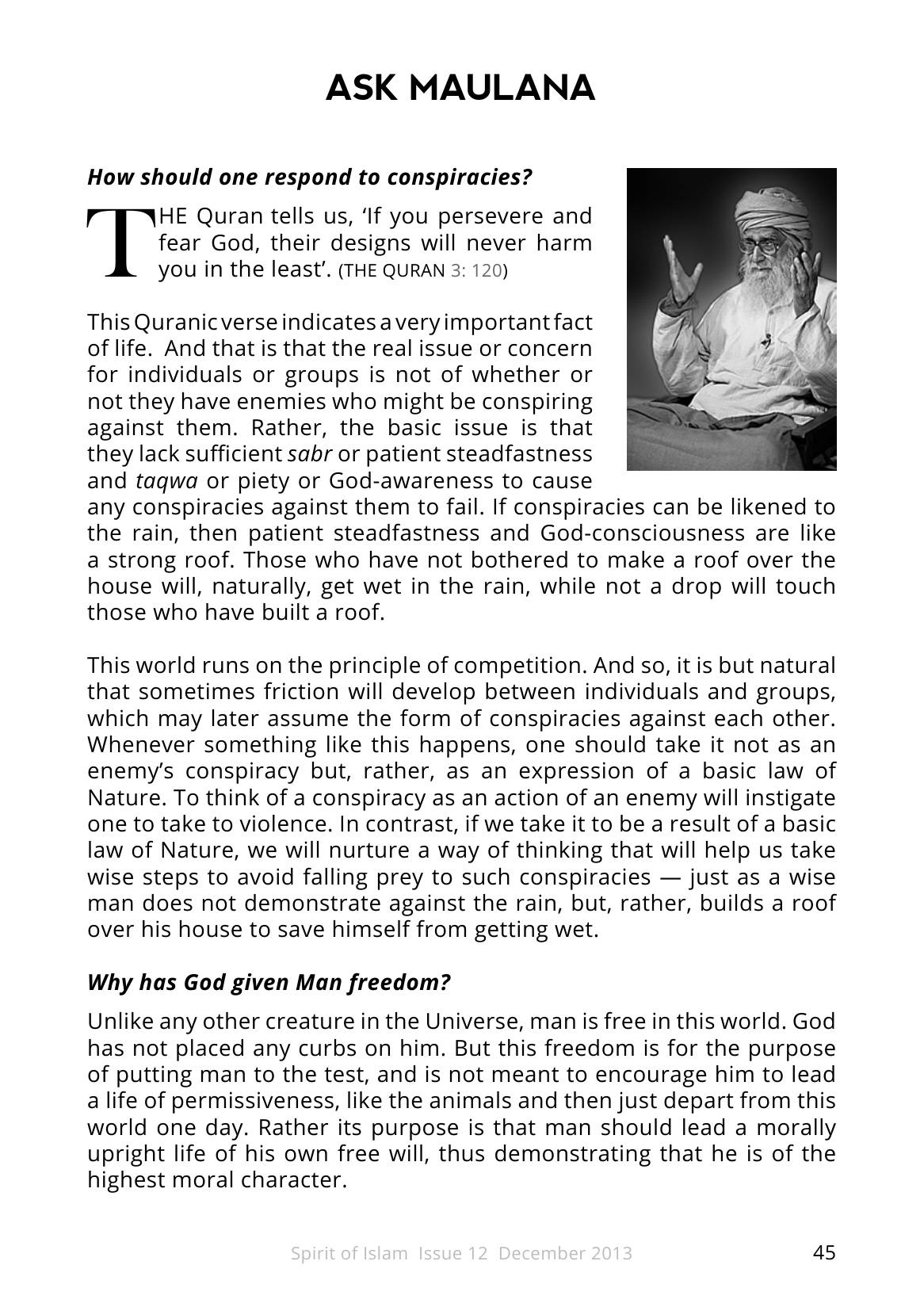
By Maulana Wahiduddin Khan
Maulana Wahiduddin Khan is named as the default author of the periodical; a piece that carries another writer’s byline is credited to that writer.
ASK MAULANA How should one respond to conspiracies? T HE Quran tells us, ‘If you persevere and fear God, their designs will never harm you in the least’. (THE QURAN 3: 120) This Quranic verse indicates a very important fact of life. And that is that the real issue or concern for individuals or groups is not of whether or not they have enemies who might be conspiring against them. Rather, the basic issue is that they lack sufficient sabr or patient steadfastness and taqwa or piety or God-awareness to cause any conspiracies against them to fail. If conspiracies can be likened to the rain, then patient steadfastness and God-consciousness are like a strong roof. Those who have not bothered to make a roof over the house will, naturally, get wet in the rain, while not a drop will touch those who have built a roof. This world runs on the principle of competition. And so, it is but natural that sometimes friction will develop between individuals and groups, which may later assume the form of conspiracies against each other. Whenever something like this happens, one should take it not as an enemy’s conspiracy but, rather, as an expression of a basic law of Nature. To think of a conspiracy as an action of an enemy will instigate one to take to violence. In contrast, if we take it to be a result of a basic law of Nature, we will nurture a way of thinking that will help us take wise steps to avoid falling prey to such conspiracies — just as a wise man does not demonstrate against the rain, but, rather, builds a roof over his house to save himself from getting wet. Why has God given Man freedom? Unlike any other creature in the Universe, man is free in this world. God has not placed any curbs on him. But this freedom is for the purpose of putting man to the test, and is not meant to encourage him to lead a life of permissiveness, like the animals and then just depart from this world one day. Rather its purpose is that man should lead a morally upright life of his own free will, thus demonstrating that he is of the highest moral character.
‹ Previous page Next page › About this issue Open in the reader