FROM MAULANA'S DESK
Spirit of Islam, Dec 2013, p. 4
By Maulana Wahiduddin Khan
Maulana Wahiduddin Khan is named as the default author of the periodical; a piece that carries another writer’s byline is credited to that writer.
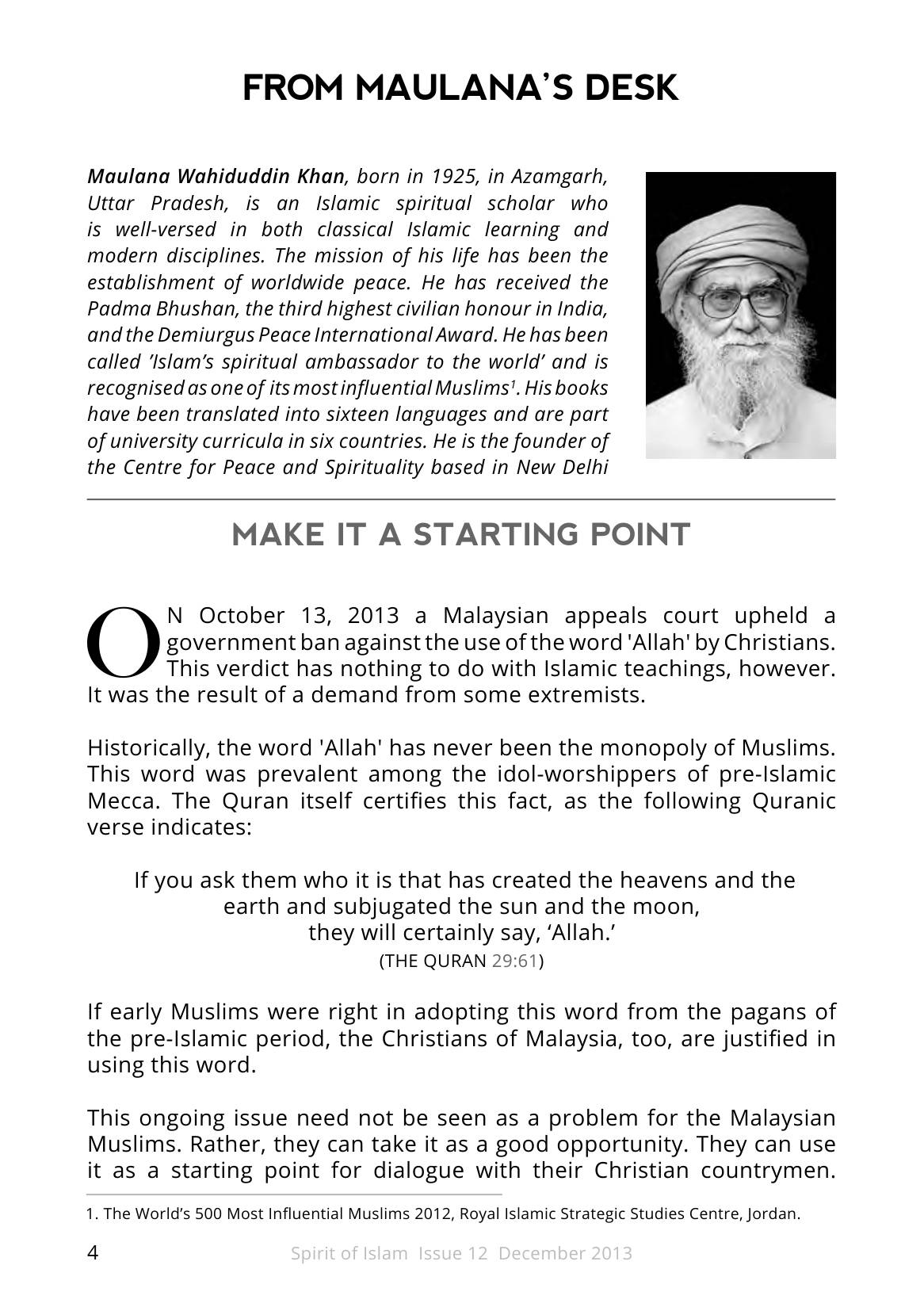
FROM MAULANA’S DESK 1. The World’s 500 Most Influential Muslims 2012, Royal Islamic Strategic Studies Centre, Jordan. Maulana Wahiduddin Khan, born in 1925, in Azamgarh, Uttar Pradesh, is an Islamic spiritual scholar who is well-versed in both classical Islamic learning and modern disciplines. The mission of his life has been the establishment of worldwide peace. He has received the Padma Bhushan, the third highest civilian honour in India, and the Demiurgus Peace International Award. He has been called ’Islam’s spiritual ambassador to the world’ and is recognised as one of its most influential Muslims1. His books have been translated into sixteen languages and are part of university curricula in six countries. He is the founder of the Centre for Peace and Spirituality based in New Delhi O N October 13, 2013 a Malaysian appeals court upheld a government ban against the use of the word 'Allah' by Christians. This verdict has nothing to do with Islamic teachings, however. It was the result of a demand from some extremists. Historically, the word 'Allah' has never been the monopoly of Muslims. This word was prevalent among the idol-worshippers of pre-Islamic Mecca. The Quran itself certifies this fact, as the following Quranic verse indicates: If you ask them who it is that has created the heavens and the earth and subjugated the sun and the moon, they will certainly say, ‘Allah.’ (THE QURAN 29:61) If early Muslims were right in adopting this word from the pagans of the pre-Islamic period, the Christians of Malaysia, too, are justified in using this word. This ongoing issue need not be seen as a problem for the Malaysian Muslims. Rather, they can take it as a good opportunity. They can use it as a starting point for dialogue with their Christian countrymen. MAKE IT A STARTING POINT
‹ Previous page Next page › About this issue Open in the reader