FROM THE SPIRITUAL TREE — Introspection
Spirit of Islam, Mar 2014, p. 18
By Maulana Wahiduddin Khan
Maulana Wahiduddin Khan is named as the default author of the periodical; a piece that carries another writer’s byline is credited to that writer.
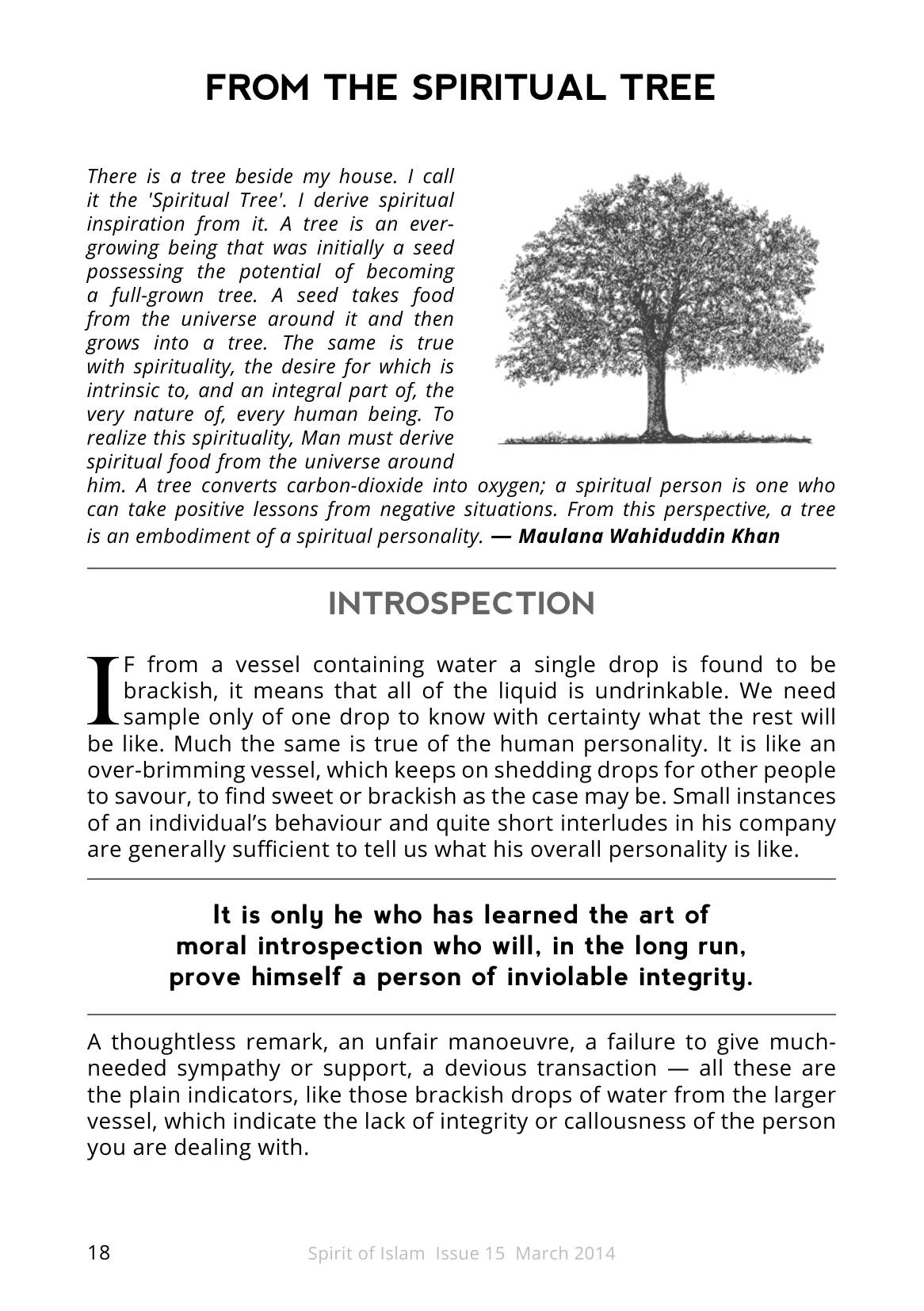
FROM THE SPIRITUAL TREE I F from a vessel containing water a single drop is found to be brackish, it means that all of the liquid is undrinkable. We need sample only of one drop to know with certainty what the rest will be like. Much the same is true of the human personality. It is like an over-brimming vessel, which keeps on shedding drops for other people to savour, to find sweet or brackish as the case may be. Small instances of an individual’s behaviour and quite short interludes in his company are generally sufficient to tell us what his overall personality is like. It is only he who has learned the art of moral introspection who will, in the long run, prove himself a person of inviolable integrity. A thoughtless remark, an unfair manoeuvre, a failure to give muchneeded sympathy or support, a devious transaction — all these are the plain indicators, like those brackish drops of water from the larger vessel, which indicate the lack of integrity or callousness of the person you are dealing with. There is a tree beside my house. I call it the 'Spiritual Tree'. I derive spiritual inspiration from it. A tree is an evergrowing being that was initially a seed possessing the potential of becoming a full-grown tree. A seed takes food from the universe around it and then grows into a tree. The same is true with spirituality, the desire for which is intrinsic to, and an integral part of, the very nature of, every human being. To realize this spirituality, Man must derive spiritual food from the universe around him. A tree converts carbon-dioxide into oxygen; a spiritual person is one who can take positive lessons from negative situations. From this perspective, a tree is an embodiment of a spiritual personality. — Maulana Wahiduddin Khan INTROSPECTION
‹ Previous page Next page › About this issue Open in the reader