FROM MAULANA'S DESK
Spirit of Islam, July 2014, p. 4
By Maulana Wahiduddin Khan
Maulana Wahiduddin Khan is named as the default author of the periodical; a piece that carries another writer’s byline is credited to that writer.
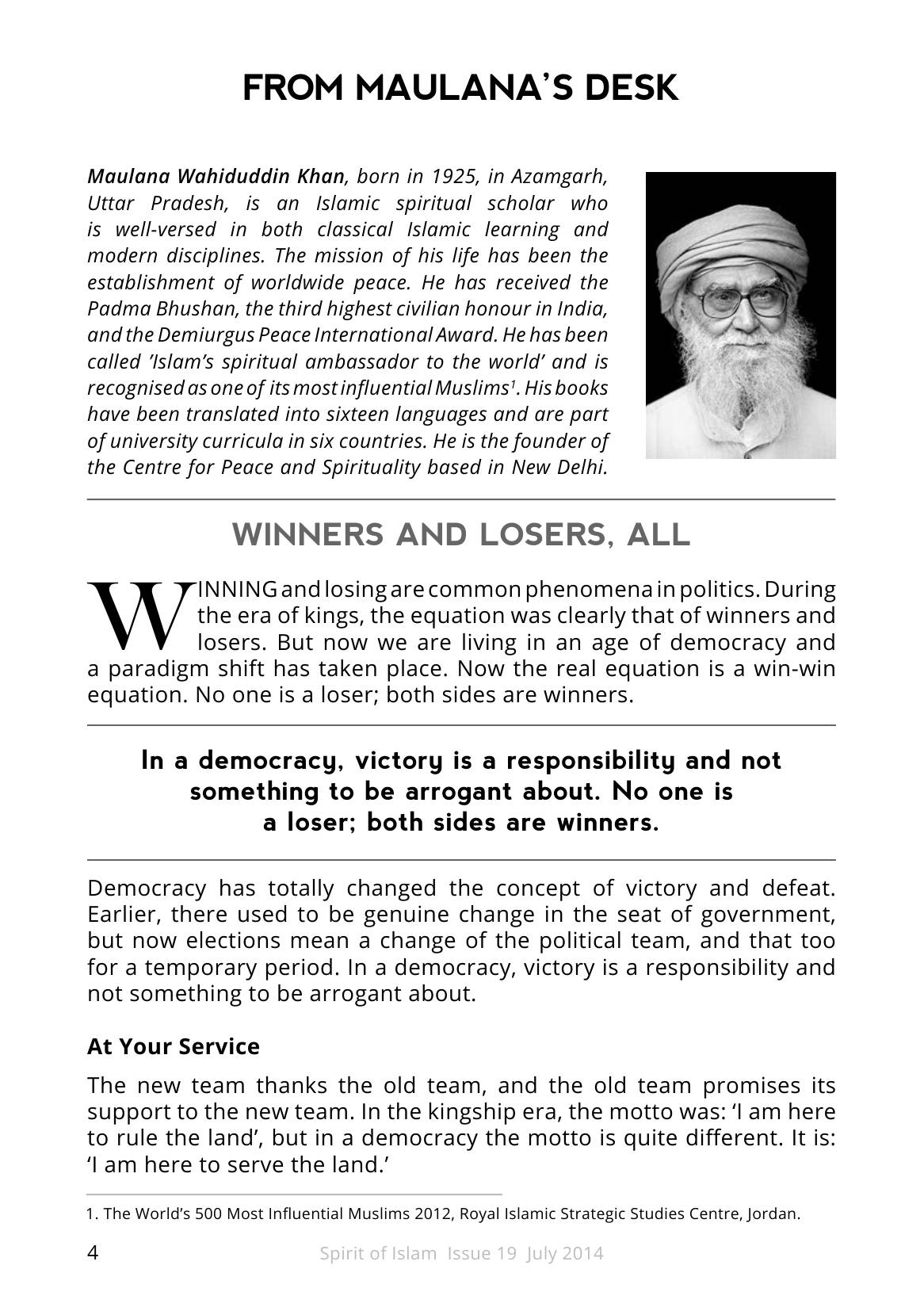
FROM MAULANA’S DESK 1. The World’s 500 Most Influential Muslims 2012, Royal Islamic Strategic Studies Centre, Jordan. Maulana Wahiduddin Khan, born in 1925, in Azamgarh, Uttar Pradesh, is an Islamic spiritual scholar who is well-versed in both classical Islamic learning and modern disciplines. The mission of his life has been the establishment of worldwide peace. He has received the Padma Bhushan, the third highest civilian honour in India, and the Demiurgus Peace International Award. He has been called ’Islam’s spiritual ambassador to the world’ and is recognised as one of its most influential Muslims1. His books have been translated into sixteen languages and are part of university curricula in six countries. He is the founder of the Centre for Peace and Spirituality based in New Delhi. WINNING and losing are common phenomena in politics. During the era of kings, the equation was clearly that of winners and losers. But now we are living in an age of democracy and a paradigm shift has taken place. Now the real equation is a win-win equation. No one is a loser; both sides are winners. In a democracy, victory is a responsibility and not something to be arrogant about. No one is a loser; both sides are winners. Democracy has totally changed the concept of victory and defeat. Earlier, there used to be genuine change in the seat of government, but now elections mean a change of the political team, and that too for a temporary period. In a democracy, victory is a responsibility and not something to be arrogant about. At Your Service The new team thanks the old team, and the old team promises its support to the new team. In the kingship era, the motto was: ‘I am here to rule the land’, but in a democracy the motto is quite different. It is: ‘I am here to serve the land.’ WINNERS AND LOSERS, ALL
‹ Previous page Next page › About this issue Open in the reader