FROM MAULANA'S DESK
Spirit of Islam, Sept 2014, p. 4
By Maulana Wahiduddin Khan
Maulana Wahiduddin Khan is named as the default author of the periodical; a piece that carries another writer’s byline is credited to that writer.
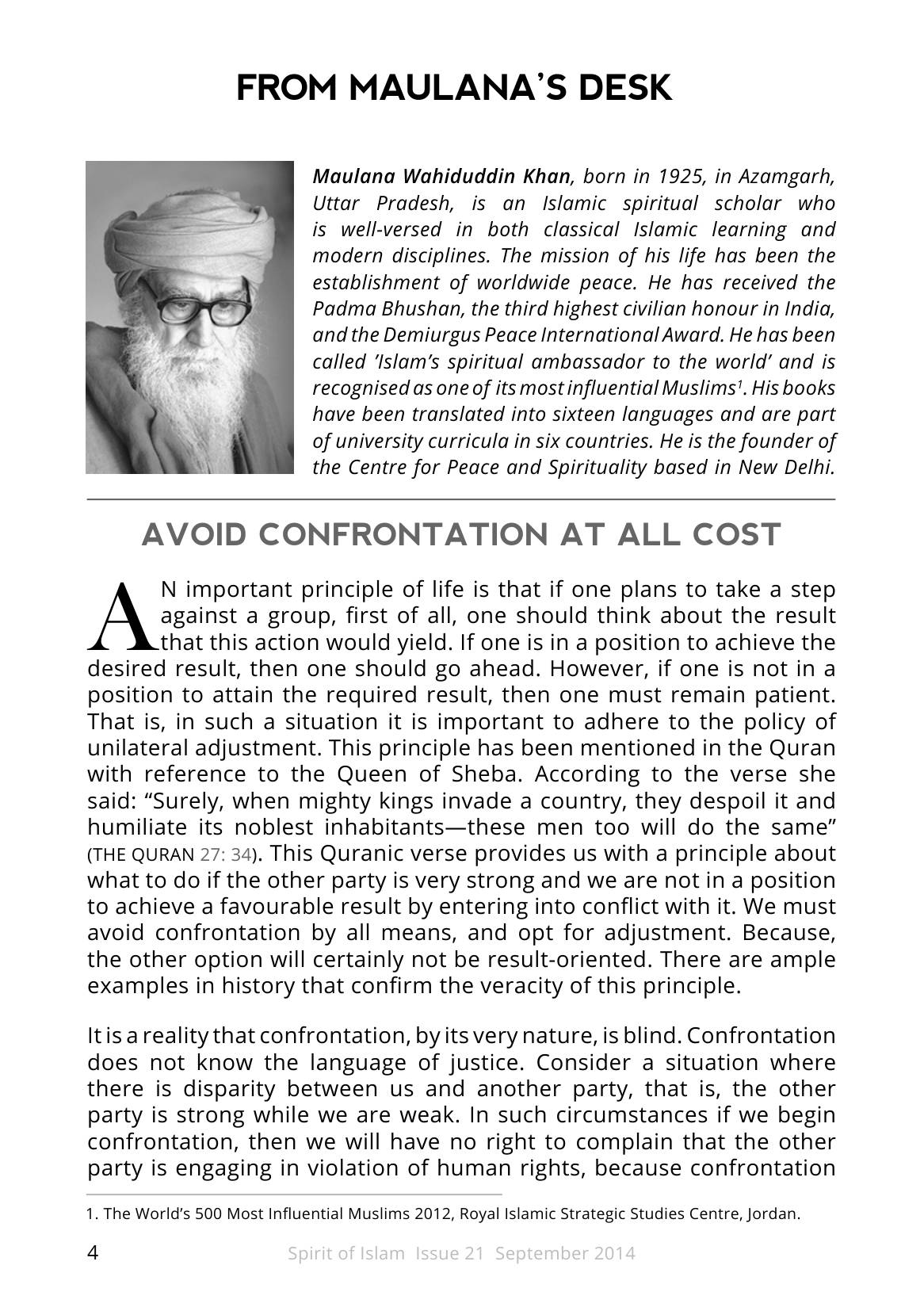
FROM MAULANA’S DESK 1. The World’s 500 Most Influential Muslims 2012, Royal Islamic Strategic Studies Centre, Jordan. Maulana Wahiduddin Khan, born in 1925, in Azamgarh, Uttar Pradesh, is an Islamic spiritual scholar who is well-versed in both classical Islamic learning and modern disciplines. The mission of his life has been the establishment of worldwide peace. He has received the Padma Bhushan, the third highest civilian honour in India, and the Demiurgus Peace International Award. He has been called ’Islam’s spiritual ambassador to the world’ and is recognised as one of its most influential Muslims1. His books have been translated into sixteen languages and are part of university curricula in six countries. He is the founder of the Centre for Peace and Spirituality based in New Delhi. A N important principle of life is that if one plans to take a step against a group, first of all, one should think about the result that this action would yield. If one is in a position to achieve the desired result, then one should go ahead. However, if one is not in a position to attain the required result, then one must remain patient. That is, in such a situation it is important to adhere to the policy of unilateral adjustment. This principle has been mentioned in the Quran with reference to the Queen of Sheba. According to the verse she said: “Surely, when mighty kings invade a country, they despoil it and humiliate its noblest inhabitants—these men too will do the same” (THE QURAN 27: 34). This Quranic verse provides us with a principle about what to do if the other party is very strong and we are not in a position to achieve a favourable result by entering into conflict with it. We must avoid confrontation by all means, and opt for adjustment. Because, the other option will certainly not be result-oriented. There are ample examples in history that confirm the veracity of this principle. It is a reality that confrontation, by its very nature, is blind. Confrontation does not know the language of justice. Consider a situation where there is disparity between us and another party, that is, the other party is strong while we are weak. In such circumstances if we begin confrontation, then we will have no right to complain that the other party is engaging in violation of human rights, because confrontation AVOID CONFRONTATION AT ALL COST
‹ Previous page Next page › About this issue Open in the reader