MONOTHEISM: ONENESS OF GOD — The Creator, Sustainer and Cherisher
Spirit of Islam, Jan 2015, p. 12
By Maulana Wahiduddin Khan
Maulana Wahiduddin Khan is named as the default author of the periodical; a piece that carries another writer’s byline is credited to that writer.
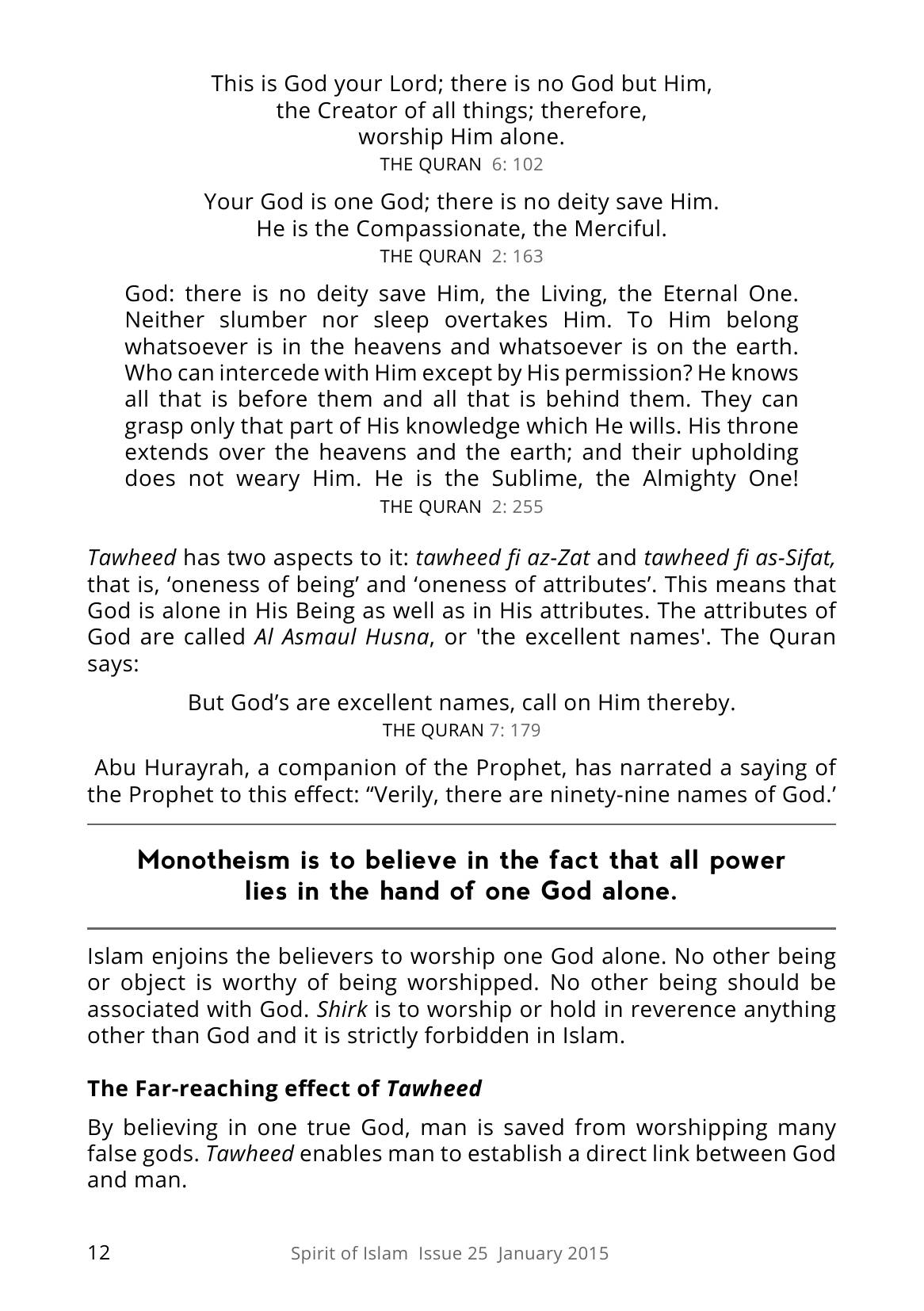
This is God your Lord; there is no God but Him, the Creator of all things; therefore, worship Him alone. THE QURAN 6: 102 Your God is one God; there is no deity save Him. He is the Compassionate, the Merciful. THE QURAN 2: 163 God: there is no deity save Him, the Living, the Eternal One. Neither slumber nor sleep overtakes Him. To Him belong whatsoever is in the heavens and whatsoever is on the earth. Who can intercede with Him except by His permission? He knows all that is before them and all that is behind them. They can grasp only that part of His knowledge which He wills. His throne extends over the heavens and the earth; and their upholding does not weary Him. He is the Sublime, the Almighty One! THE QURAN 2: 255 Tawheed has two aspects to it: tawheed fi az-Zat and tawheed fi as-Sifat, that is, ‘oneness of being’ and ‘oneness of attributes’. This means that God is alone in His Being as well as in His attributes. The attributes of God are called Al Asmaul Husna, or 'the excellent names'. The Quran says: But God’s are excellent names, call on Him thereby. THE QURAN 7: 179 Abu Hurayrah, a companion of the Prophet, has narrated a saying of the Prophet to this effect: “Verily, there are ninety-nine names of God.’ Monotheism is to believe in the fact that all power lies in the hand of one God alone. Islam enjoins the believers to worship one God alone. No other being or object is worthy of being worshipped. No other being should be associated with God. Shirk is to worship or hold in reverence anything other than God and it is strictly forbidden in Islam. The Far-reaching effect of Tawheed By believing in one true God, man is saved from worshipping many false gods. Tawheed enables man to establish a direct link between God and man.
‹ Previous page Next page › About this issue Open in the reader