FROM THE SPIRITUAL TREE
Spirit of Islam, Feb 2015, p. 24
By Maulana Wahiduddin Khan
Maulana Wahiduddin Khan is named as the default author of the periodical; a piece that carries another writer’s byline is credited to that writer.
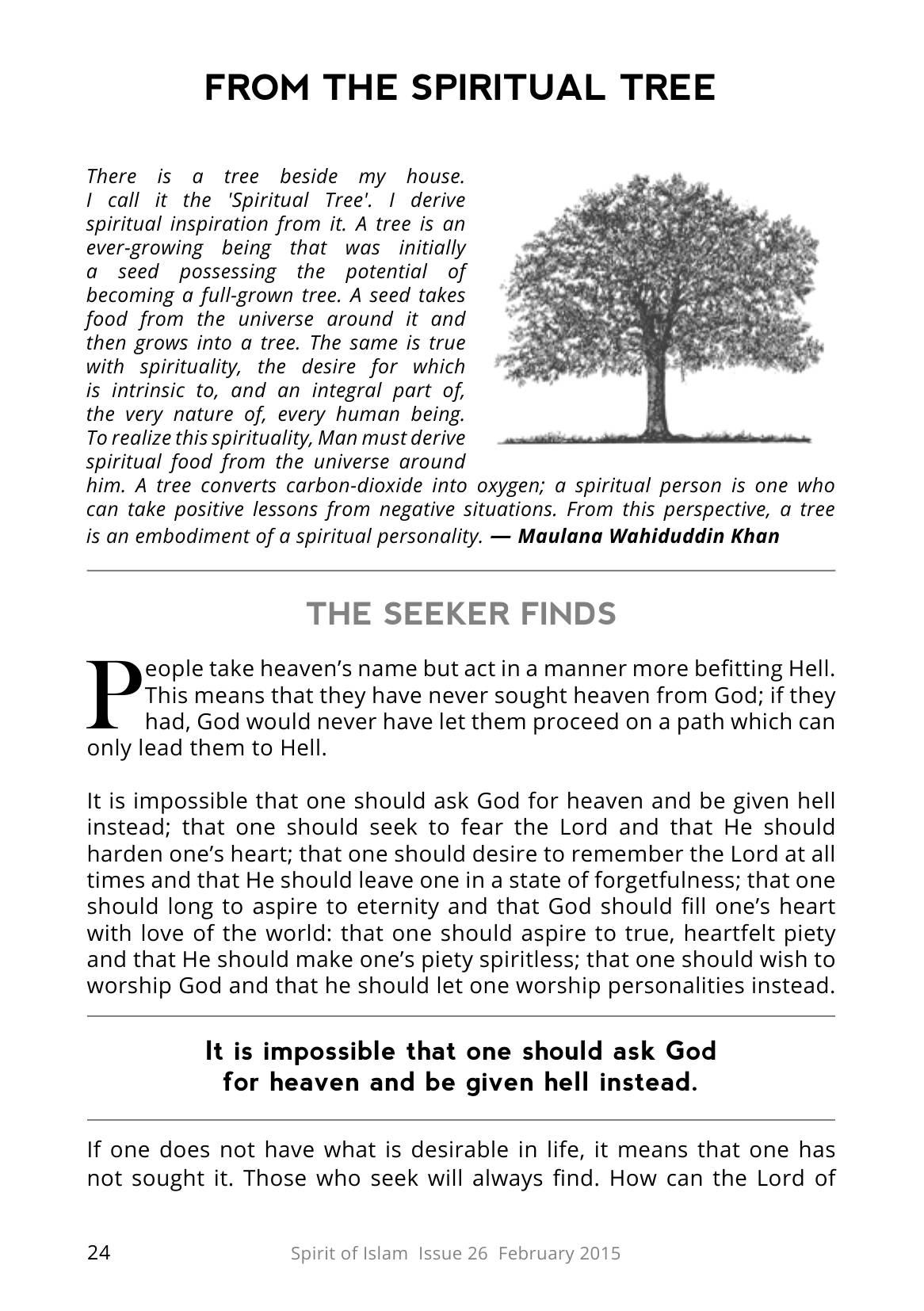
FROM THE SPIRITUAL TREE P eople take heaven’s name but act in a manner more befitting Hell. This means that they have never sought heaven from God; if they had, God would never have let them proceed on a path which can only lead them to Hell. It is impossible that one should ask God for heaven and be given hell instead; that one should seek to fear the Lord and that He should harden one’s heart; that one should desire to remember the Lord at all times and that He should leave one in a state of forgetfulness; that one should long to aspire to eternity and that God should fill one’s heart with love of the world: that one should aspire to true, heartfelt piety and that He should make one’s piety spiritless; that one should wish to worship God and that he should let one worship personalities instead. It is impossible that one should ask God for heaven and be given hell instead. If one does not have what is desirable in life, it means that one has not sought it. Those who seek will always find. How can the Lord of There is a tree beside my house. I call it the 'Spiritual Tree'. I derive spiritual inspiration from it. A tree is an ever-growing being that was initially a seed possessing the potential of becoming a full-grown tree. A seed takes food from the universe around it and then grows into a tree. The same is true with spirituality, the desire for which is intrinsic to, and an integral part of, the very nature of, every human being. To realize this spirituality, Man must derive spiritual food from the universe around him. A tree converts carbon-dioxide into oxygen; a spiritual person is one who can take positive lessons from negative situations. From this perspective, a tree is an embodiment of a spiritual personality. — Maulana Wahiduddin Khan THE SEEKER FINDS
‹ Previous page Next page › About this issue Open in the reader