FROM MAULANA'S DESK
Spirit of Islam, Mar 2015, p. 3
By Maulana Wahiduddin Khan
Maulana Wahiduddin Khan is named as the default author of the periodical; a piece that carries another writer’s byline is credited to that writer.
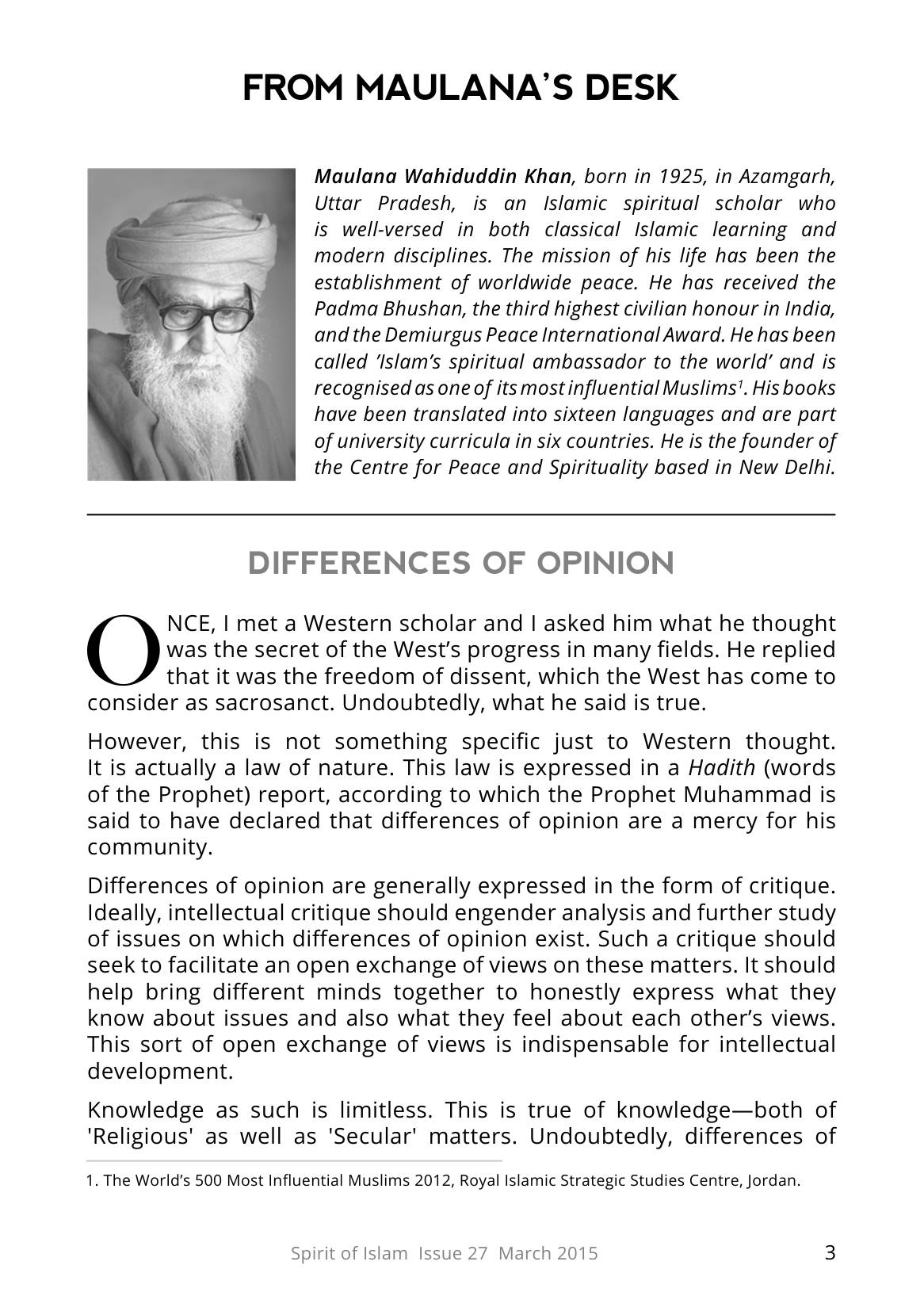
FROM MAULANA’S DESK 1. The World’s 500 Most Influential Muslims 2012, Royal Islamic Strategic Studies Centre, Jordan. Maulana Wahiduddin Khan, born in 1925, in Azamgarh, Uttar Pradesh, is an Islamic spiritual scholar who is well-versed in both classical Islamic learning and modern disciplines. The mission of his life has been the establishment of worldwide peace. He has received the Padma Bhushan, the third highest civilian honour in India, and the Demiurgus Peace International Award. He has been called ’Islam’s spiritual ambassador to the world’ and is recognised as one of its most influential Muslims1. His books have been translated into sixteen languages and are part of university curricula in six countries. He is the founder of the Centre for Peace and Spirituality based in New Delhi. O NCE, I met a Western scholar and I asked him what he thought was the secret of the West’s progress in many fields. He replied that it was the freedom of dissent, which the West has come to consider as sacrosanct. Undoubtedly, what he said is true. However, this is not something specific just to Western thought. It is actually a law of nature. This law is expressed in a Hadith (words of the Prophet) report, according to which the Prophet Muhammad is said to have declared that differences of opinion are a mercy for his community. Differences of opinion are generally expressed in the form of critique. Ideally, intellectual critique should engender analysis and further study of issues on which differences of opinion exist. Such a critique should seek to facilitate an open exchange of views on these matters. It should help bring different minds together to honestly express what they know about issues and also what they feel about each other’s views. This sort of open exchange of views is indispensable for intellectual development. Knowledge as such is limitless. This is true of knowledge—both of 'Religious' as well as 'Secular' matters. Undoubtedly, differences of DIFFERENCES OF OPINION
‹ Previous page Next page › About this issue Open in the reader