FROM MAULANA'S DESK
Spirit of Islam, May 2015, p. 3
By Maulana Wahiduddin Khan
Maulana Wahiduddin Khan is named as the default author of the periodical; a piece that carries another writer’s byline is credited to that writer.
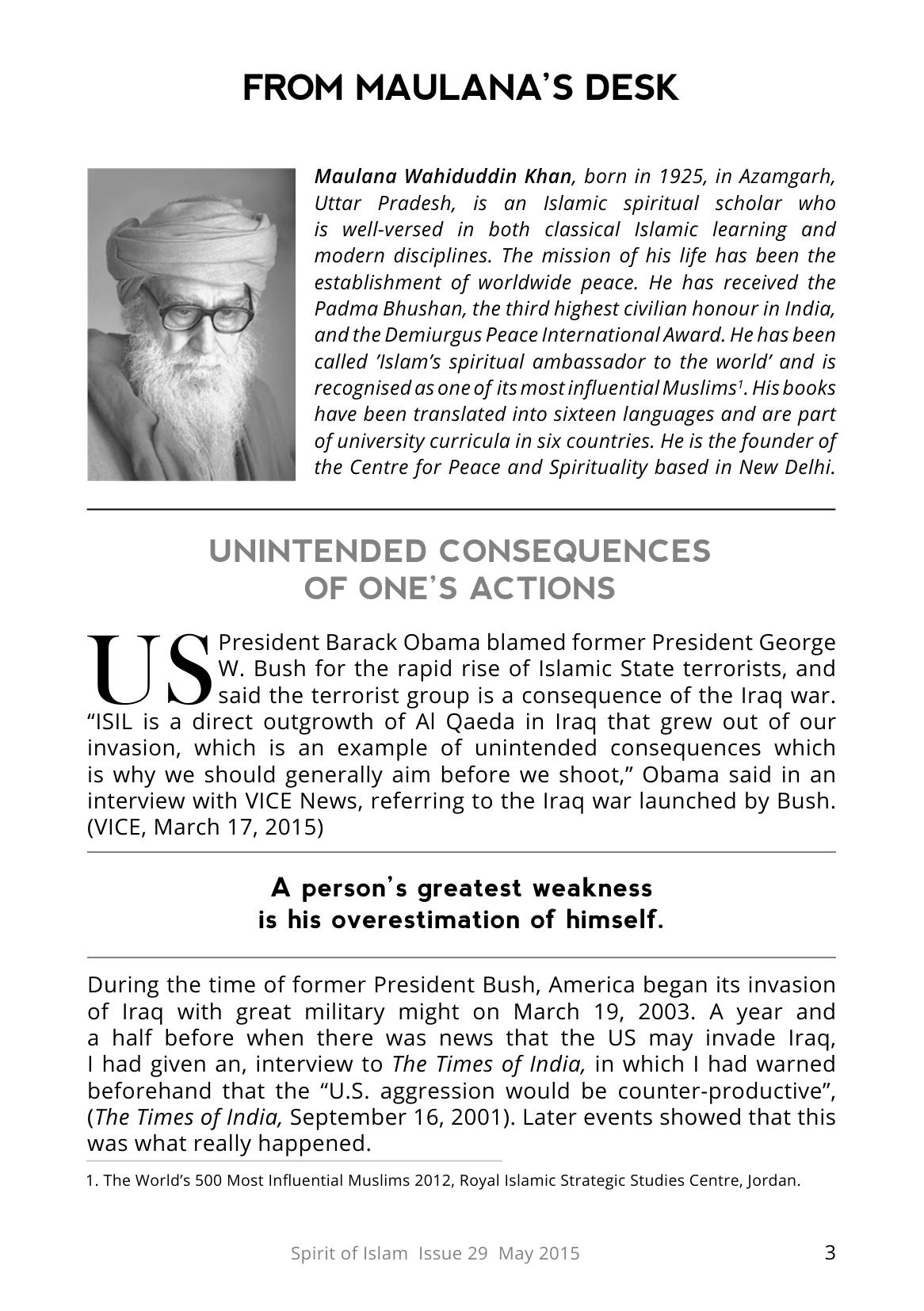
FROM MAULANA’S DESK 1. The World’s 500 Most Influential Muslims 2012, Royal Islamic Strategic Studies Centre, Jordan. Maulana Wahiduddin Khan, born in 1925, in Azamgarh, Uttar Pradesh, is an Islamic spiritual scholar who is well-versed in both classical Islamic learning and modern disciplines. The mission of his life has been the establishment of worldwide peace. He has received the Padma Bhushan, the third highest civilian honour in India, and the Demiurgus Peace International Award. He has been called ’Islam’s spiritual ambassador to the world’ and is recognised as one of its most influential Muslims1. His books have been translated into sixteen languages and are part of university curricula in six countries. He is the founder of the Centre for Peace and Spirituality based in New Delhi. US President Barack Obama blamed former President George W. Bush for the rapid rise of Islamic State terrorists, and said the terrorist group is a consequence of the Iraq war. “ISIL is a direct outgrowth of Al Qaeda in Iraq that grew out of our invasion, which is an example of unintended consequences which is why we should generally aim before we shoot,” Obama said in an interview with VICE News, referring to the Iraq war launched by Bush. (VICE, March 17, 2015) A person’s greatest weakness is his overestimation of himself. During the time of former President Bush, America began its invasion of Iraq with great military might on March 19, 2003. A year and a half before when there was news that the US may invade Iraq, I had given an, interview to The Times of India, in which I had warned beforehand that the “U.S. aggression would be counter-productive”, (The Times of India, September 16, 2001). Later events showed that this was what really happened. UNINTENDED CONSEQUENCES OF ONE’S ACTIONS
‹ Previous page Next page › About this issue Open in the reader