FROM MAULANA'S DESK
Spirit of Islam, Aug 2015, p. 3
By Maulana Wahiduddin Khan
Maulana Wahiduddin Khan is named as the default author of the periodical; a piece that carries another writer’s byline is credited to that writer.
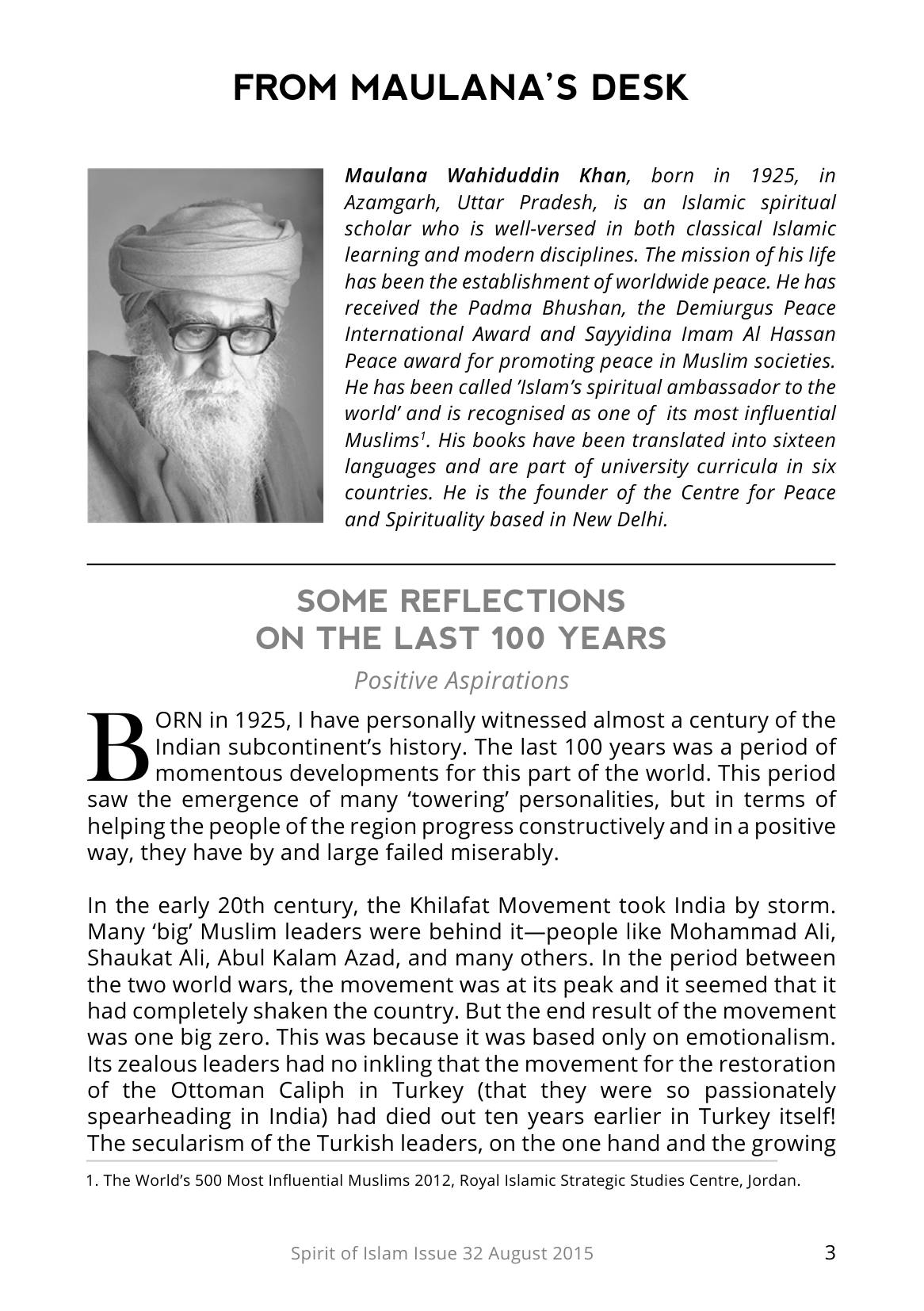
FROM MAULANA’S DESK 1. The World’s 500 Most Influential Muslims 2012, Royal Islamic Strategic Studies Centre, Jordan. Maulana Wahiduddin Khan, born in 1925, in Azamgarh, Uttar Pradesh, is an Islamic spiritual scholar who is well-versed in both classical Islamic learning and modern disciplines. The mission of his life has been the establishment of worldwide peace. He has received the Padma Bhushan, the Demiurgus Peace International Award and Sayyidina Imam Al Hassan Peace award for promoting peace in Muslim societies. He has been called ’Islam’s spiritual ambassador to the world’ and is recognised as one of its most influential Muslims1. His books have been translated into sixteen languages and are part of university curricula in six countries. He is the founder of the Centre for Peace and Spirituality based in New Delhi. BORN in 1925, I have personally witnessed almost a century of the Indian subcontinent’s history. The last 100 years was a period of momentous developments for this part of the world. This period saw the emergence of many ‘towering’ personalities, but in terms of helping the people of the region progress constructively and in a positive way, they have by and large failed miserably. In the early 20th century, the Khilafat Movement took India by storm. Many ‘big’ Muslim leaders were behind it—people like Mohammad Ali, Shaukat Ali, Abul Kalam Azad, and many others. In the period between the two world wars, the movement was at its peak and it seemed that it had completely shaken the country. But the end result of the movement was one big zero. This was because it was based only on emotionalism. Its zealous leaders had no inkling that the movement for the restoration of the Ottoman Caliph in Turkey (that they were so passionately spearheading in India) had died out ten years earlier in Turkey itself! The secularism of the Turkish leaders, on the one hand and the growing SOME REFLECTIONS ON THE LAST 100 YEARS Positive Aspirations
‹ Previous page Next page › About this issue Open in the reader