THE WORD OF GOD
Spirit of Islam, Sept 2015, p. 46
By Maulana Wahiduddin Khan
Maulana Wahiduddin Khan is named as the default author of the periodical; a piece that carries another writer’s byline is credited to that writer.
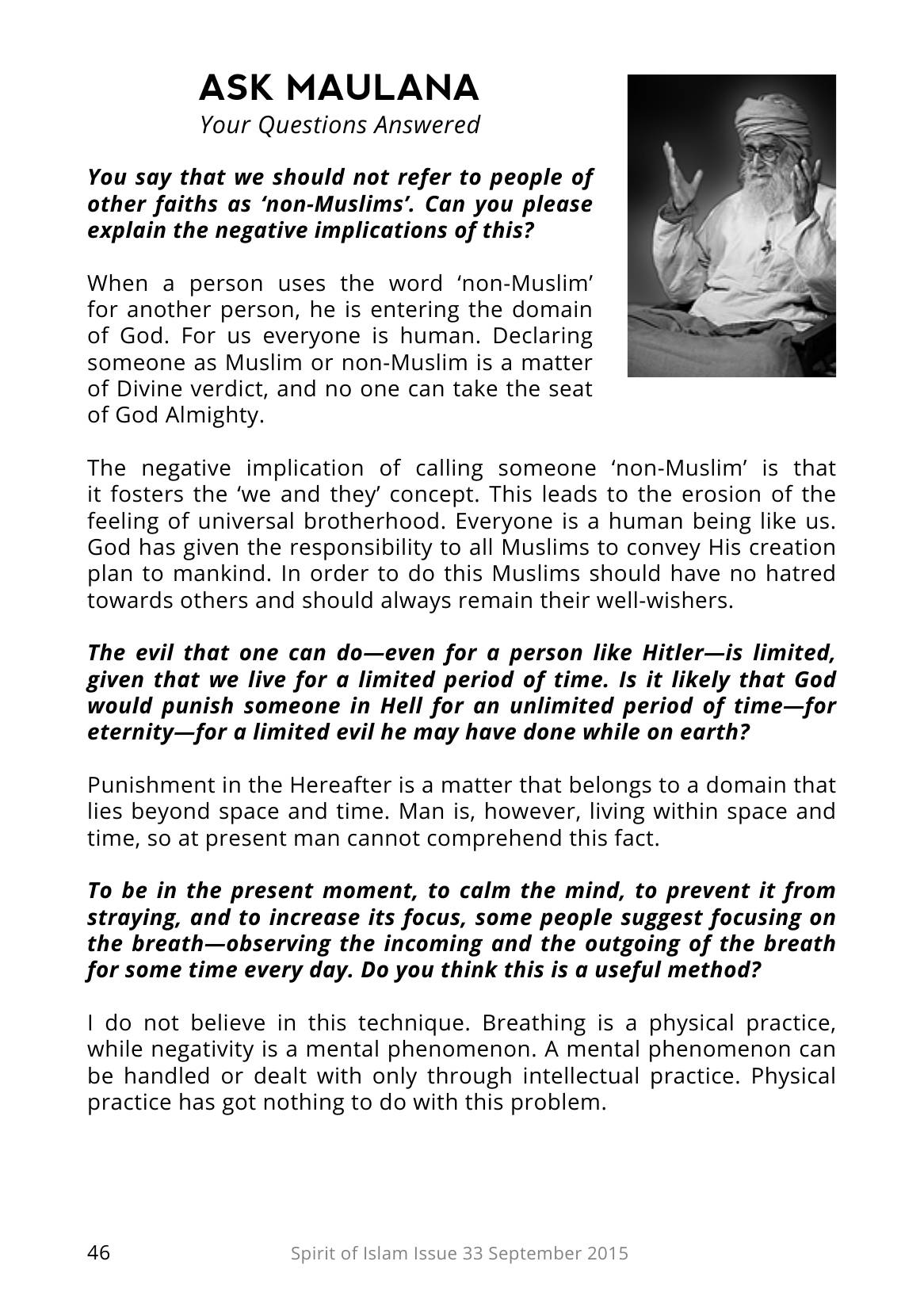
You say that we should not refer to people of other faiths as ‘non-Muslims’. Can you please explain the negative implications of this? When a person uses the word ‘non-Muslim’ for another person, he is entering the domain of God. For us everyone is human. Declaring someone as Muslim or non-Muslim is a matter of Divine verdict, and no one can take the seat of God Almighty. The negative implication of calling someone ‘non-Muslim’ is that it fosters the ‘we and they’ concept. This leads to the erosion of the feeling of universal brotherhood. Everyone is a human being like us. God has given the responsibility to all Muslims to convey His creation plan to mankind. In order to do this Muslims should have no hatred towards others and should always remain their well-wishers. The evil that one can do—even for a person like Hitler—is limited, given that we live for a limited period of time. Is it likely that God would punish someone in Hell for an unlimited period of time—for eternity—for a limited evil he may have done while on earth? Punishment in the Hereafter is a matter that belongs to a domain that lies beyond space and time. Man is, however, living within space and time, so at present man cannot comprehend this fact. To be in the present moment, to calm the mind, to prevent it from straying, and to increase its focus, some people suggest focusing on the breath—observing the incoming and the outgoing of the breath for some time every day. Do you think this is a useful method? I do not believe in this technique. Breathing is a physical practice, while negativity is a mental phenomenon. A mental phenomenon can be handled or dealt with only through intellectual practice. Physical practice has got nothing to do with this problem. ASK MAULANA Your Questions Answered
‹ Previous page Next page › About this issue Open in the reader