FROM MAULANA'S DESK
Spirit of Islam, Oct 2015, p. 3
By Maulana Wahiduddin Khan
Maulana Wahiduddin Khan is named as the default author of the periodical; a piece that carries another writer’s byline is credited to that writer.
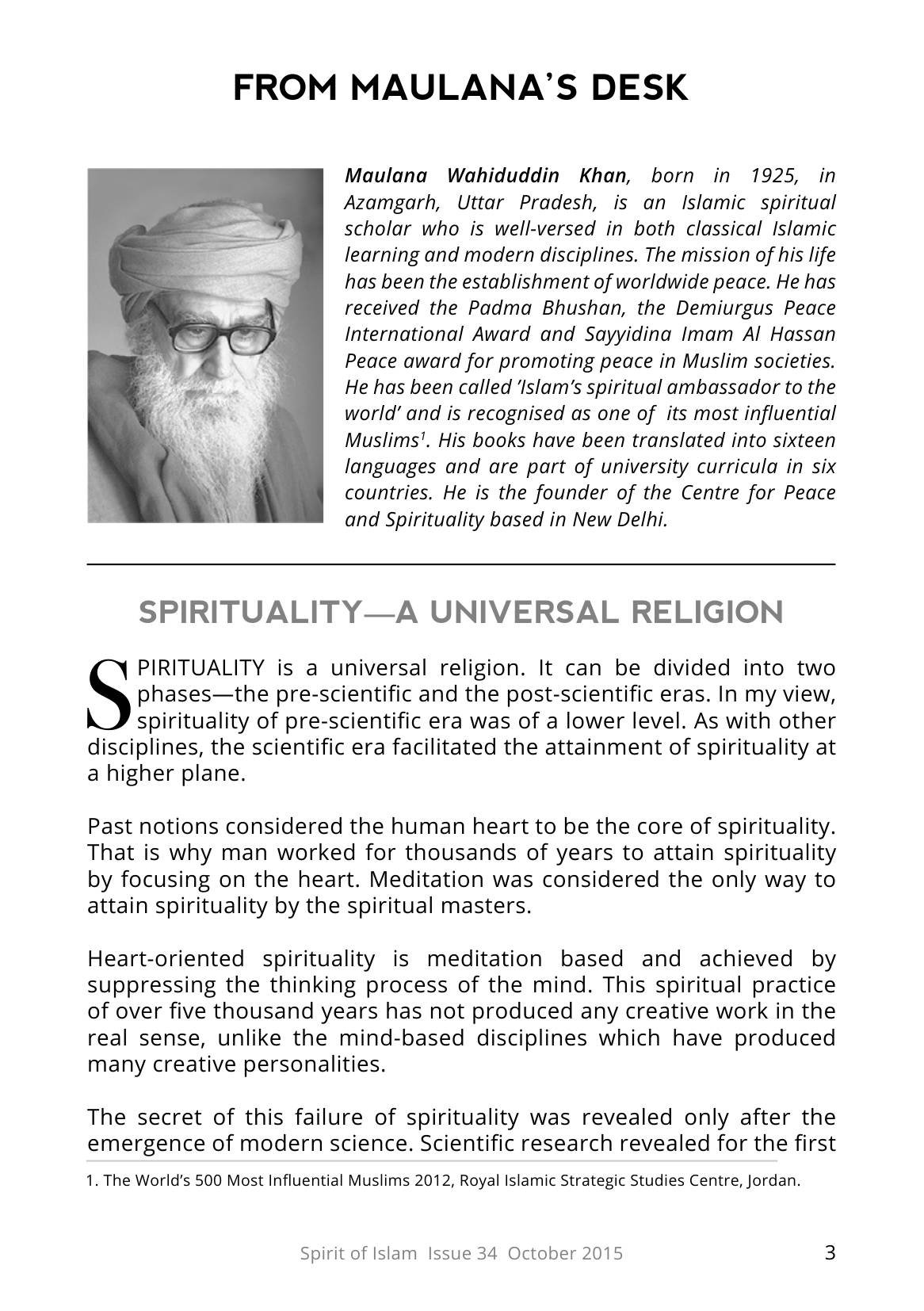
FROM MAULANA’S DESK 1. The World’s 500 Most Influential Muslims 2012, Royal Islamic Strategic Studies Centre, Jordan. Maulana Wahiduddin Khan, born in 1925, in Azamgarh, Uttar Pradesh, is an Islamic spiritual scholar who is well-versed in both classical Islamic learning and modern disciplines. The mission of his life has been the establishment of worldwide peace. He has received the Padma Bhushan, the Demiurgus Peace International Award and Sayyidina Imam Al Hassan Peace award for promoting peace in Muslim societies. He has been called ’Islam’s spiritual ambassador to the world’ and is recognised as one of its most influential Muslims1. His books have been translated into sixteen languages and are part of university curricula in six countries. He is the founder of the Centre for Peace and Spirituality based in New Delhi. S PIRITUALITY is a universal religion. It can be divided into two phases—the pre-scientific and the post-scientific eras. In my view, spirituality of pre-scientific era was of a lower level. As with other disciplines, the scientific era facilitated the attainment of spirituality at a higher plane. Past notions considered the human heart to be the core of spirituality. That is why man worked for thousands of years to attain spirituality by focusing on the heart. Meditation was considered the only way to attain spirituality by the spiritual masters. Heart-oriented spirituality is meditation based and achieved by suppressing the thinking process of the mind. This spiritual practice of over five thousand years has not produced any creative work in the real sense, unlike the mind-based disciplines which have produced many creative personalities. The secret of this failure of spirituality was revealed only after the emergence of modern science. Scientific research revealed for the first SPIRITUALITY—A UNIVERSAL RELIGION
‹ Previous page Next page › About this issue Open in the reader