FROM MAULANA'S DESK
Spirit of Islam, Feb 2016, p. 3
By Maulana Wahiduddin Khan
Maulana Wahiduddin Khan is named as the default author of the periodical; a piece that carries another writer’s byline is credited to that writer.
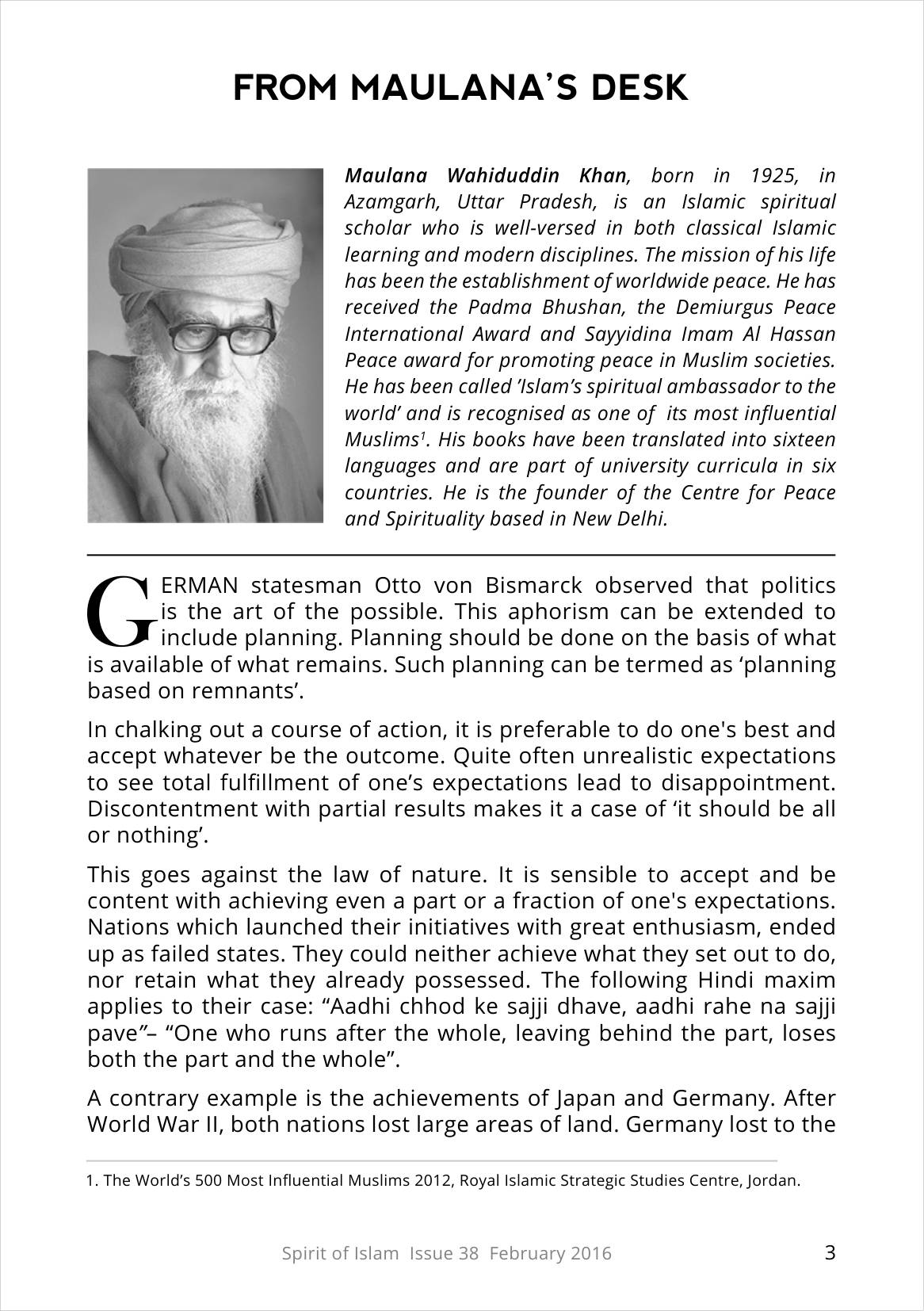
FROM MAULANA’S DESK 1. The World’s 500 Most Influential Muslims 2012, Royal Islamic Strategic Studies Centre, Jordan. Maulana Wahiduddin Khan, born in 1925, in Azamgarh, Uttar Pradesh, is an Islamic spiritual scholar who is well-versed in both classical Islamic learning and modern disciplines. The mission of his life has been the establishment of worldwide peace. He has received the Padma Bhushan, the Demiurgus Peace International Award and Sayyidina Imam Al Hassan Peace award for promoting peace in Muslim societies. He has been called ’Islam’s spiritual ambassador to the world’ and is recognised as one of its most influential Muslims1. His books have been translated into sixteen languages and are part of university curricula in six countries. He is the founder of the Centre for Peace and Spirituality based in New Delhi. GERMAN statesman Otto von Bismarck observed that politics is the art of the possible. This aphorism can be extended to include planning. Planning should be done on the basis of what is available of what remains. Such planning can be termed as ‘planning based on remnants’. In chalking out a course of action, it is preferable to do one's best and accept whatever be the outcome. Quite often unrealistic expectations to see total fulfillment of one’s expectations lead to disappointment. Discontentment with partial results makes it a case of ‘it should be all or nothing’. This goes against the law of nature. It is sensible to accept and be content with achieving even a part or a fraction of one's expectations. Nations which launched their initiatives with great enthusiasm, ended up as failed states. They could neither achieve what they set out to do, nor retain what they already possessed. The following Hindi maxim applies to their case: “Aadhi chhod ke sajji dhave, aadhi rahe na sajji pave”– “One who runs after the whole, leaving behind the part, loses both the part and the whole”. A contrary example is the achievements of Japan and Germany. After World War II, both nations lost large areas of land. Germany lost to the
‹ Previous page Next page › About this issue Open in the reader