FROM THE SPIRITUAL TREE
Spirit of Islam, Mar 2016, p. 14
By Maulana Wahiduddin Khan
Maulana Wahiduddin Khan is named as the default author of the periodical; a piece that carries another writer’s byline is credited to that writer.
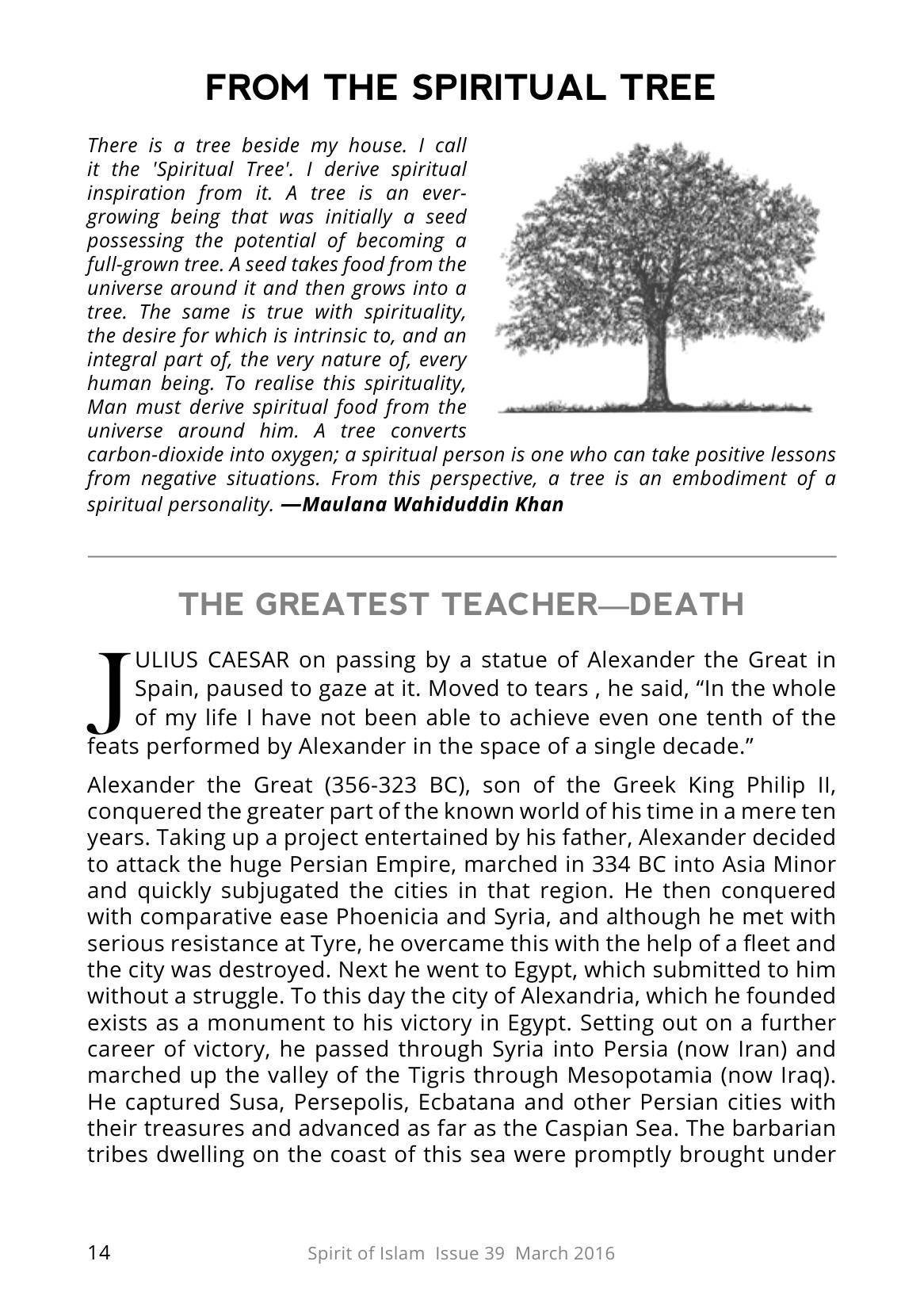
FROM THE SPIRITUAL TREE There is a tree beside my house. I call it the 'Spiritual Tree'. I derive spiritual inspiration from it. A tree is an evergrowing being that was initially a seed possessing the potential of becoming a full-grown tree. A seed takes food from the universe around it and then grows into a tree. The same is true with spirituality, the desire for which is intrinsic to, and an integral part of, the very nature of, every human being. To realise this spirituality, Man must derive spiritual food from the universe around him. A tree converts carbon-dioxide into oxygen; a spiritual person is one who can take positive lessons from negative situations. From this perspective, a tree is an embodiment of a spiritual personality. —Maulana Wahiduddin Khan THE GREATEST TEACHER—DEATH JULIUS CAESAR on passing by a statue of Alexander the Great in Spain, paused to gaze at it. Moved to tears , he said, “In the whole of my life I have not been able to achieve even one tenth of the feats performed by Alexander in the space of a single decade.” Alexander the Great (356-323 BC), son of the Greek King Philip II, conquered the greater part of the known world of his time in a mere ten years. Taking up a project entertained by his father, Alexander decided to attack the huge Persian Empire, marched in 334 BC into Asia Minor and quickly subjugated the cities in that region. He then conquered with comparative ease Phoenicia and Syria, and although he met with serious resistance at Tyre, he overcame this with the help of a fleet and the city was destroyed. Next he went to Egypt, which submitted to him without a struggle. To this day the city of Alexandria, which he founded exists as a monument to his victory in Egypt. Setting out on a further career of victory, he passed through Syria into Persia (now Iran) and marched up the valley of the Tigris through Mesopotamia (now Iraq). He captured Susa, Persepolis, Ecbatana and other Persian cities with their treasures and advanced as far as the Caspian Sea. The barbarian tribes dwelling on the coast of this sea were promptly brought under
‹ Previous page Next page › About this issue Open in the reader