FROM MAULANA’S DESK
Spirit of Islam, Apr 2016, p. 3
By Maulana Wahiduddin Khan
Maulana Wahiduddin Khan is named as the default author of the periodical; a piece that carries another writer’s byline is credited to that writer.
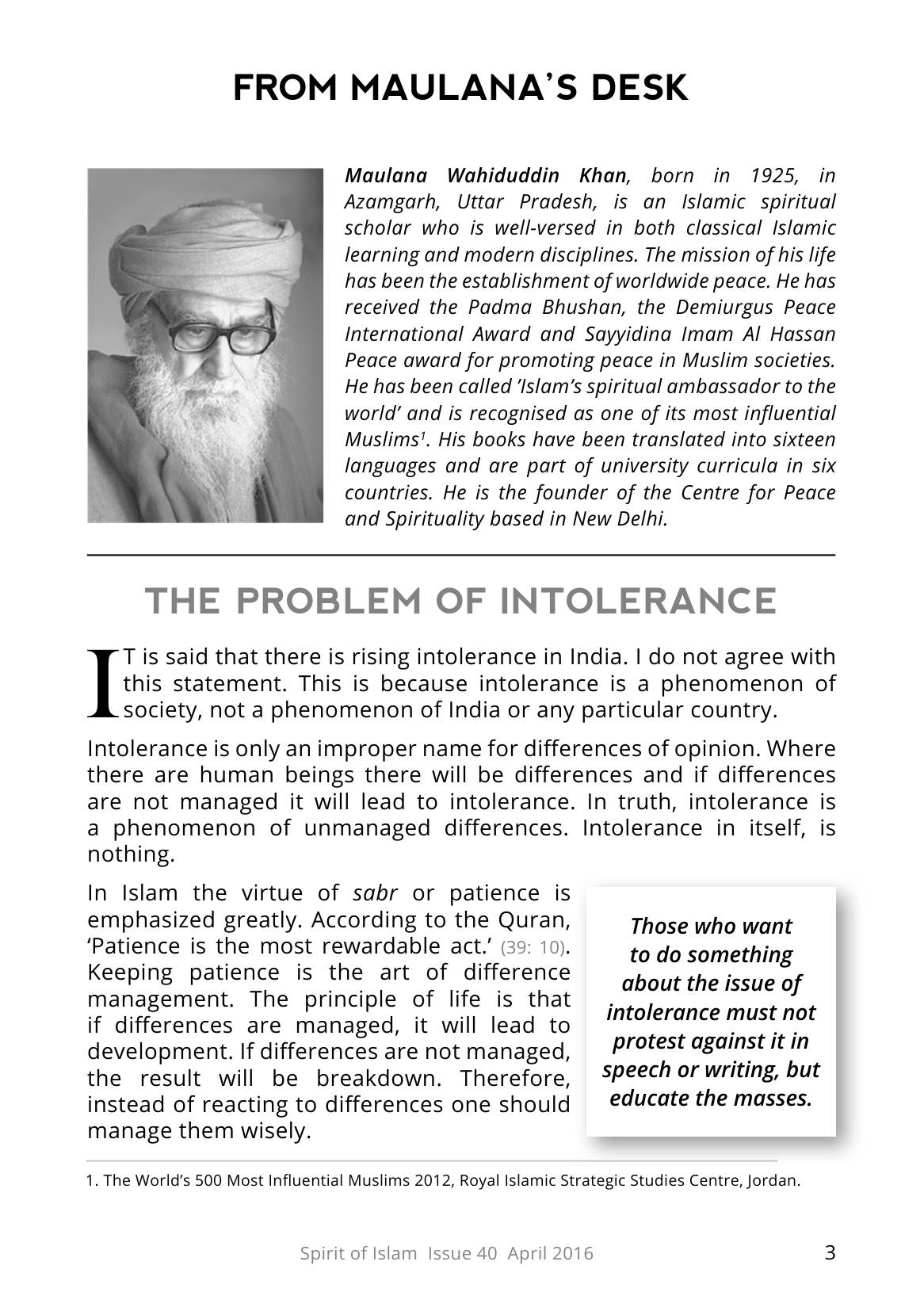
FROM MAULANA’S DESK 1. The World’s 500 Most Influential Muslims 2012, Royal Islamic Strategic Studies Centre, Jordan. Maulana Wahiduddin Khan, born in 1925, in Azamgarh, Uttar Pradesh, is an Islamic spiritual scholar who is well-versed in both classical Islamic learning and modern disciplines. The mission of his life has been the establishment of worldwide peace. He has received the Padma Bhushan, the Demiurgus Peace International Award and Sayyidina Imam Al Hassan Peace award for promoting peace in Muslim societies. He has been called ’Islam’s spiritual ambassador to the world’ and is recognised as one of its most influential Muslims1. His books have been translated into sixteen languages and are part of university curricula in six countries. He is the founder of the Centre for Peace and Spirituality based in New Delhi. I T is said that there is rising intolerance in India. I do not agree with this statement. This is because intolerance is a phenomenon of society, not a phenomenon of India or any particular country. Intolerance is only an improper name for differences of opinion. Where there are human beings there will be differences and if differences are not managed it will lead to intolerance. In truth, intolerance is a phenomenon of unmanaged differences. Intolerance in itself, is nothing. In Islam the virtue of sabr or patience is emphasized greatly. According to the Quran, ‘Patience is the most rewardable act.’ (39: 10). Keeping patience is the art of difference management. The principle of life is that if differences are managed, it will lead to development. If differences are not managed, the result will be breakdown. Therefore, instead of reacting to differences one should manage them wisely. Those who want to do something about the issue of intolerance must not protest against it in speech or writing, but educate the masses. THE PROBLEM OF INTOLERANCE
‹ Previous page Next page › About this issue Open in the reader