FROM MAULANA’S DESK
Spirit of Islam, June 2016, p. 3
By Maulana Wahiduddin Khan
Maulana Wahiduddin Khan is named as the default author of the periodical; a piece that carries another writer’s byline is credited to that writer.
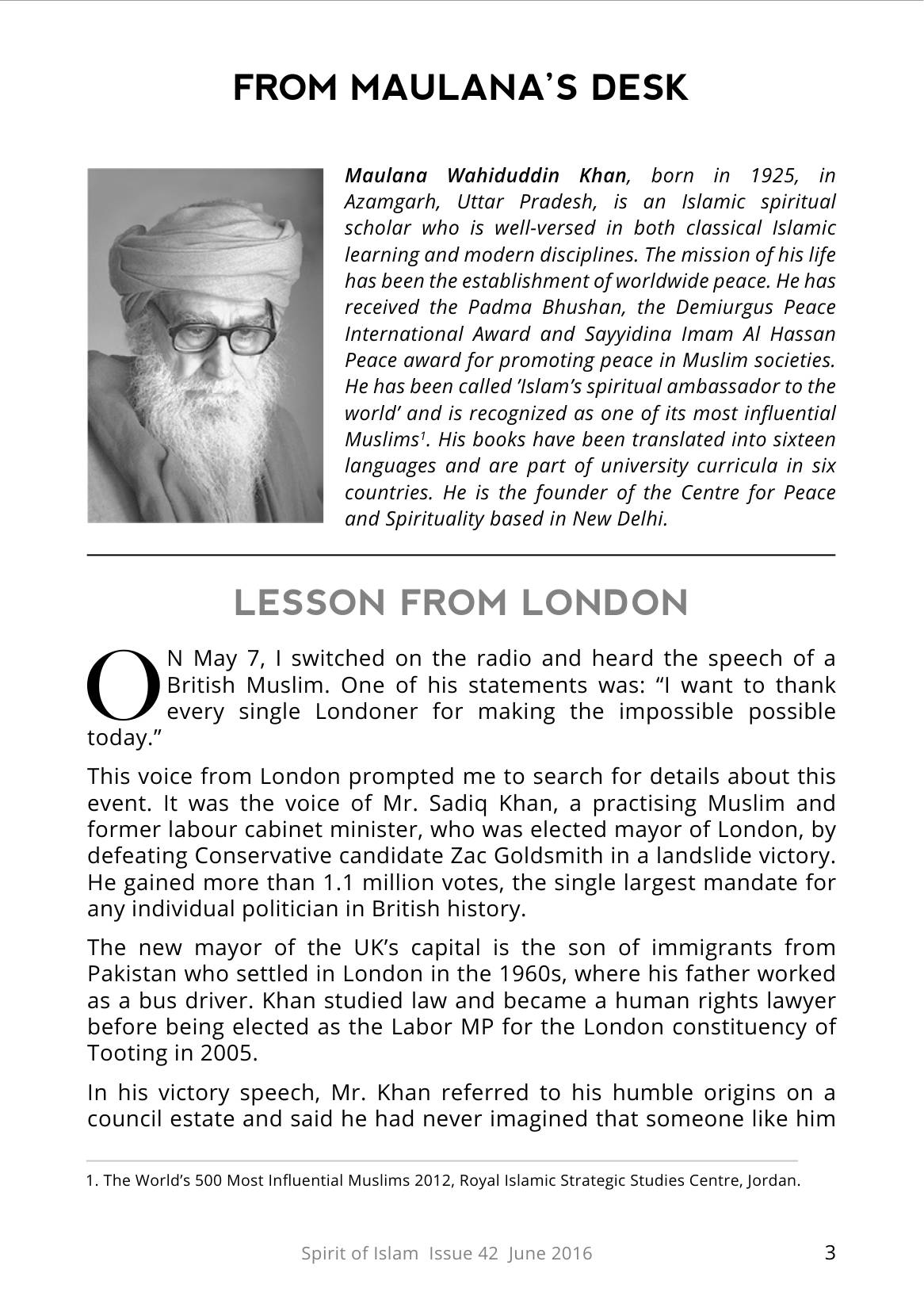
FROM MAULANA’S DESK 1. The World’s 500 Most Influential Muslims 2012, Royal Islamic Strategic Studies Centre, Jordan. Maulana Wahiduddin Khan, born in 1925, in Azamgarh, Uttar Pradesh, is an Islamic spiritual scholar who is well-versed in both classical Islamic learning and modern disciplines. The mission of his life has been the establishment of worldwide peace. He has received the Padma Bhushan, the Demiurgus Peace International Award and Sayyidina Imam Al Hassan Peace award for promoting peace in Muslim societies. He has been called ’Islam’s spiritual ambassador to the world’ and is recognized as one of its most influential Muslims1. His books have been translated into sixteen languages and are part of university curricula in six countries. He is the founder of the Centre for Peace and Spirituality based in New Delhi. LESSON FROM LONDON O N May 7, I switched on the radio and heard the speech of a British Muslim. One of his statements was: “I want to thank every single Londoner for making the impossible possible today.” This voice from London prompted me to search for details about this event. It was the voice of Mr. Sadiq Khan, a practising Muslim and former labour cabinet minister, who was elected mayor of London, by defeating Conservative candidate Zac Goldsmith in a landslide victory. He gained more than 1.1 million votes, the single largest mandate for any individual politician in British history. The new mayor of the UK’s capital is the son of immigrants from Pakistan who settled in London in the 1960s, where his father worked as a bus driver. Khan studied law and became a human rights lawyer before being elected as the Labor MP for the London constituency of Tooting in 2005. In his victory speech, Mr. Khan referred to his humble origins on a council estate and said he had never imagined that someone like him
‹ Previous page Next page › About this issue Open in the reader