FROM MAULANA’S DESK
Spirit of Islam, September 2016, p. 3
By Maulana Wahiduddin Khan
Maulana Wahiduddin Khan is named as the default author of the periodical; a piece that carries another writer’s byline is credited to that writer.
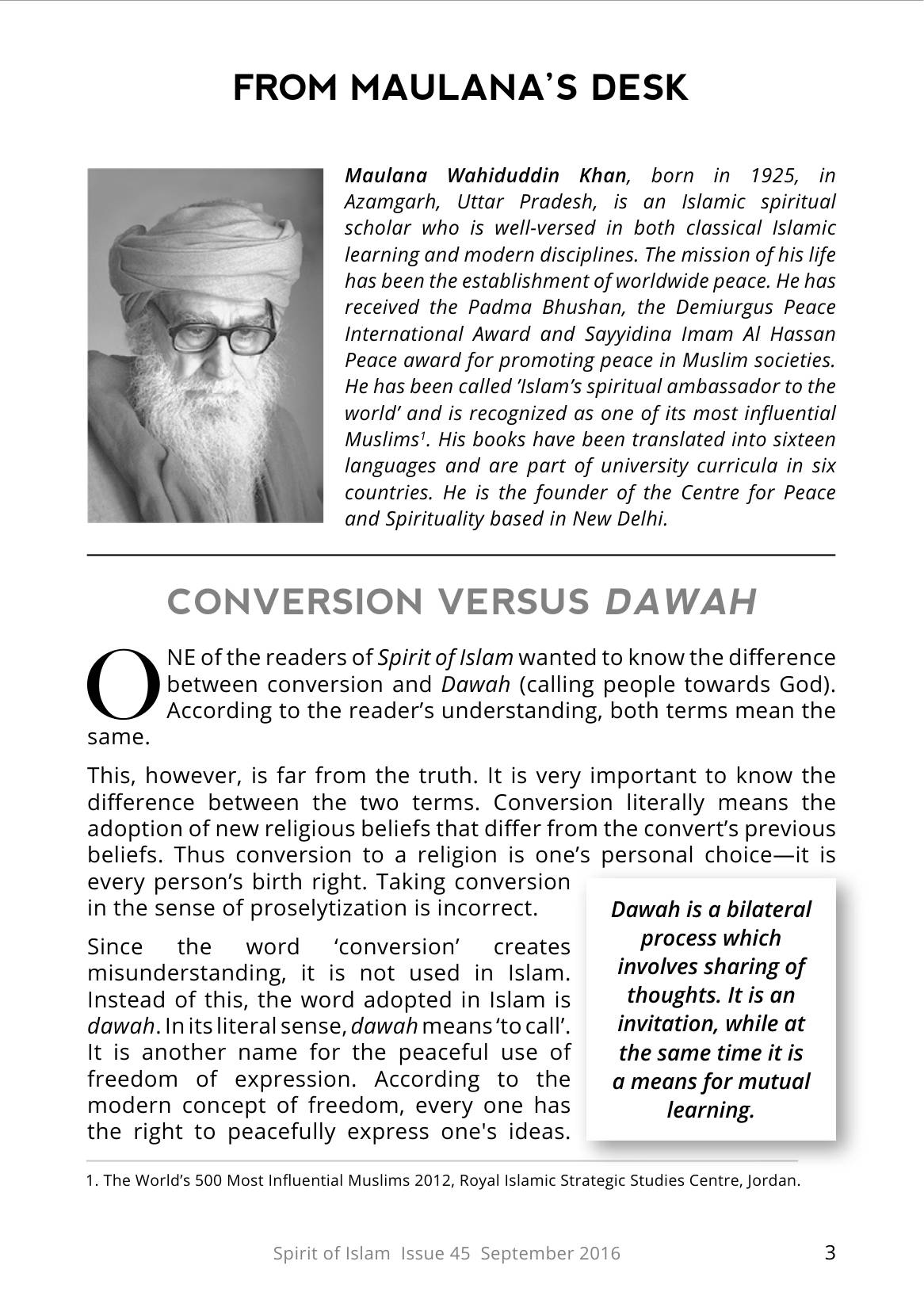
FROM MAULANA’S DESK Maulana Wahiduddin Khan, born in 1925, in Azamgarh, Uttar Pradesh, is an Islamic spiritual scholar who is well-versed in both classical Islamic learning and modern disciplines. The mission of his life has been the establishment of worldwide peace. He has received the Padma Bhushan, the Demiurgus Peace International Award and Sayyidina Imam Al Hassan Peace award for promoting peace in Muslim societies. He has been called ’Islam’s spiritual ambassador to the world’ and is recognized as one of its most influential Muslims1. His books have been translated into sixteen languages and are part of university curricula in six countries. He is the founder of the Centre for Peace and Spirituality based in New Delhi. CONVERSION VERSUS DAWAH 1. The World’s 500 Most Influential Muslims 2012, Royal Islamic Strategic Studies Centre, Jordan. O NE of the readers of Spirit of Islam wanted to know the difference between conversion and Dawah (calling people towards God). According to the reader’s understanding, both terms mean the same. This, however, is far from the truth. It is very important to know the difference between the two terms. Conversion literally means the adoption of new religious beliefs that differ from the convert’s previous beliefs. Thus conversion to a religion is one’s personal choice—it is every person’s birth right. Taking conversion in the sense of proselytization is incorrect. Since the word ‘conversion’ creates misunderstanding, it is not used in Islam. Instead of this, the word adopted in Islam is dawah. In its literal sense, dawah means ‘to call’. It is another name for the peaceful use of freedom of expression. According to the modern concept of freedom, every one has the right to peacefully express one's ideas. Dawah is a bilateral process which involves sharing of thoughts. It is an invitation, while at the same time it is a means for mutual learning.
‹ Previous page Next page › About this issue Open in the reader