FROM MAULANA’S DESK
Spirit of Islam, October 2016, p. 3
By Maulana Wahiduddin Khan
Maulana Wahiduddin Khan is named as the default author of the periodical; a piece that carries another writer’s byline is credited to that writer.
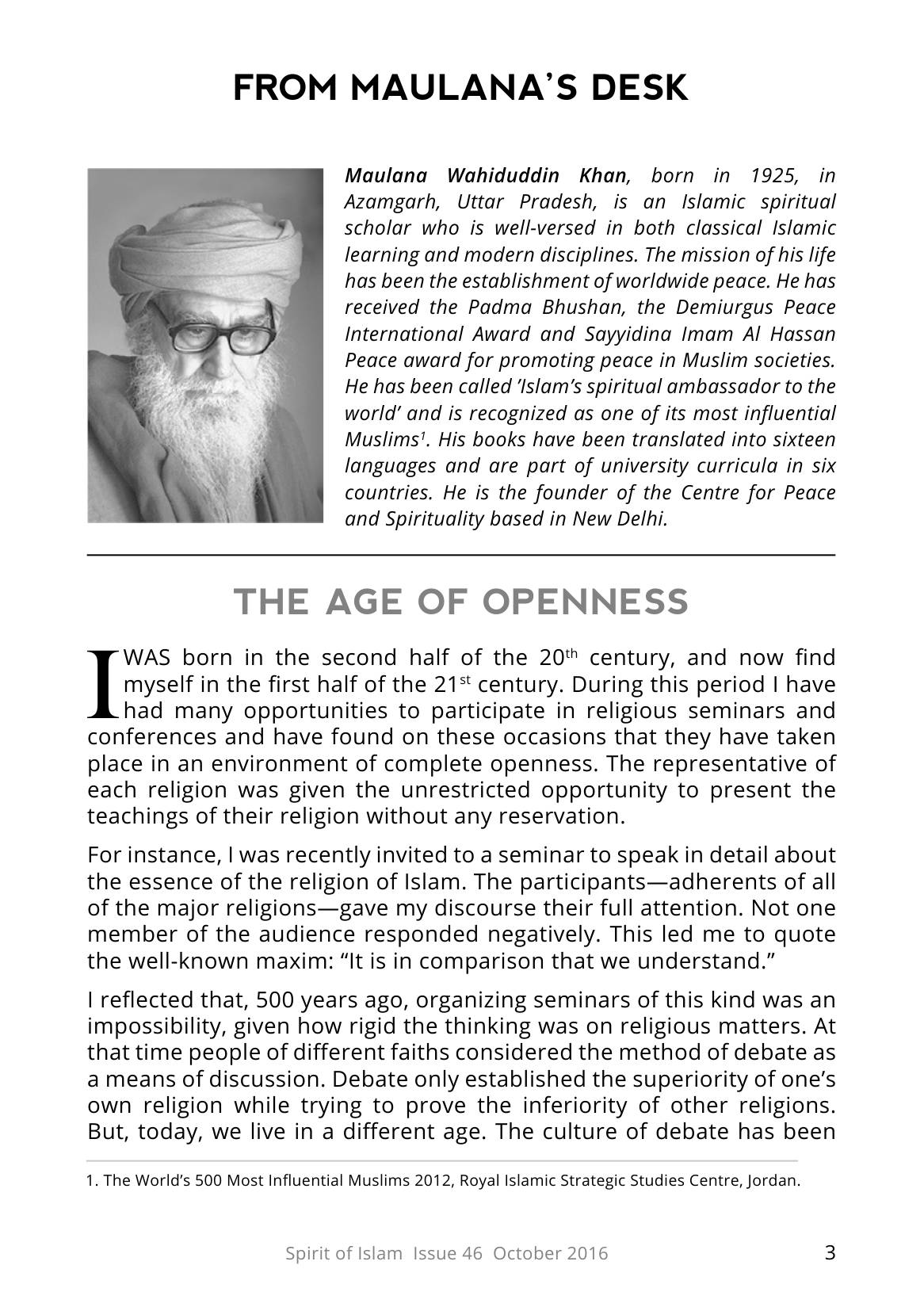
FROM MAULANA’S DESK Maulana Wahiduddin Khan, born in 1925, in Azamgarh, Uttar Pradesh, is an Islamic spiritual scholar who is well-versed in both classical Islamic learning and modern disciplines. The mission of his life has been the establishment of worldwide peace. He has received the Padma Bhushan, the Demiurgus Peace International Award and Sayyidina Imam Al Hassan Peace award for promoting peace in Muslim societies. He has been called ’Islam’s spiritual ambassador to the world’ and is recognized as one of its most influential Muslims1. His books have been translated into sixteen languages and are part of university curricula in six countries. He is the founder of the Centre for Peace and Spirituality based in New Delhi. THE AGE OF OPENNESS 1. The World’s 500 Most Influential Muslims 2012, Royal Islamic Strategic Studies Centre, Jordan. I WAS born in the second half of the 20th century, and now find myself in the first half of the 21st century. During this period I have had many opportunities to participate in religious seminars and conferences and have found on these occasions that they have taken place in an environment of complete openness. The representative of each religion was given the unrestricted opportunity to present the teachings of their religion without any reservation. For instance, I was recently invited to a seminar to speak in detail about the essence of the religion of Islam. The participants—adherents of all of the major religions—gave my discourse their full attention. Not one member of the audience responded negatively. This led me to quote the well-known maxim: “It is in comparison that we understand.” I reflected that, 500 years ago, organizing seminars of this kind was an impossibility, given how rigid the thinking was on religious matters. At that time people of different faiths considered the method of debate as a means of discussion. Debate only established the superiority of one’s own religion while trying to prove the inferiority of other religions. But, today, we live in a different age. The culture of debate has been
‹ Previous page Next page › About this issue Open in the reader