FROM MAULANA’S DESK
Spirit of Islam, December 2016, p. 3
By Maulana Wahiduddin Khan
Maulana Wahiduddin Khan is named as the default author of the periodical; a piece that carries another writer’s byline is credited to that writer.
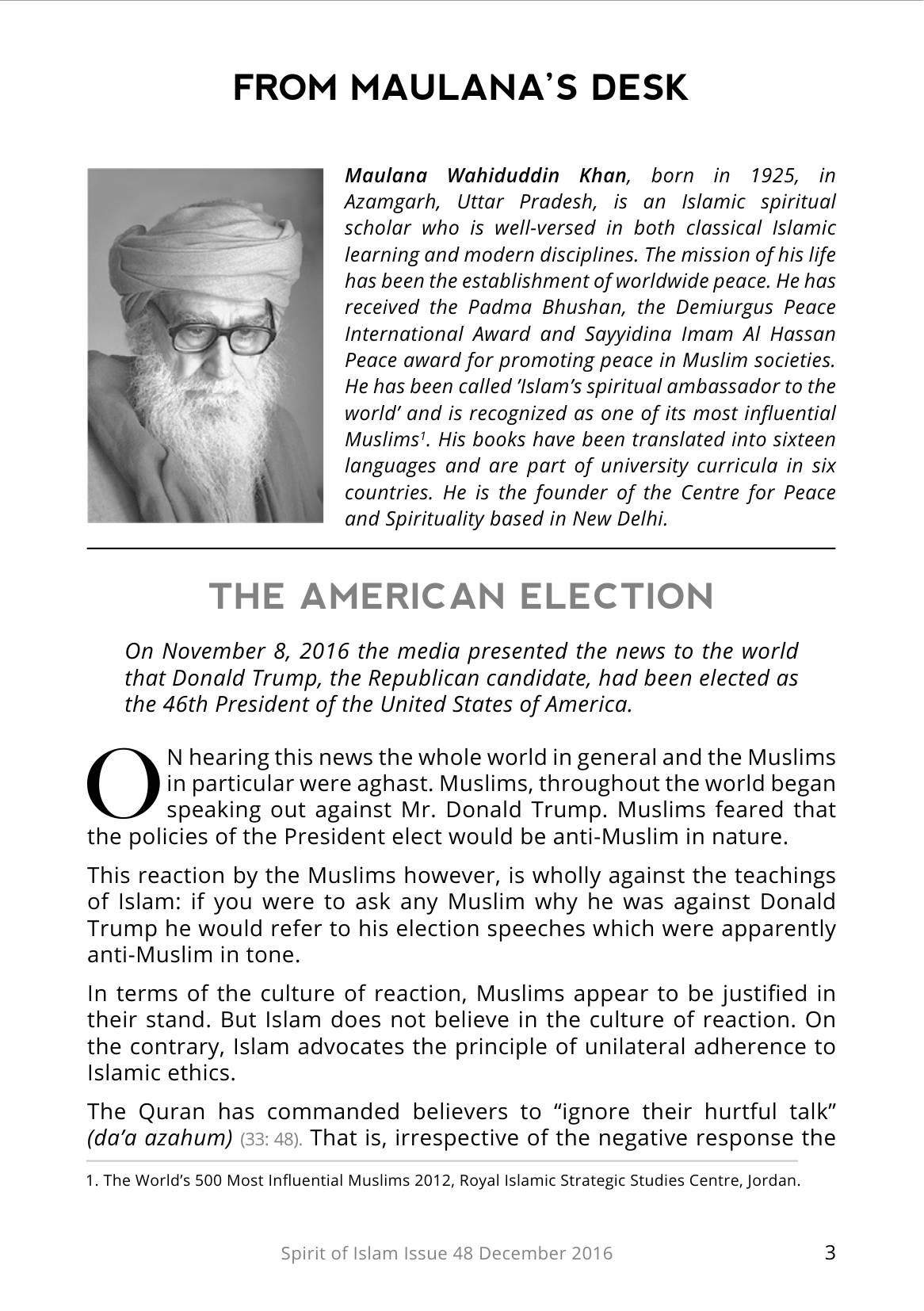
FROM MAULANA’S DESK 1. The World’s 500 Most Influential Muslims 2012, Royal Islamic Strategic Studies Centre, Jordan. Maulana Wahiduddin Khan, born in 1925, in Azamgarh, Uttar Pradesh, is an Islamic spiritual scholar who is well-versed in both classical Islamic learning and modern disciplines. The mission of his life has been the establishment of worldwide peace. He has received the Padma Bhushan, the Demiurgus Peace International Award and Sayyidina Imam Al Hassan Peace award for promoting peace in Muslim societies. He has been called ’Islam’s spiritual ambassador to the world’ and is recognized as one of its most influential Muslims1. His books have been translated into sixteen languages and are part of university curricula in six countries. He is the founder of the Centre for Peace and Spirituality based in New Delhi. THE AMERICAN ELECTION On November 8, 2016 the media presented the news to the world that Donald Trump, the Republican candidate, had been elected as the 46th President of the United States of America. O N hearing this news the whole world in general and the Muslims in particular were aghast. Muslims, throughout the world began speaking out against Mr. Donald Trump. Muslims feared that the policies of the President elect would be anti-Muslim in nature. This reaction by the Muslims however, is wholly against the teachings of Islam: if you were to ask any Muslim why he was against Donald Trump he would refer to his election speeches which were apparently anti-Muslim in tone. In terms of the culture of reaction, Muslims appear to be justified in their stand. But Islam does not believe in the culture of reaction. On the contrary, Islam advocates the principle of unilateral adherence to Islamic ethics. The Quran has commanded believers to “ignore their hurtful talk” (da’a azahum) (33: 48). That is, irrespective of the negative response the
‹ Previous page Next page › About this issue Open in the reader