ASK MAULANA
Spirit of Islam, Jan 2017, p. 44
By Maulana Wahiduddin Khan
Maulana Wahiduddin Khan is named as the default author of the periodical; a piece that carries another writer’s byline is credited to that writer.
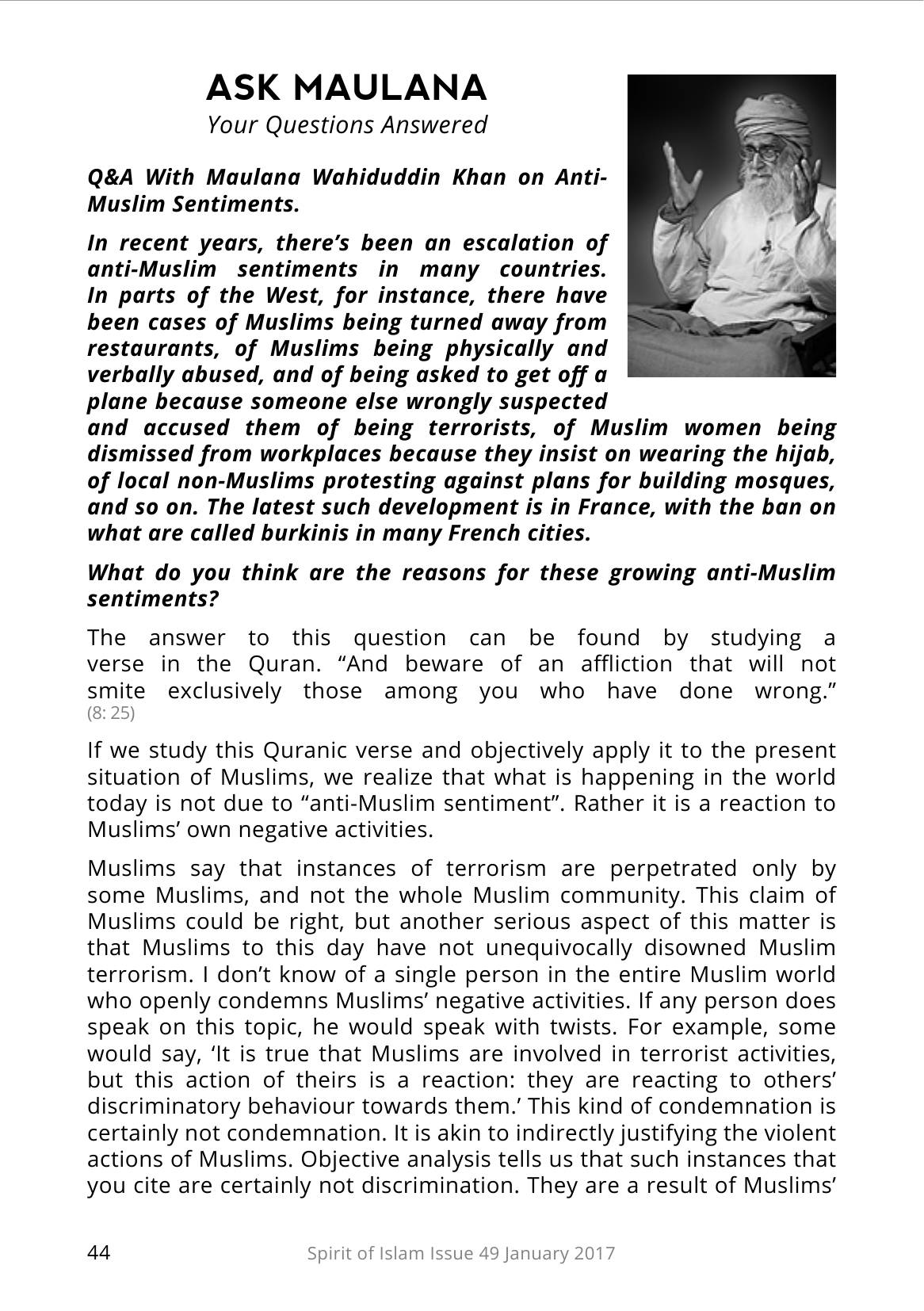
ASK MAULANA Your Questions Answered Q&A With Maulana Wahiduddin Khan on AntiMuslim Sentiments. In recent years, there’s been an escalation of anti-Muslim sentiments in many countries. In parts of the West, for instance, there have been cases of Muslims being turned away from restaurants, of Muslims being physically and verbally abused, and of being asked to get off a plane because someone else wrongly suspected and accused them of being terrorists, of Muslim women being dismissed from workplaces because they insist on wearing the hijab, of local non-Muslims protesting against plans for building mosques, and so on. The latest such development is in France, with the ban on what are called burkinis in many French cities. What do you think are the reasons for these growing anti-Muslim sentiments? The answer to this question can be found by studying a verse in the Quran. “And beware of an affliction that will not smite exclusively those among you who have done wrong.” (8: 25) If we study this Quranic verse and objectively apply it to the present situation of Muslims, we realize that what is happening in the world today is not due to “anti-Muslim sentiment”. Rather it is a reaction to Muslims’ own negative activities. Muslims say that instances of terrorism are perpetrated only by some Muslims, and not the whole Muslim community. This claim of Muslims could be right, but another serious aspect of this matter is that Muslims to this day have not unequivocally disowned Muslim terrorism. I don’t know of a single person in the entire Muslim world who openly condemns Muslims’ negative activities. If any person does speak on this topic, he would speak with twists. For example, some would say, ‘It is true that Muslims are involved in terrorist activities, but this action of theirs is a reaction: they are reacting to others’ discriminatory behaviour towards them.’ This kind of condemnation is certainly not condemnation. It is akin to indirectly justifying the violent actions of Muslims. Objective analysis tells us that such instances that you cite are certainly not discrimination. They are a result of Muslims’
‹ Previous page Next page › About this issue Open in the reader