ASK MAULANA
Spirit of Islam, Feb 2017, p. 45
By Maulana Wahiduddin Khan
Maulana Wahiduddin Khan is named as the default author of the periodical; a piece that carries another writer’s byline is credited to that writer.
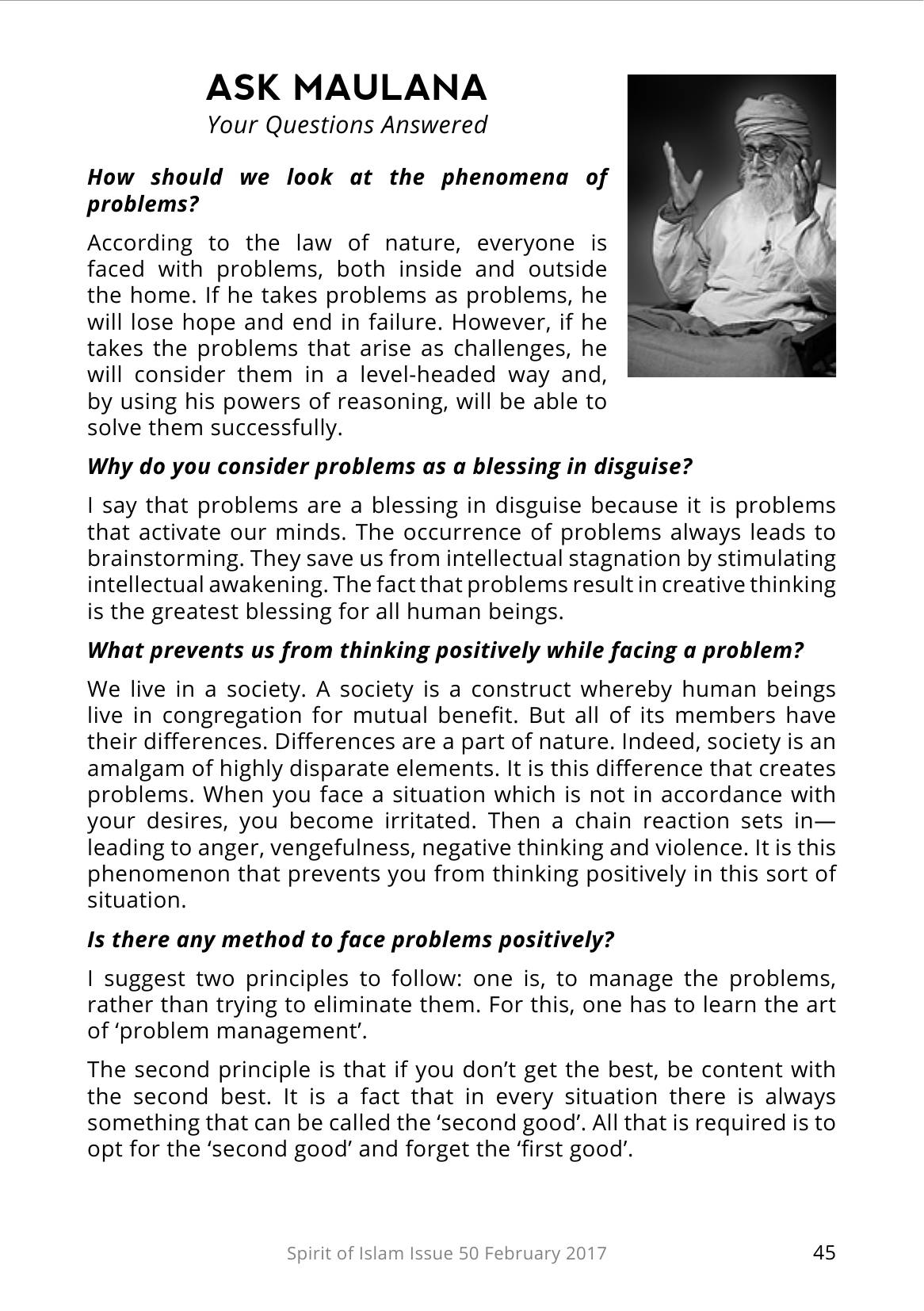
ASK MAULANA Your Questions Answered How should we look at the phenomena of problems? According to the law of nature, everyone is faced with problems, both inside and outside the home. If he takes problems as problems, he will lose hope and end in failure. However, if he takes the problems that arise as challenges, he will consider them in a level-headed way and, by using his powers of reasoning, will be able to solve them successfully. Why do you consider problems as a blessing in disguise? I say that problems are a blessing in disguise because it is problems that activate our minds. The occurrence of problems always leads to brainstorming. They save us from intellectual stagnation by stimulating intellectual awakening. The fact that problems result in creative thinking is the greatest blessing for all human beings. What prevents us from thinking positively while facing a problem? We live in a society. A society is a construct whereby human beings live in congregation for mutual benefit. But all of its members have their differences. Differences are a part of nature. Indeed, society is an amalgam of highly disparate elements. It is this difference that creates problems. When you face a situation which is not in accordance with your desires, you become irritated. Then a chain reaction sets in— leading to anger, vengefulness, negative thinking and violence. It is this phenomenon that prevents you from thinking positively in this sort of situation. Is there any method to face problems positively? I suggest two principles to follow: one is, to manage the problems, rather than trying to eliminate them. For this, one has to learn the art of ‘problem management’. The second principle is that if you don’t get the best, be content with the second best. It is a fact that in every situation there is always something that can be called the ‘second good’. All that is required is to opt for the ‘second good’ and forget the ‘first good’.
‹ Previous page Next page › About this issue Open in the reader