ASK MAULANA
Spirit of Islam, Mar 2017, p. 44
By Maulana Wahiduddin Khan
Maulana Wahiduddin Khan is named as the default author of the periodical; a piece that carries another writer’s byline is credited to that writer.
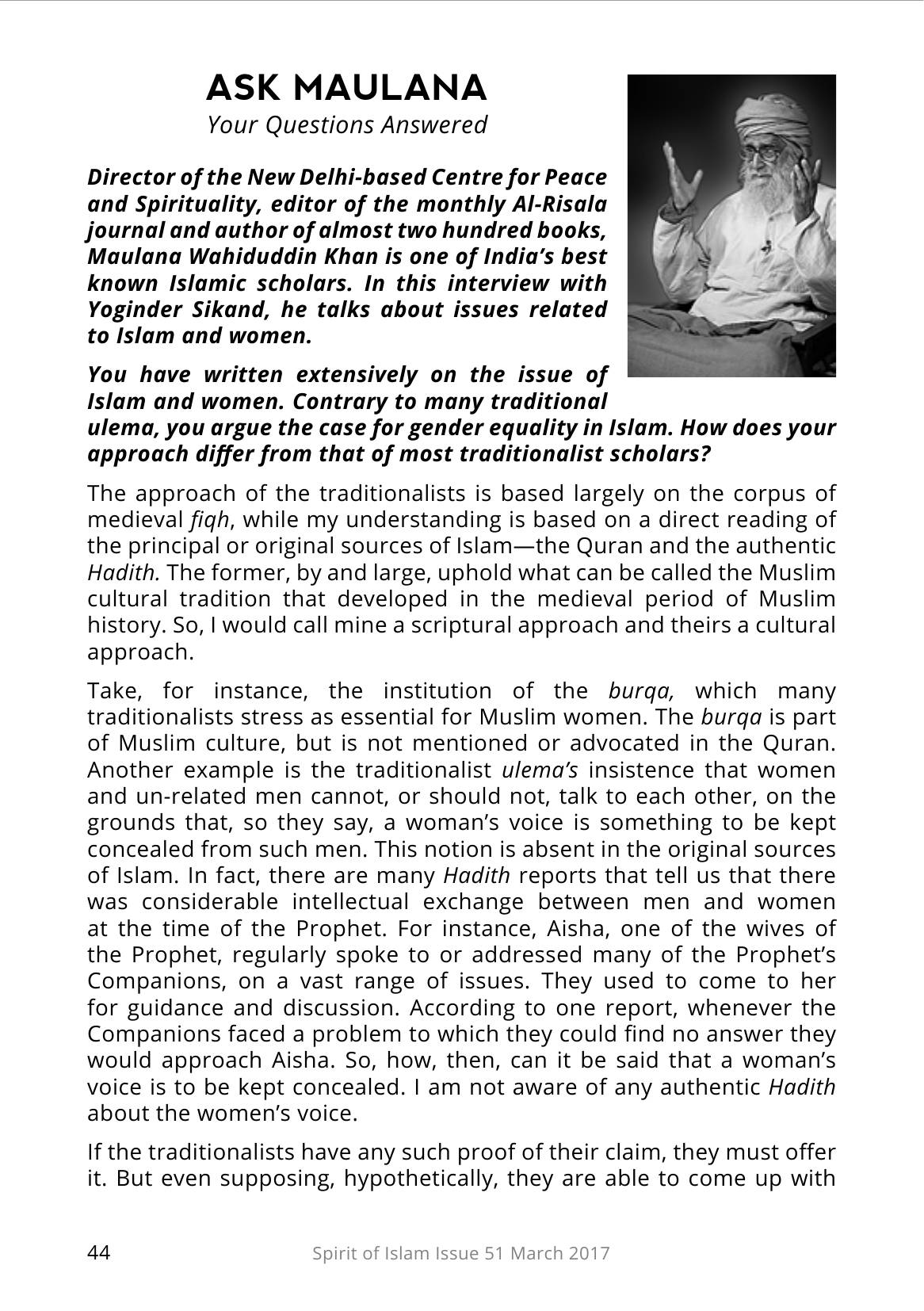
ASK MAULANA Your Questions Answered Director of the New Delhi-based Centre for Peace and Spirituality, editor of the monthly Al-Risala journal and author of almost two hundred books, Maulana Wahiduddin Khan is one of India’s best known Islamic scholars. In this interview with Yoginder Sikand, he talks about issues related to Islam and women. You have written extensively on the issue of Islam and women. Contrary to many traditional ulema, you argue the case for gender equality in Islam. How does your approach differ from that of most traditionalist scholars? The approach of the traditionalists is based largely on the corpus of medieval fiqh, while my understanding is based on a direct reading of the principal or original sources of Islam—the Quran and the authentic Hadith. The former, by and large, uphold what can be called the Muslim cultural tradition that developed in the medieval period of Muslim history. So, I would call mine a scriptural approach and theirs a cultural approach. Take, for instance, the institution of the burqa, which many traditionalists stress as essential for Muslim women. The burqa is part of Muslim culture, but is not mentioned or advocated in the Quran. Another example is the traditionalist ulema’s insistence that women and un-related men cannot, or should not, talk to each other, on the grounds that, so they say, a woman’s voice is something to be kept concealed from such men. This notion is absent in the original sources of Islam. In fact, there are many Hadith reports that tell us that there was considerable intellectual exchange between men and women at the time of the Prophet. For instance, Aisha, one of the wives of the Prophet, regularly spoke to or addressed many of the Prophet’s Companions, on a vast range of issues. They used to come to her for guidance and discussion. According to one report, whenever the Companions faced a problem to which they could find no answer they would approach Aisha. So, how, then, can it be said that a woman’s voice is to be kept concealed. I am not aware of any authentic Hadith about the women’s voice. If the traditionalists have any such proof of their claim, they must offer it. But even supposing, hypothetically, they are able to come up with
‹ Previous page Next page › About this issue Open in the reader