FROM MAULANA’S DESK
Spirit of Islam, May 2017, p. 3
By Maulana Wahiduddin Khan
Maulana Wahiduddin Khan is named as the default author of the periodical; a piece that carries another writer’s byline is credited to that writer.
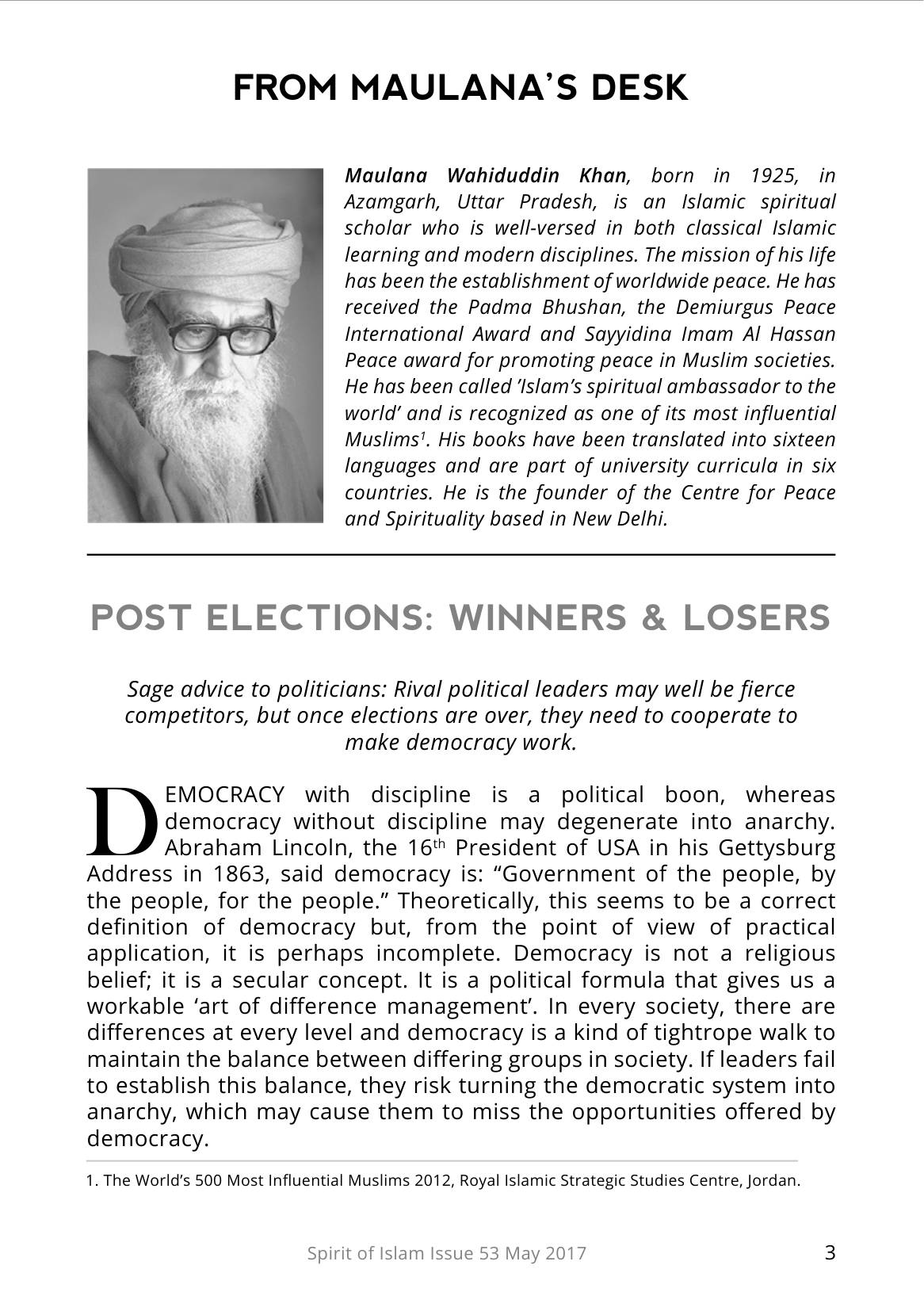
FROM MAULANA’S DESK 1. The World’s 500 Most Influential Muslims 2012, Royal Islamic Strategic Studies Centre, Jordan. Maulana Wahiduddin Khan, born in 1925, in Azamgarh, Uttar Pradesh, is an Islamic spiritual scholar who is well-versed in both classical Islamic learning and modern disciplines. The mission of his life has been the establishment of worldwide peace. He has received the Padma Bhushan, the Demiurgus Peace International Award and Sayyidina Imam Al Hassan Peace award for promoting peace in Muslim societies. He has been called ’Islam’s spiritual ambassador to the world’ and is recognized as one of its most influential Muslims1. His books have been translated into sixteen languages and are part of university curricula in six countries. He is the founder of the Centre for Peace and Spirituality based in New Delhi. POST ELECTIONS: WINNERS & LOSERS Sage advice to politicians: Rival political leaders may well be fierce competitors, but once elections are over, they need to cooperate to make democracy work. DEMOCRACY with discipline is a political boon, whereas democracy without discipline may degenerate into anarchy. Abraham Lincoln, the 16th President of USA in his Gettysburg Address in 1863, said democracy is: “Government of the people, by the people, for the people.” Theoretically, this seems to be a correct definition of democracy but, from the point of view of practical application, it is perhaps incomplete. Democracy is not a religious belief; it is a secular concept. It is a political formula that gives us a workable ‘art of difference management’. In every society, there are differences at every level and democracy is a kind of tightrope walk to maintain the balance between differing groups in society. If leaders fail to establish this balance, they risk turning the democratic system into anarchy, which may cause them to miss the opportunities offered by democracy.
‹ Previous page Next page › About this issue Open in the reader