ASK MAULANA
Spirit of Islam, June 2017, p. 45
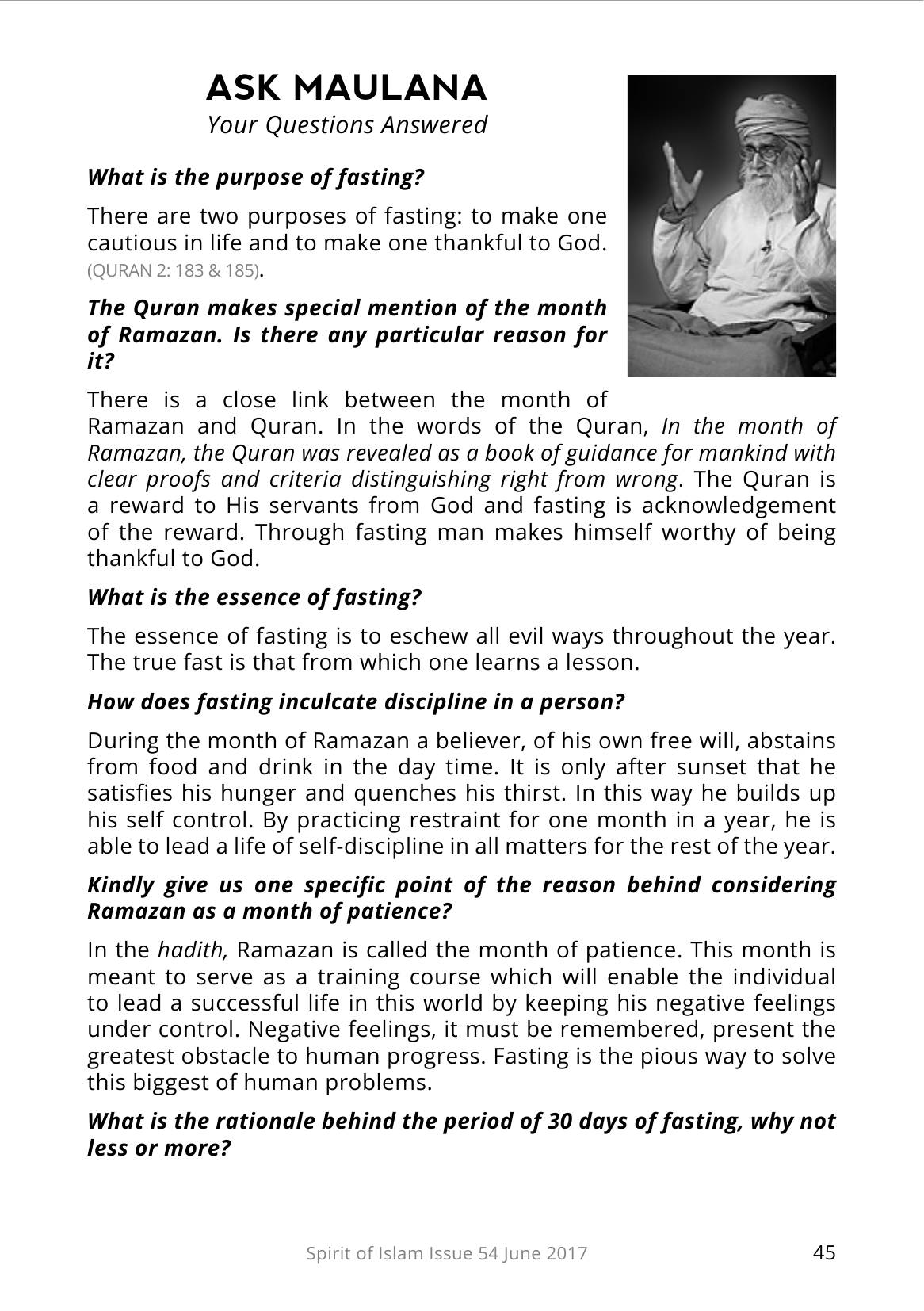
By Maulana Wahiduddin Khan
Maulana Wahiduddin Khan is named as the default author of the periodical; a piece that carries another writer’s byline is credited to that writer.
ASK MAULANA Your Questions Answered What is the purpose of fasting? There are two purposes of fasting: to make one cautious in life and to make one thankful to God. (QURAN 2: 183 & 185). The Quran makes special mention of the month of Ramazan. Is there any particular reason for it? There is a close link between the month of Ramazan and Quran. In the words of the Quran, In the month of Ramazan, the Quran was revealed as a book of guidance for mankind with clear proofs and criteria distinguishing right from wrong. The Quran is a reward to His servants from God and fasting is acknowledgement of the reward. Through fasting man makes himself worthy of being thankful to God. What is the essence of fasting? The essence of fasting is to eschew all evil ways throughout the year. The true fast is that from which one learns a lesson. How does fasting inculcate discipline in a person? During the month of Ramazan a believer, of his own free will, abstains from food and drink in the day time. It is only after sunset that he satisfies his hunger and quenches his thirst. In this way he builds up his self control. By practicing restraint for one month in a year, he is able to lead a life of self-discipline in all matters for the rest of the year. Kindly give us one specific point of the reason behind considering Ramazan as a month of patience? In the hadith, Ramazan is called the month of patience. This month is meant to serve as a training course which will enable the individual to lead a successful life in this world by keeping his negative feelings under control. Negative feelings, it must be remembered, present the greatest obstacle to human progress. Fasting is the pious way to solve this biggest of human problems. What is the rationale behind the period of 30 days of fasting, why not less or more?
‹ Previous page Next page › About this issue Open in the reader