FROM MAULANA’S DESK
Spirit of Islam, Nov 2017, p. 3
By Maulana Wahiduddin Khan
Maulana Wahiduddin Khan is named as the default author of the periodical; a piece that carries another writer’s byline is credited to that writer.
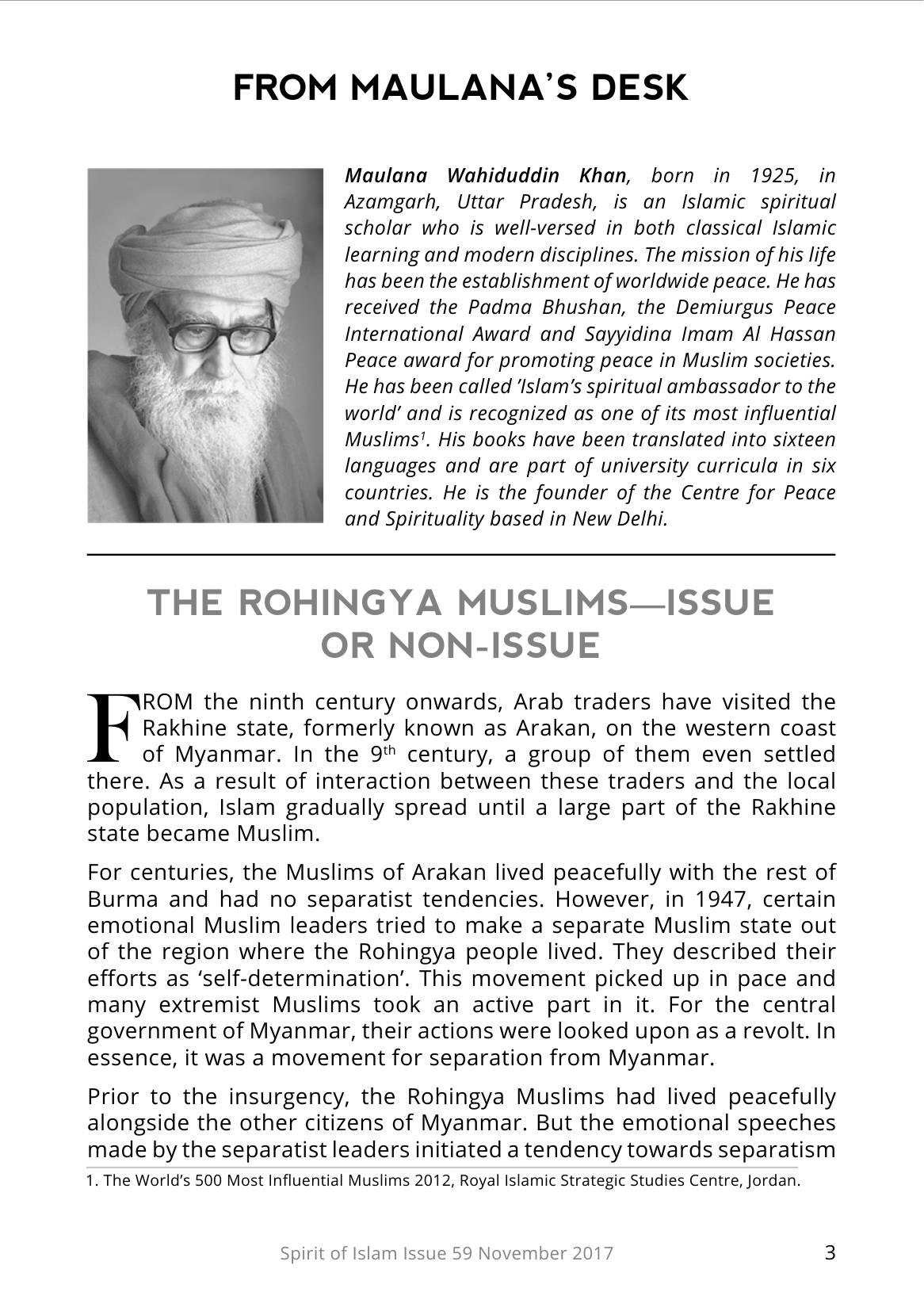
FROM MAULANA’S DESK 1. The World’s 500 Most Influential Muslims 2012, Royal Islamic Strategic Studies Centre, Jordan. Maulana Wahiduddin Khan, born in 1925, in Azamgarh, Uttar Pradesh, is an Islamic spiritual scholar who is well-versed in both classical Islamic learning and modern disciplines. The mission of his life has been the establishment of worldwide peace. He has received the Padma Bhushan, the Demiurgus Peace International Award and Sayyidina Imam Al Hassan Peace award for promoting peace in Muslim societies. He has been called ’Islam’s spiritual ambassador to the world’ and is recognized as one of its most influential Muslims1. His books have been translated into sixteen languages and are part of university curricula in six countries. He is the founder of the Centre for Peace and Spirituality based in New Delhi. THE ROHINGYA MUSLIMS—ISSUE OR NON-ISSUE F ROM the ninth century onwards, Arab traders have visited the Rakhine state, formerly known as Arakan, on the western coast of Myanmar. In the 9th century, a group of them even settled there. As a result of interaction between these traders and the local population, Islam gradually spread until a large part of the Rakhine state became Muslim. For centuries, the Muslims of Arakan lived peacefully with the rest of Burma and had no separatist tendencies. However, in 1947, certain emotional Muslim leaders tried to make a separate Muslim state out of the region where the Rohingya people lived. They described their efforts as ‘self-determination’. This movement picked up in pace and many extremist Muslims took an active part in it. For the central government of Myanmar, their actions were looked upon as a revolt. In essence, it was a movement for separation from Myanmar. Prior to the insurgency, the Rohingya Muslims had lived peacefully alongside the other citizens of Myanmar. But the emotional speeches made by the separatist leaders initiated a tendency towards separatism
‹ Previous page Next page › About this issue Open in the reader