FROM MAULANA’S DESK
Spirit of Islam, Dec 2017, p. 3
By Maulana Wahiduddin Khan
Maulana Wahiduddin Khan is named as the default author of the periodical; a piece that carries another writer’s byline is credited to that writer.
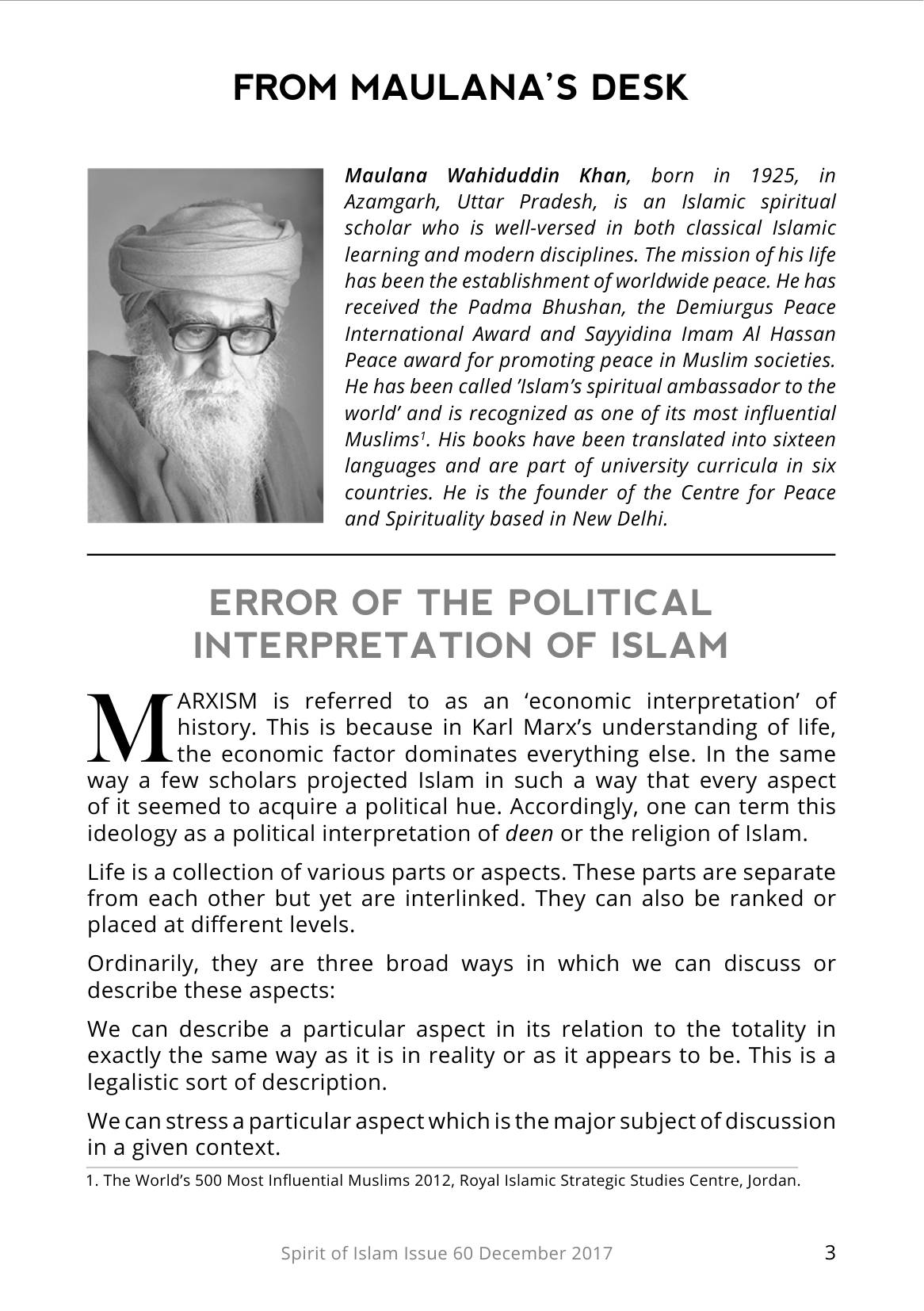
FROM MAULANA’S DESK 1. The World’s 500 Most Influential Muslims 2012, Royal Islamic Strategic Studies Centre, Jordan. Maulana Wahiduddin Khan, born in 1925, in Azamgarh, Uttar Pradesh, is an Islamic spiritual scholar who is well-versed in both classical Islamic learning and modern disciplines. The mission of his life has been the establishment of worldwide peace. He has received the Padma Bhushan, the Demiurgus Peace International Award and Sayyidina Imam Al Hassan Peace award for promoting peace in Muslim societies. He has been called ’Islam’s spiritual ambassador to the world’ and is recognized as one of its most influential Muslims1. His books have been translated into sixteen languages and are part of university curricula in six countries. He is the founder of the Centre for Peace and Spirituality based in New Delhi. ERROR OF THE POLITICAL INTERPRETATION OF ISLAM MARXISM is referred to as an ‘economic interpretation’ of history. This is because in Karl Marx’s understanding of life, the economic factor dominates everything else. In the same way a few scholars projected Islam in such a way that every aspect of it seemed to acquire a political hue. Accordingly, one can term this ideology as a political interpretation of deen or the religion of Islam. Life is a collection of various parts or aspects. These parts are separate from each other but yet are interlinked. They can also be ranked or placed at different levels. Ordinarily, they are three broad ways in which we can discuss or describe these aspects: We can describe a particular aspect in its relation to the totality in exactly the same way as it is in reality or as it appears to be. This is a legalistic sort of description. We can stress a particular aspect which is the major subject of discussion in a given context.
‹ Previous page Next page › About this issue Open in the reader