FROM THE SPIRITUAL TREE
Spirit of Islam, January 2018, p. 24
By Maulana Wahiduddin Khan
Maulana Wahiduddin Khan is named as the default author of the periodical; a piece that carries another writer’s byline is credited to that writer.
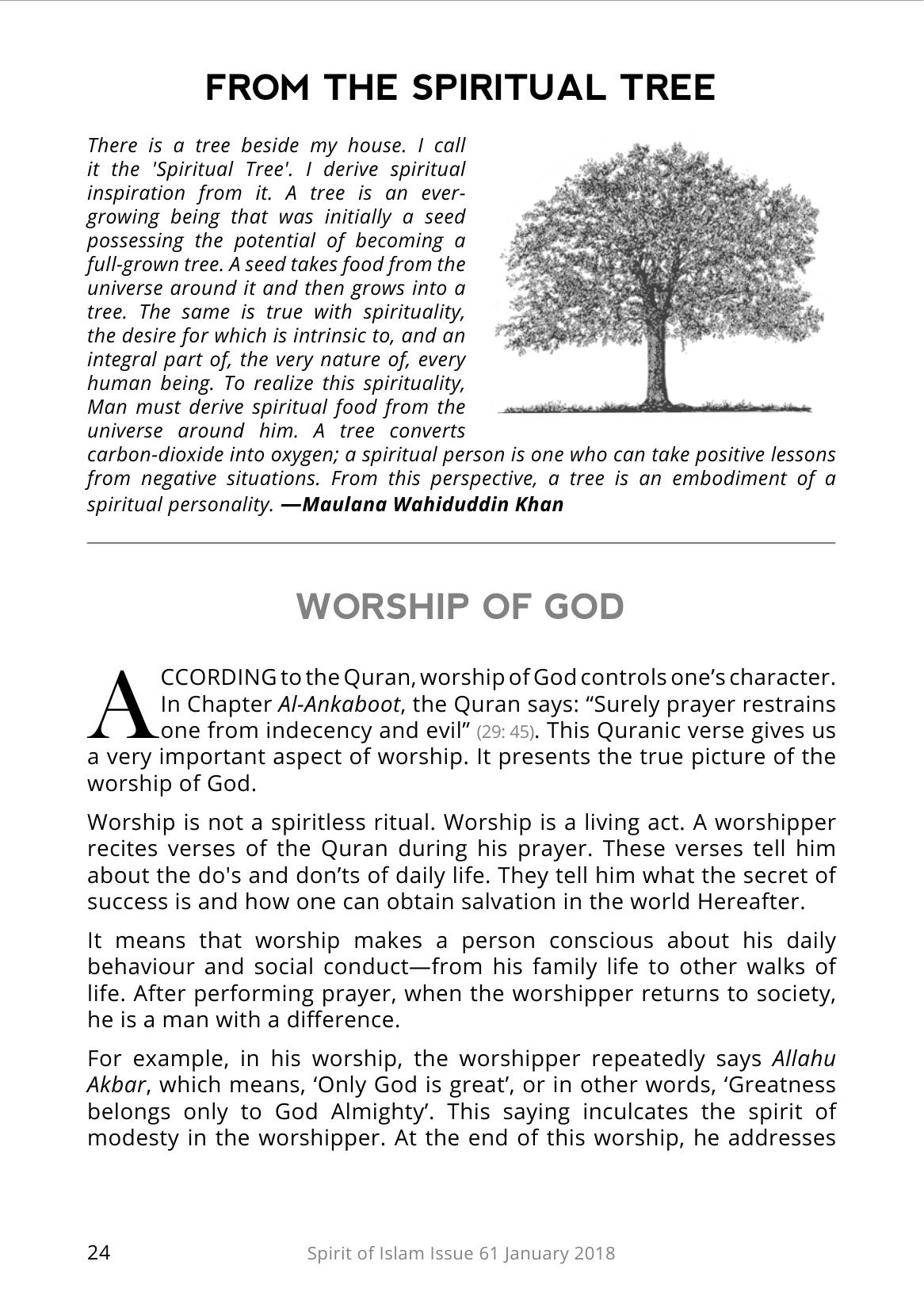
FROM THE SPIRITUAL TREE There is a tree beside my house. I call it the 'Spiritual Tree'. I derive spiritual inspiration from it. A tree is an evergrowing being that was initially a seed possessing the potential of becoming a full-grown tree. A seed takes food from the universe around it and then grows into a tree. The same is true with spirituality, the desire for which is intrinsic to, and an integral part of, the very nature of, every human being. To realize this spirituality, Man must derive spiritual food from the universe around him. A tree converts carbon-dioxide into oxygen; a spiritual person is one who can take positive lessons from negative situations. From this perspective, a tree is an embodiment of a spiritual personality. —Maulana Wahiduddin Khan WORSHIP OF GOD A CCORDING to the Quran, worship of God controls one’s character. In Chapter Al-Ankaboot, the Quran says: “Surely prayer restrains one from indecency and evil” (29: 45). This Quranic verse gives us a very important aspect of worship. It presents the true picture of the worship of God. Worship is not a spiritless ritual. Worship is a living act. A worshipper recites verses of the Quran during his prayer. These verses tell him about the do's and don’ts of daily life. They tell him what the secret of success is and how one can obtain salvation in the world Hereafter. It means that worship makes a person conscious about his daily behaviour and social conduct—from his family life to other walks of life. After performing prayer, when the worshipper returns to society, he is a man with a difference. For example, in his worship, the worshipper repeatedly says Allahu Akbar, which means, ‘Only God is great’, or in other words, ‘Greatness belongs only to God Almighty’. This saying inculcates the spirit of modesty in the worshipper. At the end of this worship, he addresses
‹ Previous page Next page › About this issue Open in the reader