FROM THE SPIRITUAL TREE
Spirit of Islam, September 2018, p. 24
By Maulana Wahiduddin Khan
Maulana Wahiduddin Khan is named as the default author of the periodical; a piece that carries another writer’s byline is credited to that writer.
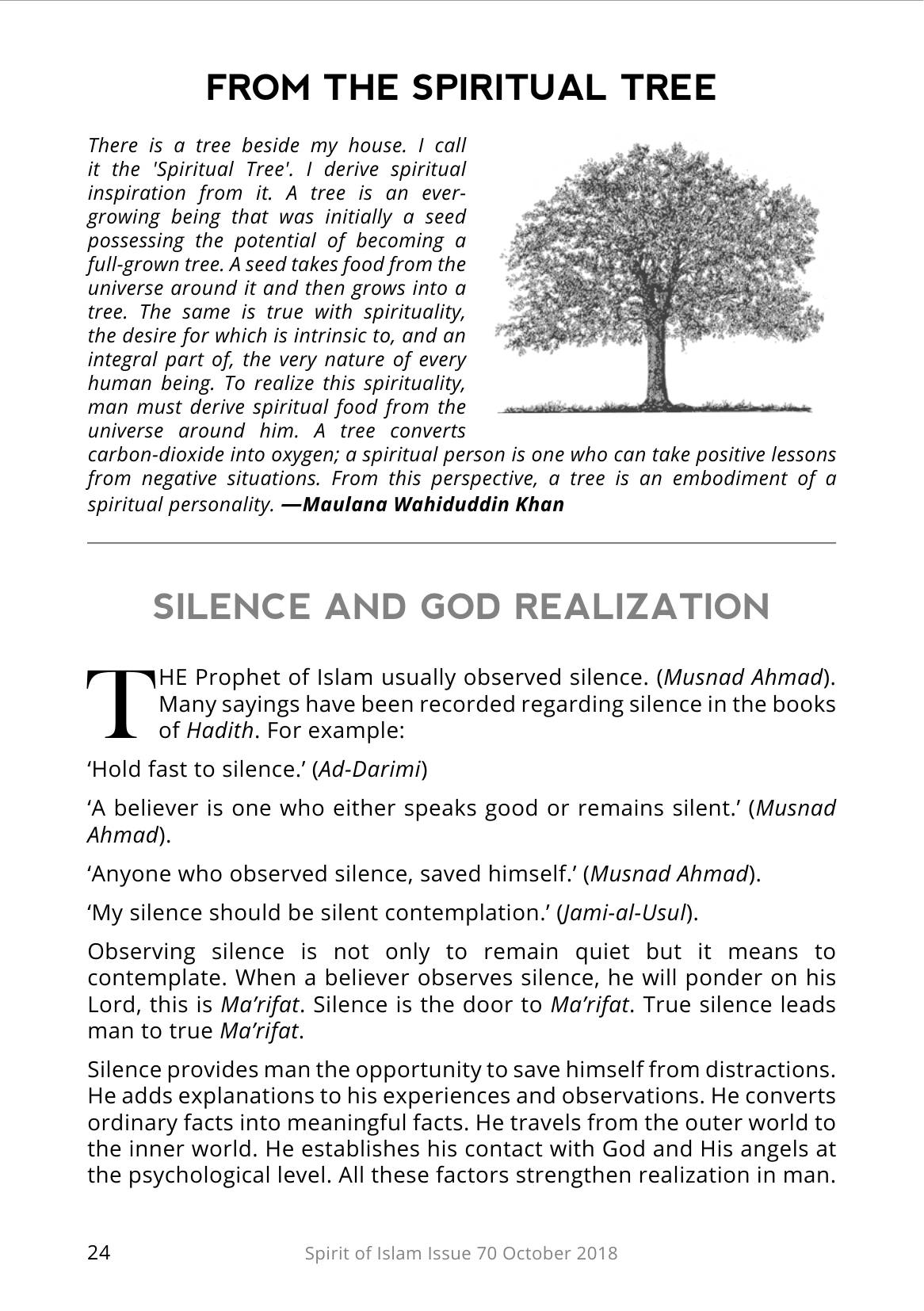
FROM THE SPIRITUAL TREE There is a tree beside my house. I call it the 'Spiritual Tree'. I derive spiritual inspiration from it. A tree is an evergrowing being that was initially a seed possessing the potential of becoming a full-grown tree. A seed takes food from the universe around it and then grows into a tree. The same is true with spirituality, the desire for which is intrinsic to, and an integral part of, the very nature of every human being. To realize this spirituality, man must derive spiritual food from the universe around him. A tree converts carbon-dioxide into oxygen; a spiritual person is one who can take positive lessons from negative situations. From this perspective, a tree is an embodiment of a spiritual personality. —Maulana Wahiduddin Khan SILENCE AND GOD REALIZATION T HE Prophet of Islam usually observed silence. (Musnad Ahmad). Many sayings have been recorded regarding silence in the books of Hadith. For example: ‘Hold fast to silence.’ (Ad-Darimi) ‘A believer is one who either speaks good or remains silent.’ (Musnad Ahmad). ‘Anyone who observed silence, saved himself.’ (Musnad Ahmad). ‘My silence should be silent contemplation.’ (Jami-al-Usul). Observing silence is not only to remain quiet but it means to contemplate. When a believer observes silence, he will ponder on his Lord, this is Ma’rifat. Silence is the door to Ma’rifat. True silence leads man to true Ma’rifat. Silence provides man the opportunity to save himself from distractions. He adds explanations to his experiences and observations. He converts ordinary facts into meaningful facts. He travels from the outer world to the inner world. He establishes his contact with God and His angels at the psychological level. All these factors strengthen realization in man.
‹ Previous page Next page › About this issue Open in the reader