ASK MAULANA
Spirit of Islam, September 2018, p. 44
By Maulana Wahiduddin Khan
Maulana Wahiduddin Khan is named as the default author of the periodical; a piece that carries another writer’s byline is credited to that writer.
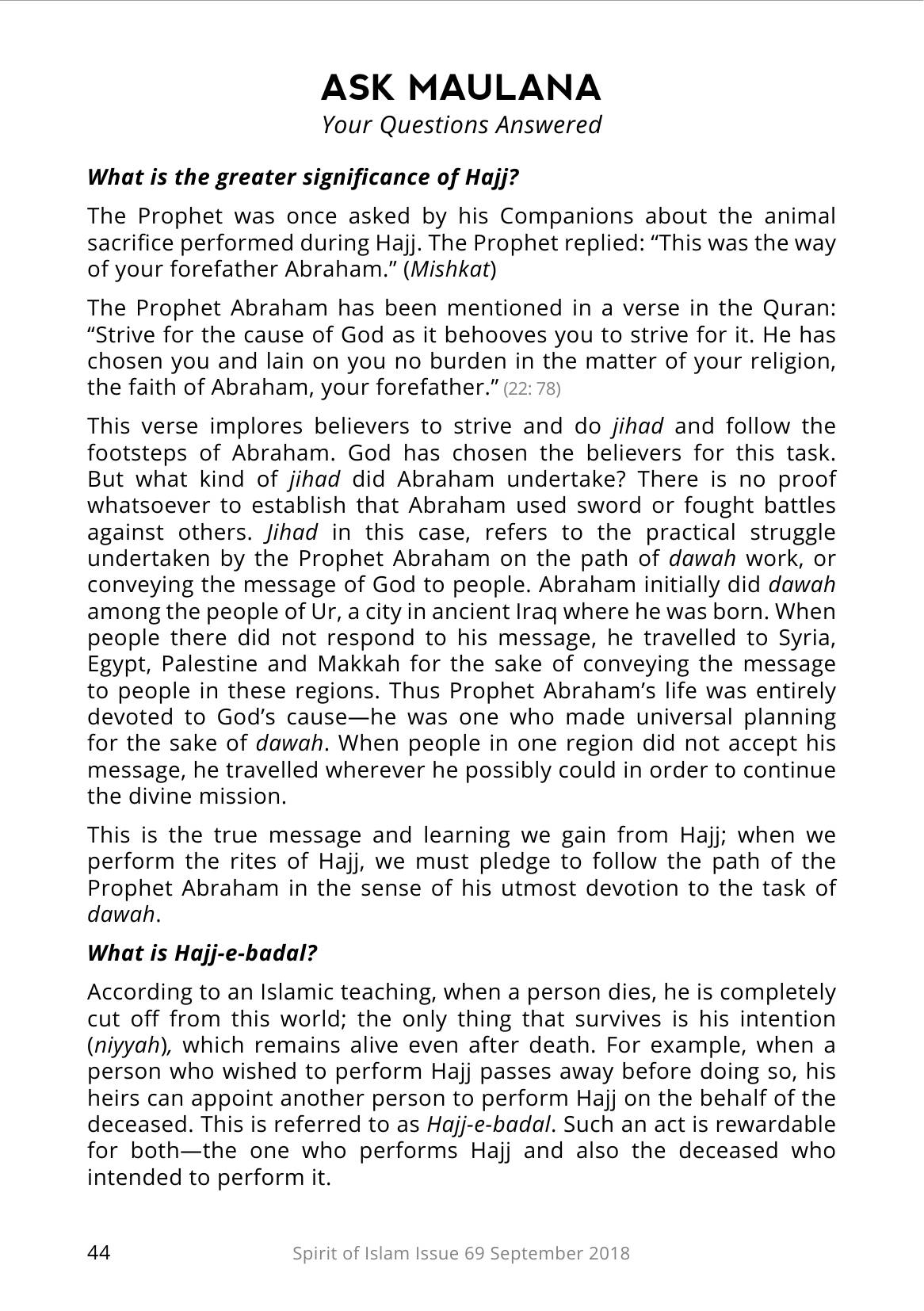
ASK MAULANA Your Questions Answered What is the greater significance of Hajj? The Prophet was once asked by his Companions about the animal sacrifice performed during Hajj. The Prophet replied: “This was the way of your forefather Abraham.” (Mishkat) The Prophet Abraham has been mentioned in a verse in the Quran: “Strive for the cause of God as it behooves you to strive for it. He has chosen you and lain on you no burden in the matter of your religion, the faith of Abraham, your forefather.” (22: 78) This verse implores believers to strive and do jihad and follow the footsteps of Abraham. God has chosen the believers for this task. But what kind of jihad did Abraham undertake? There is no proof whatsoever to establish that Abraham used sword or fought battles against others. Jihad in this case, refers to the practical struggle undertaken by the Prophet Abraham on the path of dawah work, or conveying the message of God to people. Abraham initially did dawah among the people of Ur, a city in ancient Iraq where he was born. When people there did not respond to his message, he travelled to Syria, Egypt, Palestine and Makkah for the sake of conveying the message to people in these regions. Thus Prophet Abraham’s life was entirely devoted to God’s cause—he was one who made universal planning for the sake of dawah. When people in one region did not accept his message, he travelled wherever he possibly could in order to continue the divine mission. This is the true message and learning we gain from Hajj; when we perform the rites of Hajj, we must pledge to follow the path of the Prophet Abraham in the sense of his utmost devotion to the task of dawah. What is Hajj-e-badal? According to an Islamic teaching, when a person dies, he is completely cut off from this world; the only thing that survives is his intention (niyyah), which remains alive even after death. For example, when a person who wished to perform Hajj passes away before doing so, his heirs can appoint another person to perform Hajj on the behalf of the deceased. This is referred to as Hajj-e-badal. Such an act is rewardable for both—the one who performs Hajj and also the deceased who intended to perform it.
‹ Previous page Next page › About this issue Open in the reader