FROM MAULANA’S DESK
Spirit of Islam, September 2018, p. 3
By Maulana Wahiduddin Khan
Maulana Wahiduddin Khan is named as the default author of the periodical; a piece that carries another writer’s byline is credited to that writer.
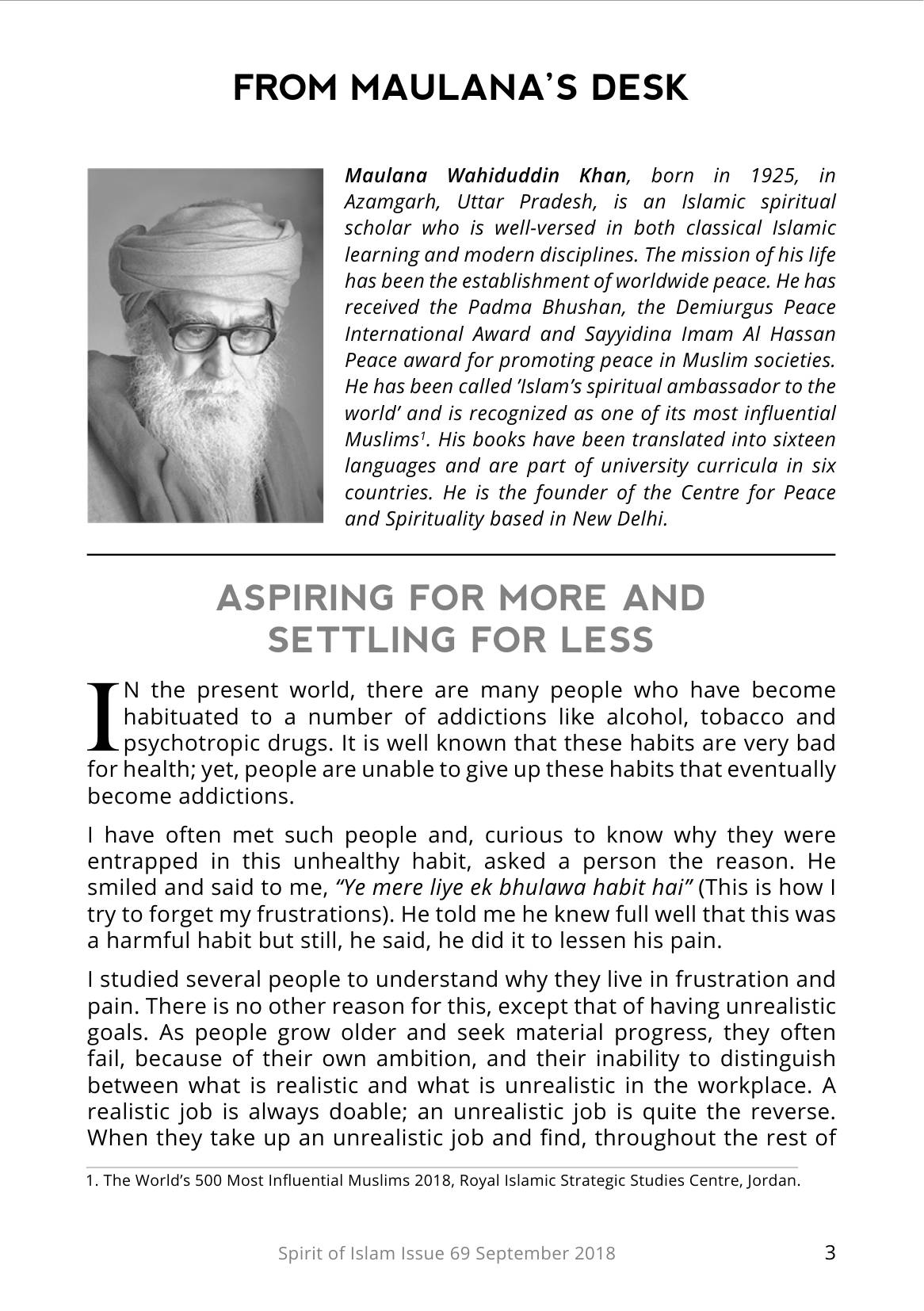
FROM MAULANA’S DESK 1. The World’s 500 Most Influential Muslims 2018, Royal Islamic Strategic Studies Centre, Jordan. Maulana Wahiduddin Khan, born in 1925, in Azamgarh, Uttar Pradesh, is an Islamic spiritual scholar who is well-versed in both classical Islamic learning and modern disciplines. The mission of his life has been the establishment of worldwide peace. He has received the Padma Bhushan, the Demiurgus Peace International Award and Sayyidina Imam Al Hassan Peace award for promoting peace in Muslim societies. He has been called ’Islam’s spiritual ambassador to the world’ and is recognized as one of its most influential Muslims1. His books have been translated into sixteen languages and are part of university curricula in six countries. He is the founder of the Centre for Peace and Spirituality based in New Delhi. ASPIRING FOR MORE AND SETTLING FOR LESS I N the present world, there are many people who have become habituated to a number of addictions like alcohol, tobacco and psychotropic drugs. It is well known that these habits are very bad for health; yet, people are unable to give up these habits that eventually become addictions. I have often met such people and, curious to know why they were entrapped in this unhealthy habit, asked a person the reason. He smiled and said to me, “Ye mere liye ek bhulawa habit hai” (This is how I try to forget my frustrations). He told me he knew full well that this was a harmful habit but still, he said, he did it to lessen his pain. I studied several people to understand why they live in frustration and pain. There is no other reason for this, except that of having unrealistic goals. As people grow older and seek material progress, they often fail, because of their own ambition, and their inability to distinguish between what is realistic and what is unrealistic in the workplace. A realistic job is always doable; an unrealistic job is quite the reverse. When they take up an unrealistic job and find, throughout the rest of
‹ Previous page Next page › About this issue Open in the reader