FROM THE SPIRITUAL TREE
Spirit of Islam, December 2019, p. 24
By Maulana Wahiduddin Khan
Maulana Wahiduddin Khan is named as the default author of the periodical; a piece that carries another writer’s byline is credited to that writer.
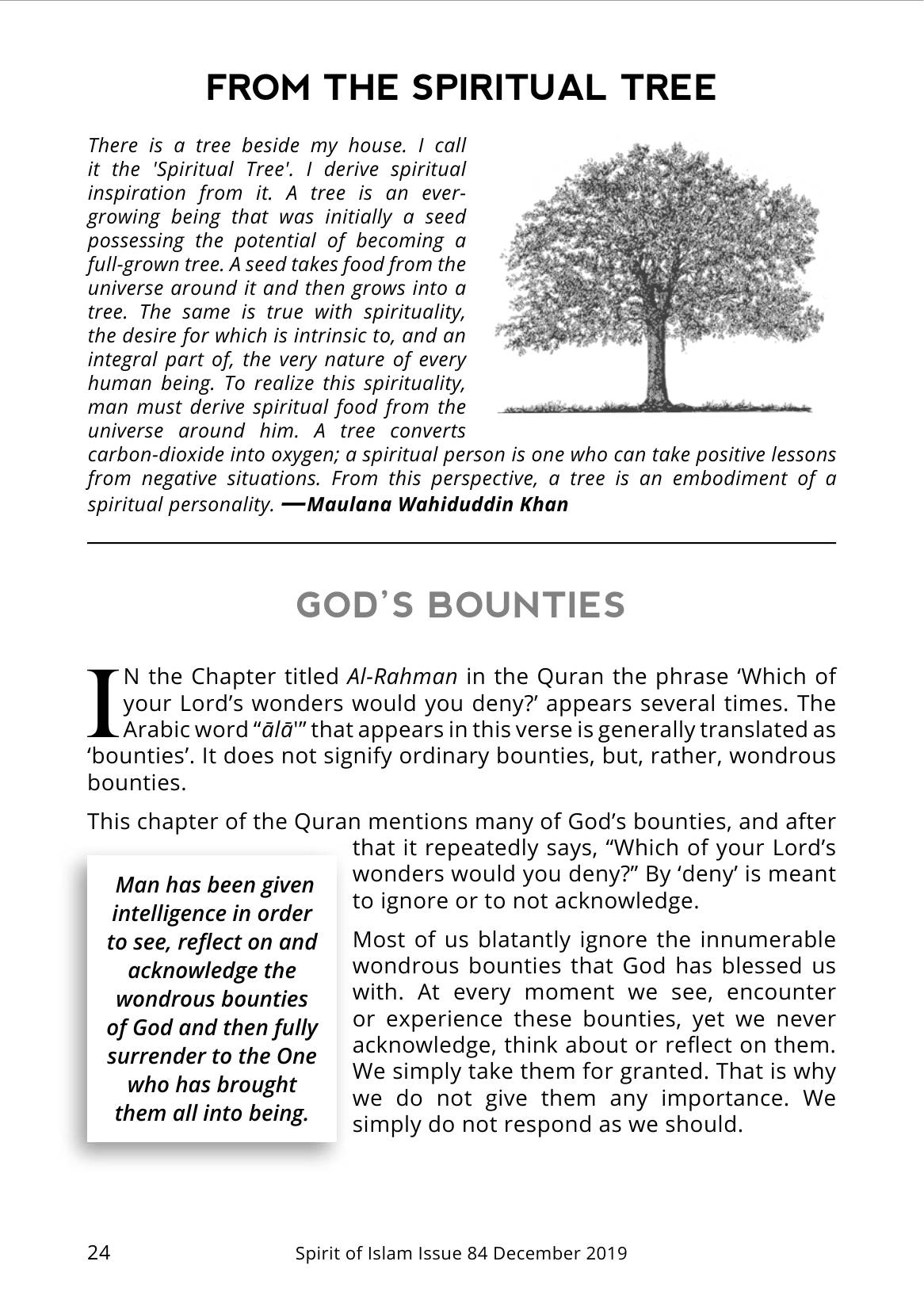
FROM THE SPIRITUAL TREE There is a tree beside my house. I call it the 'Spiritual Tree'. I derive spiritual inspiration from it. A tree is an evergrowing being that was initially a seed possessing the potential of becoming a full-grown tree. A seed takes food from the universe around it and then grows into a tree. The same is true with spirituality, the desire for which is intrinsic to, and an integral part of, the very nature of every human being. To realize this spirituality, man must derive spiritual food from the universe around him. A tree converts carbon-dioxide into oxygen; a spiritual person is one who can take positive lessons from negative situations. From this perspective, a tree is an embodiment of a spiritual personality. —Maulana Wahiduddin Khan GOD’S BOUNTIES I N the Chapter titled Al-Rahman in the Quran the phrase ‘Which of your Lord’s wonders would you deny?’ appears several times. The Arabic word “ālā'” that appears in this verse is generally translated as ‘bounties’. It does not signify ordinary bounties, but, rather, wondrous bounties. This chapter of the Quran mentions many of God’s bounties, and after that it repeatedly says, “Which of your Lord’s wonders would you deny?” By ‘deny’ is meant to ignore or to not acknowledge. Most of us blatantly ignore the innumerable wondrous bounties that God has blessed us with. At every moment we see, encounter or experience these bounties, yet we never acknowledge, think about or reflect on them. We simply take them for granted. That is why we do not give them any importance. We simply do not respond as we should. Man has been given intelligence in order to see, reflect on and acknowledge the wondrous bounties of God and then fully surrender to the One who has brought them all into being.
‹ Previous page Next page › About this issue Open in the reader