PATIENCE AND PIETY
Spirit of Islam, December 2019, p. 38
By Maulana Wahiduddin Khan
Maulana Wahiduddin Khan is named as the default author of the periodical; a piece that carries another writer’s byline is credited to that writer.
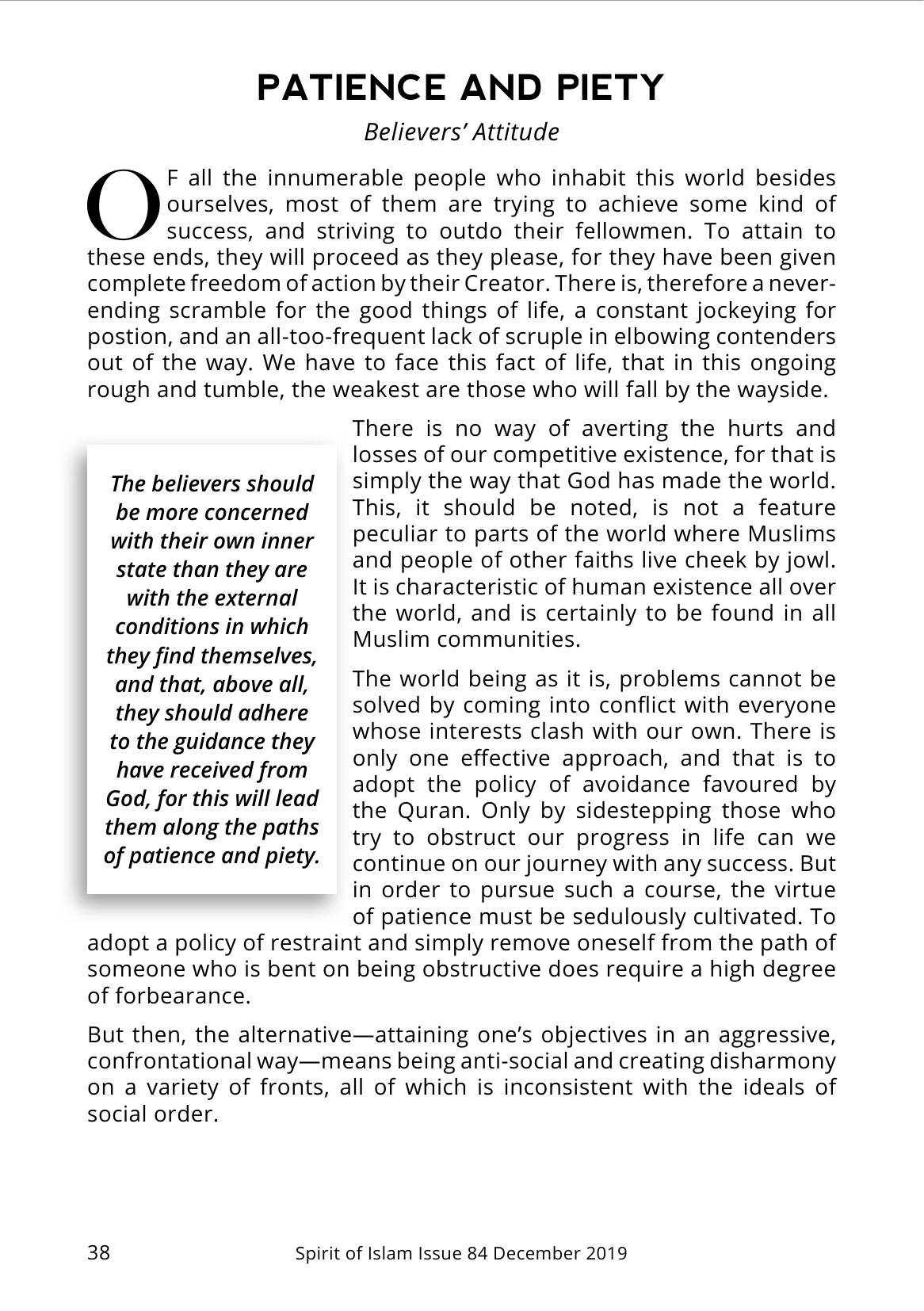
PATIENCE AND PIETY Believers’ Attitude O F all the innumerable people who inhabit this world besides ourselves, most of them are trying to achieve some kind of success, and striving to outdo their fellowmen. To attain to these ends, they will proceed as they please, for they have been given complete freedom of action by their Creator. There is, therefore a neverending scramble for the good things of life, a constant jockeying for postion, and an all-too-frequent lack of scruple in elbowing contenders out of the way. We have to face this fact of life, that in this ongoing rough and tumble, the weakest are those who will fall by the wayside. There is no way of averting the hurts and losses of our competitive existence, for that is simply the way that God has made the world. This, it should be noted, is not a feature peculiar to parts of the world where Muslims and people of other faiths live cheek by jowl. It is characteristic of human existence all over the world, and is certainly to be found in all Muslim communities. The world being as it is, problems cannot be solved by coming into conflict with everyone whose interests clash with our own. There is only one effective approach, and that is to adopt the policy of avoidance favoured by the Quran. Only by sidestepping those who try to obstruct our progress in life can we continue on our journey with any success. But in order to pursue such a course, the virtue of patience must be sedulously cultivated. To adopt a policy of restraint and simply remove oneself from the path of someone who is bent on being obstructive does require a high degree of forbearance. But then, the alternative—attaining one’s objectives in an aggressive, confrontational way—means being anti-social and creating disharmony on a variety of fronts, all of which is inconsistent with the ideals of social order. The believers should be more concerned with their own inner state than they are with the external conditions in which they find themselves, and that, above all, they should adhere to the guidance they have received from God, for this will lead them along the paths of patience and piety.
‹ Previous page Next page › About this issue Open in the reader