ASK MAULANA
Spirit of Islam, December 2019, p. 46
By Maulana Wahiduddin Khan
Maulana Wahiduddin Khan is named as the default author of the periodical; a piece that carries another writer’s byline is credited to that writer.
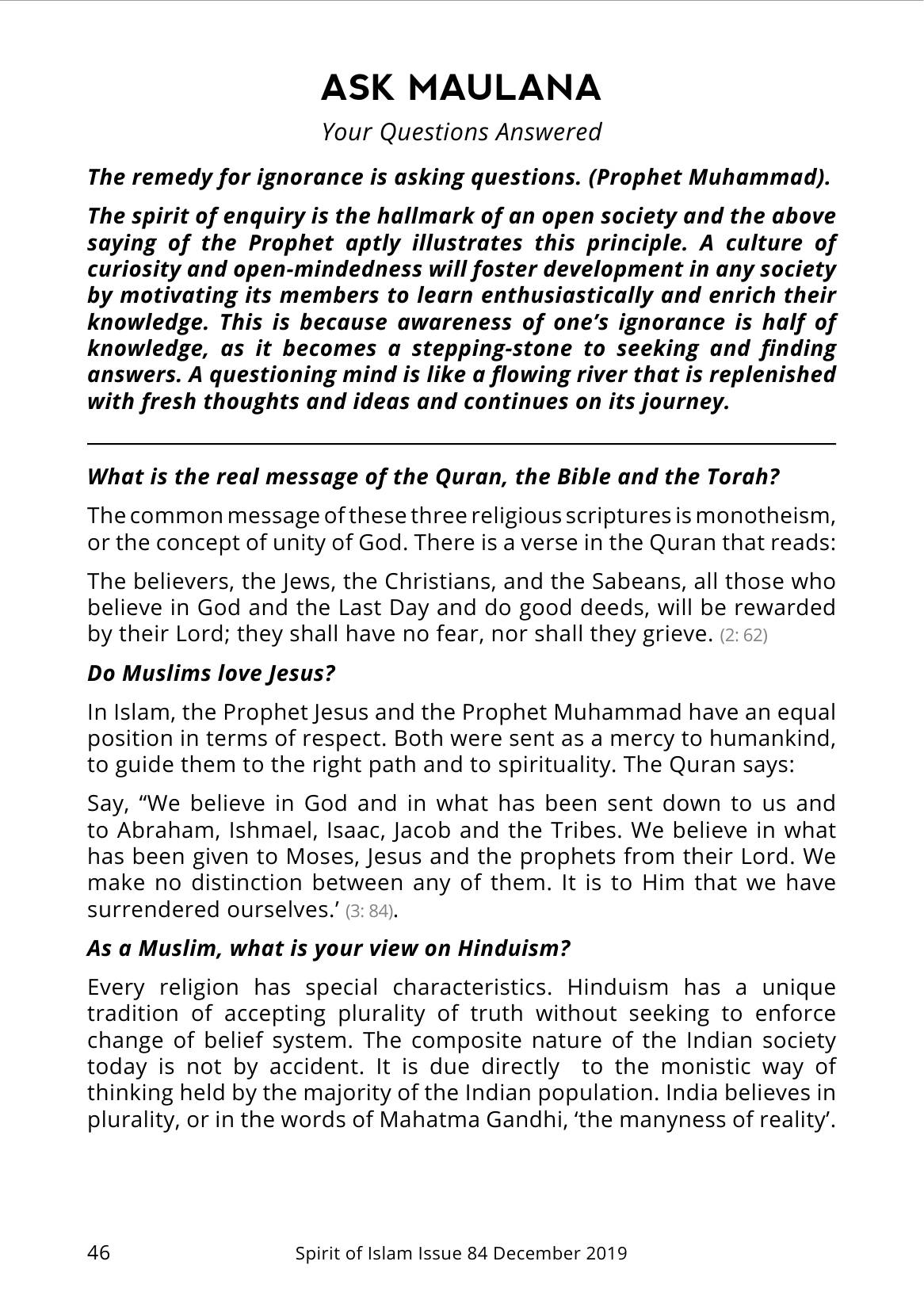
ASK MAULANA Your Questions Answered The remedy for ignorance is asking questions. (Prophet Muhammad). The spirit of enquiry is the hallmark of an open society and the above saying of the Prophet aptly illustrates this principle. A culture of curiosity and open-mindedness will foster development in any society by motivating its members to learn enthusiastically and enrich their knowledge. This is because awareness of one’s ignorance is half of knowledge, as it becomes a stepping-stone to seeking and finding answers. A questioning mind is like a flowing river that is replenished with fresh thoughts and ideas and continues on its journey. What is the real message of the Quran, the Bible and the Torah? The common message of these three religious scriptures is monotheism, or the concept of unity of God. There is a verse in the Quran that reads: The believers, the Jews, the Christians, and the Sabeans, all those who believe in God and the Last Day and do good deeds, will be rewarded by their Lord; they shall have no fear, nor shall they grieve. (2: 62) Do Muslims love Jesus? In Islam, the Prophet Jesus and the Prophet Muhammad have an equal position in terms of respect. Both were sent as a mercy to humankind, to guide them to the right path and to spirituality. The Quran says: Say, “We believe in God and in what has been sent down to us and to Abraham, Ishmael, Isaac, Jacob and the Tribes. We believe in what has been given to Moses, Jesus and the prophets from their Lord. We make no distinction between any of them. It is to Him that we have surrendered ourselves.’ (3: 84). As a Muslim, what is your view on Hinduism? Every religion has special characteristics. Hinduism has a unique tradition of accepting plurality of truth without seeking to enforce change of belief system. The composite nature of the Indian society today is not by accident. It is due directly to the monistic way of thinking held by the majority of the Indian population. India believes in plurality, or in the words of Mahatma Gandhi, ‘the manyness of reality’.
‹ Previous page Next page › About this issue Open in the reader